光伏组件涨价

Search documents
银价推涨光伏组件报价 下游企业承压涨价至近1元/瓦
Di Yi Cai Jing· 2026-01-31 05:52
业内企业表示,光伏组件此轮涨价主要是受银价上涨的影响,下游厂家属于被动集体承压涨价。 受成本端银价上涨影响,本周光伏组件价格再次上调。据行业机构Infolink Consulting最新统计,本周 TOPCon光伏组件的公示价格再次上调,TOPCon组件国内均价调涨至0.739元/瓦。 "涨价已经有半个月了,目前大致在0.9元/瓦以上,高功率组件超过1元/瓦。"某国内头部一体化组件企 业相关负责人在接受第一财经记者采访时表示,"组件涨价主要是受银价上涨的影响,下游厂家属于被 动集体承压涨价。排产方面,目前公司的排产整体随行就市,灵活调节产能。" 不过,临近春节假期,这轮组件涨价的持续性和实际成交情况仍待观察。 因上游成本的上涨,光伏组件被迫上调报价,当前中国分布式光伏组件的报价为0.8元/瓦至0.88元/瓦, 实际成交价格为0.75元/瓦至0.8元/瓦。第一财经记者注意到,本月以来,出货量处于一梯队的天合光能 (688599.SH)已三次上调组件报价,报价区间锁定在0.88元/瓦至0.92元/瓦。 "虽然本周国内组件价格继续上涨,但涨幅已开始下降。"郑天鸿分析,当前终端项目也对高价组件接受 意愿度下降较多,随 ...
明日主题前瞻智元拆分灵巧手部门为独立公司,灵巧手赛道已进入精细发展阶段
Xin Lang Cai Jing· 2026-01-21 12:22
Group 1: Robotics and Automation - ZhiYuan Robotics has spun off its dexterous hand division into an independent company, Shanghai Critical Point Innovation Technology Co., Ltd, with an investment of 4 million yuan for an 80% stake, led by former business head Xiong Kun [1][2] - The dexterous hand market in China is expected to exceed 340,000 units by 2030, with a CAGR of approximately 90% from 2024 to 2030, indicating a shift towards specialized development in core components [2] - Companies like Tongyi and Zhaowei have made significant advancements in dexterous hand technology, focusing on control precision and reliability, with products showcased at major events like CES 2026 [3] Group 2: Brain-Computer Interface - Neuralink's first subject has reported that their brain-computer interface can now receive OTA updates wirelessly, marking a significant milestone in the technology [3][4] - The global brain-computer interface market is projected to reach $7.63 billion by 2029, driven by policy support and technological breakthroughs, transitioning from clinical trials to commercial viability [4] - Companies like Beixin Source and Tianqi are actively developing applications for brain-computer interfaces, exploring new modes of human-machine collaboration [4] Group 3: Solar Energy - The price of mainstream photovoltaic components has returned to the "1 yuan era," with recent price adjustments indicating a trend of increasing component prices [5][6] - Major companies like Trina Solar have raised their component prices multiple times in 2026, reflecting a broader industry trend towards price increases due to supply chain dynamics [5] - Companies such as Dongfang Risen and Mingguan New Materials are advancing in high-efficiency solar technologies, contributing to the overall growth of the solar energy sector [6] Group 4: Sodium-Ion Batteries - LG is advancing the construction of a pilot production line for sodium-ion batteries in Nanjing, highlighting the technology's potential for cost reduction and low-temperature performance [7][8] - The sodium-ion battery market is gaining traction as leading manufacturers push for product development and industrialization, indicating a promising growth trajectory [7] - Companies like Zhongke Electric and Ding Sheng New Materials are actively involved in the production and development of materials for sodium-ion batteries, positioning themselves for future opportunities [8] Group 5: Machine Tool Industry - China has surpassed Germany to become the world's largest exporter of machine tools, capturing 21.6% of the global market share, while Germany's share has declined to 16.7% [9] - The growth of China's machine tool exports is attributed to the booming demand in sectors like new energy vehicles and aerospace, providing opportunities for domestic manufacturers to advance in high-end markets [9] - Companies like Huachen Equipment and Huadong CNC are developing high-precision machine tools to support various manufacturing sectors, enhancing their competitive edge [10][11] Group 6: Medical Robotics - The 37th batch of medical service pricing guidelines has introduced a tiered pricing model for surgical robots, linking costs to their clinical value and participation in surgeries [11][12] - The introduction of a pricing framework for robotic-assisted surgeries is expected to drive significant growth in the medical robotics sector, with companies like Tianzhihang leading the market [12]
光伏组件涨价或冲击0.8元/W? 成本端力挺,需求端泼冷水
2 1 Shi Ji Jing Ji Bao Dao· 2025-12-25 05:27
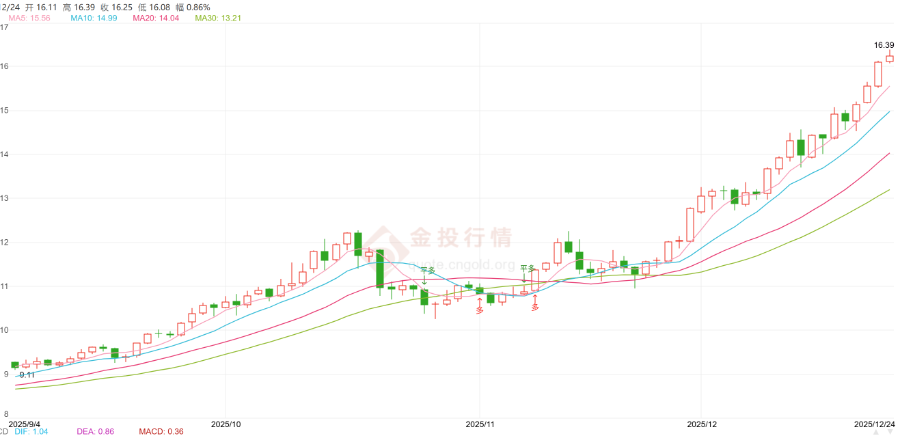
Core Viewpoint - Recent price increases in photovoltaic (PV) modules have been reported, driven primarily by rising upstream material costs, particularly silver paste and silicon materials [1][2][3] Group 1: Price Increases and Causes - Major PV manufacturers like Longi Green Energy and Jinko Solar have raised module prices by 0.02 to 0.05 yuan per watt due to increased costs of upstream materials [1] - Silver paste has become the largest cost component in PV modules, accounting for 17% of the total cost, followed by silicon materials at 14% and glass at 13% [3] - The price of silver has surged, with spot prices rising from 6.68 yuan per gram at the beginning of the year to 16.11 yuan per gram by December 24, marking a 141.17% increase [3] Group 2: Market Dynamics and Implications - Despite rising costs, the price increase for PV modules has lagged behind other components, with module prices increasing less than 2% this year compared to significant increases in silicon and wafer prices [4][5] - The internal rate of return (IRR) for solar power projects has been negatively impacted by declining feed-in tariffs, leading to concerns that higher module prices could deter investment [4][5] - Industry experts suggest that for manufacturers to achieve profitability, module prices need to stabilize between 0.9 to 1 yuan per watt, with current average prices around 0.698 yuan per watt [7][8] Group 3: Quality Concerns and Market Demand - The push for lower module prices has raised concerns about product quality, with the overall qualification rate of PV modules dropping from 100% in 2019 to 62.9% in 2024 [7] - The current market demand for PV modules is limited, and expectations for rapid growth in installation capacity have diminished, indicating a potential slowdown in the market [8]



光伏组件涨价或冲击0.8元/W?成本端力挺,需求端泼冷水
2 1 Shi Ji Jing Ji Bao Dao· 2025-12-24 11:29
21世纪经济报道记者曹恩惠 最近三个月白银现货价格走势图片来源:金投网 最近一周,光伏组件环节传来涨价消息。 根据市场消息,隆基绿能、晶科能源等光伏组件厂商相继上调了组件报价,每瓦上调的区间在0.02元至0.05元。而各家组件厂商 涨价的原因基本一致:受上游材料价格上升所致。 据21世纪经济报道记者了解,此番组件企业给出的涨价原因是银浆涨价,向产业链传导。 在日前举行的"2025光伏供应链配套发展研讨会"上,国金证券分析师姚遥指出,以2025年12月产业链成交价格测算,目前组件 成本较高的前三大单一项依次为银浆、硅料、玻璃,占比分别为17%、14%、13%。且随着银价上涨,银浆成本占比在过去半年 内显著上升,从而加速光伏行业少银或无银化技术推进。 按照上述数据,银浆已成光伏组件第一大成本来源。在此之前,是硅料。但由于近些年来硅料价格持续下跌,其在光伏组件的 成本占比亦随之下滑。 从成本端上看,此次光伏企业上调组件价格的确有据可依——作为目前最大的两个材料成本来源,硅料和银浆的价格今年以来 出现了显著上升。 在硅料价格方面,N型多晶硅复投料的成交均价已由年初的4.15万元/吨,上升至12月24日的5.39万元/ ...