光伏行业少银或无银化技术

Search documents
上游材料价格上升 光伏组件厂商相继上调组件报价
2 1 Shi Ji Jing Ji Bao Dao· 2025-12-26 00:06
Core Viewpoint - The recent price increase of photovoltaic (PV) modules is primarily driven by rising upstream material costs, particularly silver paste, which has seen significant price hikes due to surging silver prices [1][4]. Group 1: Price Increases and Market Dynamics - Major PV manufacturers like Longi Green Energy and JinkoSolar have raised module prices by 0.02 to 0.05 yuan per watt, citing increased costs of upstream materials [1]. - Silver futures and spot prices have reached historical highs, with increases of over 130% and 150% respectively this year [1]. - Despite the price increases in upstream materials, the price of PV modules has only risen by less than 2% this year, lagging behind other components like silicon wafers and battery cells, which have seen increases of over 19% and 15% respectively [4][6]. Group 2: Cost Structure Changes - The cost structure of PV modules has shifted, with silver paste now accounting for 17% of the total cost, surpassing silicon materials, which have decreased in cost share due to falling prices [3]. - The average transaction price of N-type multi-crystalline silicon has risen from 41,500 yuan/ton at the beginning of the year to 53,900 yuan/ton by December 24, marking a 29.88% increase [4]. Group 3: Investment Returns and Market Sentiment - The internal rate of return (IRR) for PV projects has been negatively impacted by declining feed-in tariffs, with current IRR expectations for domestic projects ranging from 6% to 7%, down from previous standards of 7% to 7.5% [5][6]. - There is a strong correlation between module prices and IRR, suggesting that rising module prices could deter investment in new installations [6]. Group 4: Future Outlook and Demand - The demand for PV modules is currently limited, and expectations for rapid market growth are diminishing, with the industry facing a potential inflection point in demand growth [8]. - The National Energy Administration reported that from January to October, China added 252.87 GW of new PV capacity, but the market is expected to stabilize rather than experience rapid growth in the future [8].




白银狂飙141%,硅料大涨,光伏组件想涨价却涨不动
21世纪经济报道· 2025-12-25 23:34
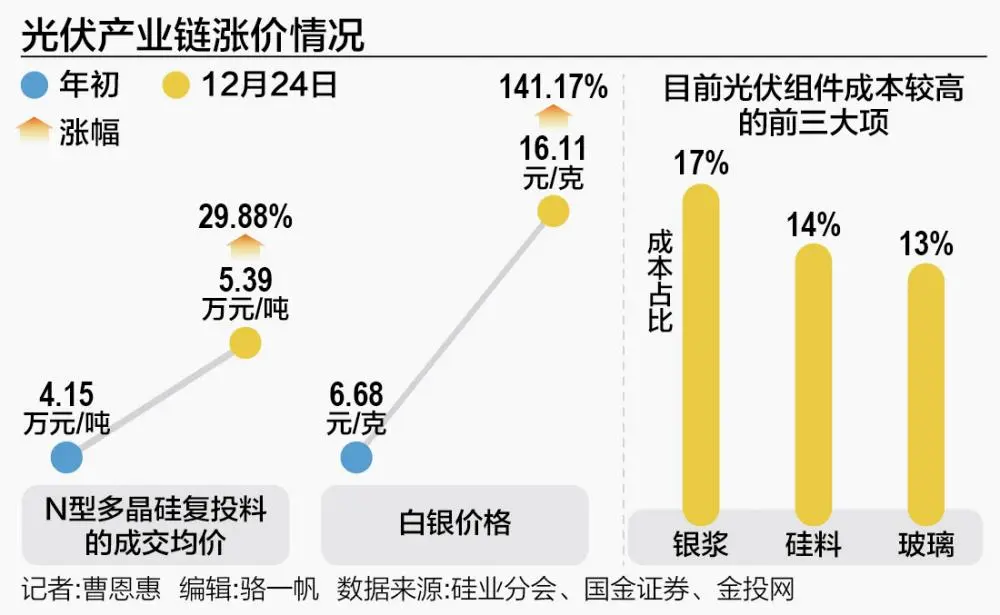
Core Viewpoint - The recent price increase of photovoltaic (PV) modules is primarily driven by rising upstream material costs, particularly silver paste, which has seen significant price hikes due to the surge in silver prices [1][5][6]. Group 1: Price Increases and Cost Structure - Major PV module manufacturers, including Longi Green Energy and JinkoSolar, have raised their module prices by 0.02 to 0.05 yuan per watt due to increased costs of upstream materials [1]. - Silver paste has become the largest cost component in PV modules, accounting for 17% of the total cost, followed by silicon materials at 14% and glass at 13% [5]. - The average price of N-type multicrystalline silicon has risen from 41,500 yuan/ton at the beginning of the year to 53,900 yuan/ton by December 24, marking a 29.88% increase [6]. - The spot price of silver has increased from 6.68 yuan/gram to 16.11 yuan/gram, reflecting a 141.17% rise [6]. Group 2: Market Dynamics and Investment Returns - The price increase of upstream materials has not effectively translated to module prices due to concerns over the internal rate of return (IRR) for downstream solar power plant operators, which has been negatively impacted by recent policy changes [6][7]. - The IRR for domestic PV projects has decreased to a range of 6% to 7%, down from previous standards of 7% to 7.5% [6][7]. - There is a strong correlation between module prices and the IRR for solar power plants, indicating that any price increase in modules could dampen installation demand [7]. Group 3: Future Price Expectations and Market Demand - Industry experts suggest that module prices need to reach at least 0.8 yuan/W to ensure profitability for integrated module companies, with some estimates suggesting a target range of 0.88 to 0.99 yuan/W [9]. - The current average price for N-type TOPCon modules is 0.698 yuan/W, with a slight increase of 0.7% noted recently [9]. - Despite the desire for price increases, the limited market demand poses challenges for driving module prices higher in the short term [10]. - The newly released data indicates that China's newly installed PV capacity reached 252.87 GW from January to October, but the growth rate is expected to slow down, leading to uncertainty in future demand [10].

光伏组件涨价或冲击0.8元/W?成本端力挺,需求端泼冷水
2 1 Shi Ji Jing Ji Bao Dao· 2025-12-24 11:29
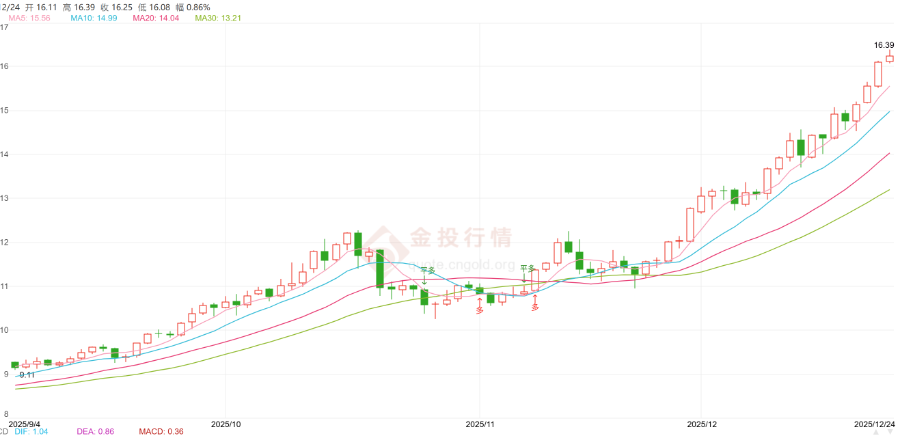
21世纪经济报道记者曹恩惠 最近三个月白银现货价格走势图片来源:金投网 最近一周,光伏组件环节传来涨价消息。 根据市场消息,隆基绿能、晶科能源等光伏组件厂商相继上调了组件报价,每瓦上调的区间在0.02元至0.05元。而各家组件厂商 涨价的原因基本一致:受上游材料价格上升所致。 据21世纪经济报道记者了解,此番组件企业给出的涨价原因是银浆涨价,向产业链传导。 在日前举行的"2025光伏供应链配套发展研讨会"上,国金证券分析师姚遥指出,以2025年12月产业链成交价格测算,目前组件 成本较高的前三大单一项依次为银浆、硅料、玻璃,占比分别为17%、14%、13%。且随着银价上涨,银浆成本占比在过去半年 内显著上升,从而加速光伏行业少银或无银化技术推进。 按照上述数据,银浆已成光伏组件第一大成本来源。在此之前,是硅料。但由于近些年来硅料价格持续下跌,其在光伏组件的 成本占比亦随之下滑。 从成本端上看,此次光伏企业上调组件价格的确有据可依——作为目前最大的两个材料成本来源,硅料和银浆的价格今年以来 出现了显著上升。 在硅料价格方面,N型多晶硅复投料的成交均价已由年初的4.15万元/吨,上升至12月24日的5.39万元/ ...