光刻胶国产化替代

Search documents
新材料50ETF(159761)盘中涨超2%,新材料领域成长性机会值得关注
Mei Ri Jing Ji Xin Wen· 2026-01-15 04:02
Group 1 - The new materials sector presents growth opportunities, particularly in the solid-state battery industry, which is transitioning from semi-solid to fully solid-state, with engineering breakthroughs expected by 2026-2027 [1] - Key materials such as silicon-based anodes, lithium metal anodes, high-nickel ternary, lithium-rich manganese-based cathodes, and solid electrolytes are anticipated to see development due to this transition [1] - The demand for photoresists, a critical material in the supply chain, is strong, with a continuously expanding market size and a high reliance on imports for high-end products, accelerating the substitution process [1] Group 2 - In the phosphorus chemical sector, the rapid development of the energy storage market is expected to boost the demand for lithium iron phosphate and its upstream phosphoric acid [1] - The New Materials 50 ETF (159761) tracks the New Materials Index (H30597), which selects listed companies involved in advanced basic materials, key strategic materials, and cutting-edge new materials to reflect the overall performance of related securities [1]

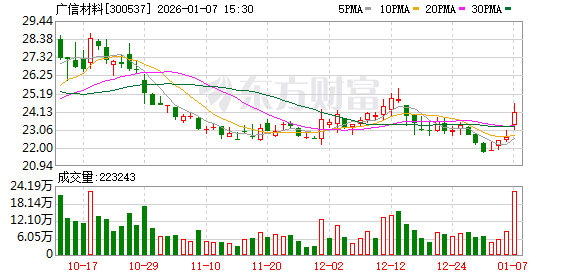
广信材料:公司在光刻胶板块以PCB光刻胶为基本盘稳健增长、适时拓展光伏胶等泛半导体领域
Zheng Quan Ri Bao· 2026-01-07 14:15
Core Viewpoint - The company, Guangxin Materials, highlights significant market opportunities in the traditional photoresist sector, particularly in PCB photoresists, where over 50% of the market share is still held by Japanese companies, indicating substantial potential for domestic alternatives [2] Group 1: Company Development - Guangxin Materials has achieved steady growth in the PCB photoresist segment and is expanding into photovoltaic adhesives and other semiconductor-related fields [2] - The company has established itself as a leading domestic player in the PCB photoresist market and a frontrunner in photovoltaic adhesives [2] - The gradual trial production at the Longnan base and further optimization of production capacity are expected to enhance operational efficiency, research capabilities, and market expansion [2] Group 2: Industry Landscape - The current landscape of the photoresist market is dominated by Japanese and Korean suppliers, with a significant opportunity for domestic companies to increase their market share [2] - The highest domestic penetration rate is observed in PCB photoresists, yet there remains a considerable portion of the market that is still accessible for local manufacturers [2]


光刻胶咽喉上的中国:95%进口依赖率背后的产业真相
材料汇· 2025-07-21 14:48
Core Viewpoint - The global and Chinese photoresist market is experiencing growth driven by the semiconductor and display panel industries, with future demand expected to increase significantly despite recent fluctuations in specific sectors [5][10]. Group 1: Global Photoresist Market Overview - The global photoresist market size is expected to grow at an annual rate of approximately 5% from 2022 to 2027, despite a 2% decline in 2022 due to decreased demand in the new display industry [5]. - In the semiconductor sector, the global market size reached $573.5 billion in 2022, with a year-on-year growth of 3.2%, and photoresist consumption in this sector was approximately 23.8 billion yuan, growing by 8% [6]. - The new display panel market saw a decline in 2022, with a total shipment area of 237 million square meters, down 4.3%, leading to a 19% decrease in photoresist consumption to about 12.6 billion yuan [7]. - The PCB industry is projected to grow at an average annual rate of 4% from 2022 to 2027, with photoresist consumption in this sector reaching approximately 16.3 billion yuan in 2022, a 2% increase [9]. Group 2: Chinese Photoresist Market Overview - China's photoresist demand is expected to grow at an average annual rate of 7% from 2022 to 2027, despite the market size remaining stable in 2022 compared to 2021 [12]. - In the semiconductor sector, China's photoresist consumption reached 4.6 billion yuan in 2022, with a growth rate of 15%, and is expected to grow at 10% annually over the next five years [13]. - The new display sector in China saw a decline in photoresist consumption to 6.1 billion yuan in 2022, down 13%, but is projected to grow at 8% annually in the coming years [14]. - The PCB industry in China had a total output value of $43.6 billion in 2022, with photoresist consumption reaching approximately 10.1 billion yuan, a 3% increase [16]. Group 3: Development Status of China's Photoresist Industry - The domestic production rate of photoresists is relatively low, with significant reliance on imports for semiconductor and display panel photoresists [19]. - Several domestic companies have made progress in the production of G/I line photoresists, with KrF photoresists seeing some successful local production [25]. - The market for TFT positive photoresists is dominated by foreign companies, with domestic production accounting for about 20% of the total market [32]. - The PCB photoresist market is characterized by a growing domestic supply of wet film photoresists and imaging solder masks, with a current domestic production rate of approximately 55% [36]. Group 4: Challenges and Future Prospects - The high technical barriers in the photoresist industry and the need for collaboration with lithography equipment manufacturers pose challenges for rapid domestic development [19]. - There is a significant opportunity for domestic companies to increase their market share in high-end photoresists, as the current production capabilities are still limited [42]. - Ongoing projects in China aim to enhance the production capacity of photoresists and related materials, indicating a strong push towards achieving greater self-sufficiency [41].