
全价值链本地化

Search documents
从“卖全球”到“链全球”:谁将赢得下一个十年?
Xin Lang Cai Jing· 2026-01-09 01:21
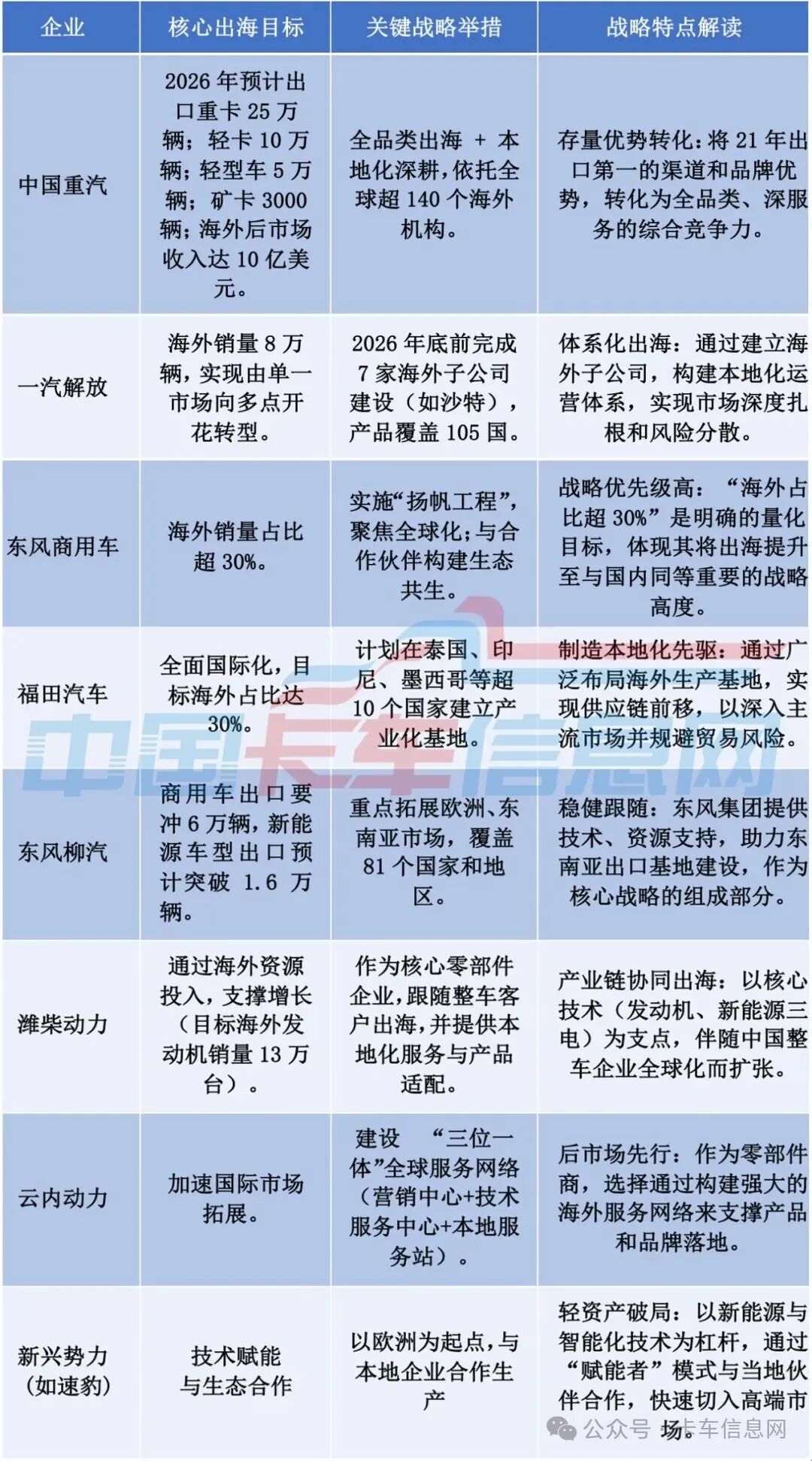
Core Insights - The evolution of Chinese truck exports has transitioned from "product trade" to "ecosystem layout," marking a significant shift towards global operations and local value chain integration [1][16][17] Group 1: Evolution of Export Strategies - Chinese truck exports have progressed through three stages: 1.0 Product output era focused on cost-effectiveness and trade with developing countries [18] 2.0 Market deepening era with established distribution networks and brand awareness while maintaining centralized decision-making [19] 3.0 Chain-rooted era by 2026, emphasizing local integration of R&D, manufacturing, supply chain, finance, and services [19][20] Group 2: Diverse Strategic Paths for 2026 - China National Heavy Duty Truck Corporation aims to export 250,000 heavy trucks and achieve $1 billion in overseas market revenue by leveraging its extensive global network [20] - FAW Jiefang plans to sell 80,000 units overseas and establish seven subsidiaries to diversify its market presence [20] - Dongfeng Commercial Vehicle targets over 30% of its sales from overseas, focusing on building an ecosystem through partnerships [20] - Foton Motor's strategy includes establishing production bases in over 10 countries to enhance local manufacturing and mitigate trade risks [20] - Weichai Power aims for 130,000 overseas engine sales, supporting mainstream vehicle manufacturers with diverse energy solutions [20][27] Group 3: Strategic Models - China National Heavy Duty Truck and FAW Jiefang are replicating successful domestic systems internationally, focusing on comprehensive operational frameworks [22][23] - Foton Motor adopts a "anchor" model with aggressive global production layout to ensure local integration [24] - Dongfeng Commercial Vehicle emphasizes an "integrator" model, shifting from transactional relationships to ecosystem collaboration [25] - Weichai Power and Yunnei Power are pursuing a "guardian" model, enhancing supply chain collaboration to support vehicle manufacturers [26][28] Group 4: Necessity of Localization by 2026 - Companies are increasingly localizing production to overcome traditional tariff and non-tariff barriers, ensuring sustainable market access [29] - Local operations allow firms to capture lifecycle value through financial services, data, and after-sales support, enhancing profitability [30] Group 5: Challenges Ahead - The path to global integration is fraught with complexities, including compliance costs and political risks associated with deep localization [31] - Effective management of overseas subsidiaries and diverse teams poses significant challenges for Chinese companies [32] - Large-scale investments in overseas facilities require substantial capital and a skilled workforce familiar with international operations [33] Group 6: Future Competitive Landscape - The competition in the global truck market by 2026 will hinge on the robustness of localized value chains and ecosystem-building capabilities [34] - Companies that can leverage China's technological advantages in new energy and smart solutions will be better positioned against global competitors [34][35]




济南|济企出海:越过浅滩 驶入深港
Da Zhong Ri Bao· 2025-12-25 02:36
Core Insights - The article discusses the transformation of Chinese companies, particularly those from Jinan, from being mere exporters to becoming integral players in global supply chains, emphasizing the shift from selling products to providing comprehensive solutions [1][4]. Group 1: Export Growth and Strategy - Jinan's total import and export value reached 258.81 billion yuan from January to November 2025, marking a 24.9% year-on-year increase, the highest in the province [1]. - Qilu Pharmaceutical has transitioned from exporting raw materials to finished pharmaceutical products, with 34 products now exported to the U.S., establishing a significant presence in major regulatory markets [2]. - In the first three quarters of the year, Qilu Pharmaceutical achieved an export value of 869 million USD, reflecting an 11% increase [2]. Group 2: Innovative Business Models - Qilu Pharmaceutical's ability to provide a reliable management system has allowed it to be recognized as a trusted solution provider, enhancing its international standing [2]. - Jinan Kehong Biopharmaceutical has adopted a "global selection + global coverage" model, establishing a network across nearly 70 countries and regions, and integrating over 40 domestic pharmaceutical products into its offerings [3]. Group 3: Localized Operations and Ecosystem Building - China National Heavy Duty Truck Group has shifted its business model from trade to a comprehensive global operation covering R&D, manufacturing, and service, reflecting a significant change in operational logic [4][5]. - The company has localized its workforce in Australia, achieving over 50% local team composition, which has helped it quickly rise to a top-five market position [5]. Group 4: Advanced Technology and Market Positioning - Shandong Tianyue Advanced Technology has emerged as a leader in the silicon carbide substrate market, achieving a 47.53% share of overseas revenue and establishing partnerships with top semiconductor manufacturers [7]. - Huaxi Biotechnology has invested significantly in a synthetic biology pilot transformation platform, aiming to address global challenges in biomanufacturing and expand its market presence [8][9]. Group 5: Comprehensive Solutions and Industry Integration - Shandong High-Speed Group is transitioning from an engineering contractor to a comprehensive solution provider, exemplified by its involvement in high-profile projects in Serbia and Bangladesh [6]. - The company has developed a collaborative ecosystem with five regional companies and ten specialized firms to support local enterprises in international markets [6].