全时段经营

Search documents
蜜雪冰城要卖早餐了?网友喊话:价格给我打下来
3 6 Ke· 2025-12-12 10:38
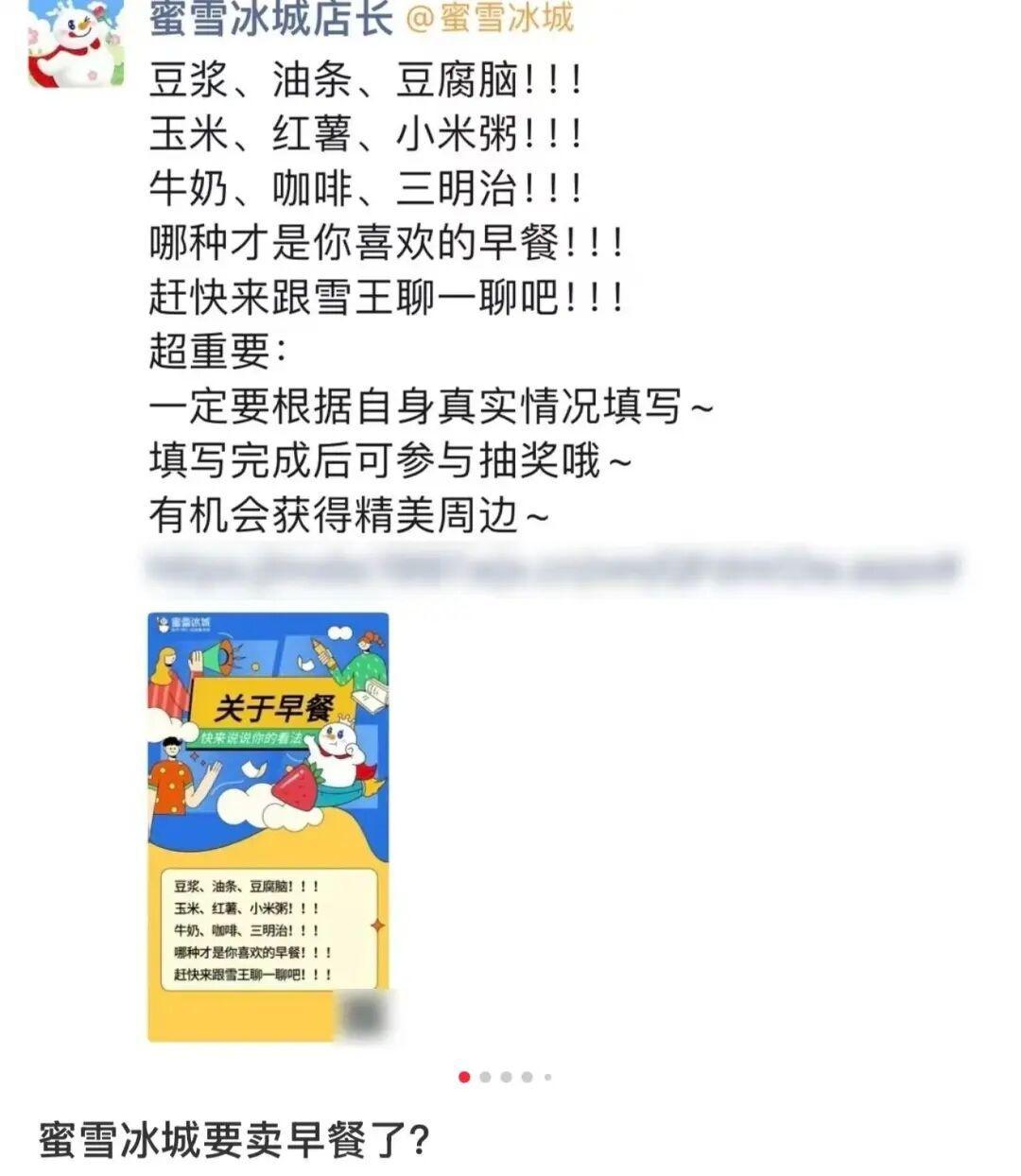
Core Viewpoint - The company Mixue Ice City is testing a breakfast business model by launching a survey to gather consumer preferences and has introduced a breakfast combo in select cities, aiming to expand its operational hours and revenue potential [1][4][6]. Group 1: Survey and Consumer Feedback - A survey was shared on social media asking consumers about their favorite breakfast options, including various traditional and modern choices [1]. - The survey also collected demographic information such as gender, age, occupation, and spending habits on breakfast [1]. Group 2: Breakfast Business Launch - Mixue Ice City has piloted a breakfast combo of "breakfast milk + bread" priced at 7.9 yuan in cities like Hangzhou, Xi'an, Dalian, and Nanning [4]. - The breakfast milk comes in four flavors, and the bread options include three types, reflecting a diverse offering [4]. Group 3: Market Reactions and Pricing Concerns - The introduction of the breakfast menu has sparked discussions on social media, with some consumers expressing excitement while others criticize the pricing as too high compared to traditional breakfast options [6]. - A comparison highlighted that traditional breakfast costs around 3.5 yuan, making the 7.9 yuan combo seem expensive [6]. Group 4: Strategic Implications - This move is part of Mixue Ice City's strategy to explore revenue opportunities during non-peak hours, particularly in the morning [6]. - The company aims to leverage its supply chain and store network advantages in the breakfast market, although it faces challenges in balancing cost and consumer expectations [6].


海底捞22元工作餐背后:餐饮巨头的下沉生存战
Sou Hu Cai Jing· 2025-06-17 17:40
Core Insights - Haidilao is adapting to the evolving Chinese dining market by introducing lower-priced meal options, such as a 22 yuan self-service lunch, which is significantly less than its traditional hot pot offerings [1][4] - The company is facing challenges with high idle rates during lunch hours, prompting a reevaluation of its operational strategies [4][8] - Haidilao's innovative approach includes transforming employee cafeterias into public dining options, thereby maximizing supply chain efficiency and addressing off-peak dining hours [5][8] Group 1: Business Strategy - The "Red Pomegranate Plan" involves the development of 11 sub-brands, creating a diverse product range from formal dining to fast food, leveraging existing supply chains [7] - Cost control measures are highly effective, with employee meal standards being directly converted into consumer products, optimizing resource utilization [7] - The company is implementing a regional experimentation strategy, allowing for tailored offerings in different locations, such as self-service in Xi'an and boxed meals in Beijing [7][8] Group 2: Market Positioning - Haidilao is addressing the lunch market gap by offering a 22 yuan meal, which has increased table turnover rates to 4.1 times per day, outperforming the industry average by 30% [8] - The company has established a tiered product system, ranging from 97 yuan for formal dining to 1.5 yuan for tea eggs, balancing brand integrity with consumer demand [8] - By granting regional stores pricing autonomy, Haidilao is successfully combining standardized services with personalized products, reshaping the expansion logic of chain restaurants [8] Group 3: Industry Trends - The restaurant industry is shifting towards maximizing existing customer bases rather than solely focusing on growth, as evidenced by Haidilao's strategic pivot [11] - The ongoing "lunch revolution" highlights the need for businesses to adapt to consumer behavior and preferences in a fragmented market [11] - The future of dining is increasingly tied to the real-life movements and needs of consumers, necessitating a balance between premium branding and mass-market accessibility [11]