全球流动性环境

Search documents
财通基金金梓才:2026年A股投资聚焦AI算力与出海龙头企业
Sou Hu Cai Jing· 2026-01-15 10:49
Core Viewpoint - The 2026 investment outlook for the A-share market is optimistic, driven by improved global liquidity and the acceleration of the artificial intelligence industry, suggesting a year of better overall conditions and deepening structural characteristics [1] Macro Environment - Global and domestic liquidity conditions are expected to improve simultaneously, providing a solid foundation for the market [1] - The Federal Reserve may accelerate interest rate cuts in 2026, significantly reducing external constraints on the A-share market and creating a more favorable environment for foreign capital [1] - Domestic monetary policy will continue to support high-quality economic development and industrial upgrades, maintaining reasonable liquidity levels [1] Investment Focus - Investment strategies should align closely with industrial trends, focusing on high-quality growth leaders [1]
金融期权周报-20251117
Guo Tou Qi Huo· 2025-11-17 13:23
1. Report Industry Investment Rating - No information provided in the content. 2. Core Views of the Report - Last week, the overall market showed a volatile trend. Except for the Shanghai 50 Index, major indices generally closed lower, with the Science and Technology Innovation 50 Index leading the decline with a weekly drop of 3.84%. Textile and apparel industries performed well with a weekly increase of about 4.42%, while the electronics sector was weak with a weekly decline of about 4.76% [1]. - The market continued to focus on the issue of US dollar liquidity. Although the news of the end of the US government shutdown boosted market risk appetite to some extent, the tightness of US dollar liquidity remained unchanged. The Fed continued to send hawkish signals, reducing market expectations for a December interest - rate cut, and the weak yen also supported the US dollar. As a result, the US dollar remained strong last week, but the RMB was relatively stable, and the impact on Chinese asset prices was limited [1]. - In the short term, the global liquidity environment remains unstable, and the domestic market is expected to continue its volatile pattern. Attention should be paid to subsequent changes in the geopolitical environment and domestic policy signals [1]. - Most financial option implied volatilities (IV) in the options market continued to decline last week. The IVs of the Science and Technology Innovation 50 options (IV = 31%) and ChiNext Index options (IV = 29%) have been falling since September but are still at relatively high levels above the median of the past year. The IVs of 50 and 300 options are currently in the range of 12% - 15%, and those of CSI 500 and CSI 1000 options are in the range of 17% - 19%. The position PCR of most financial options is in the range of 80% - 115%, slightly higher than the previous week [2]. - The market may continue its volatile pattern, and the IVs of most financial options continue to decline. External liquidity pressure has a certain but limited impact on domestic asset prices. The domestic liquidity environment is generally positive, and the stable RMB exchange rate provides support for the A - share market. Investors can continue to hold indices with reasonable valuations, such as the CSI 300 and CSI A500. With the decline of option IVs, they can also buy out - of - the - money call options on the corresponding indices with long - term expirations. For the Science and Technology Innovation 50 Index, which has large fluctuations and relatively high static valuations, investors holding spot can consider buying out - of - the - money put options or selling out - of - the - money call options to reduce exposure risks. If they have accumulated substantial spot returns, they can consider taking profits on the spot and keeping a small number of long - term call options to cope with irrational market rallies, such as the ChiNext Index. The CSI 1000 - 2603 stock index futures still have a high discount, and investors can consider continuing to hold the covered call strategy of long stock index and short out - of - the - money call options [3]. 3. Summary by Related Catalogs 3.1 Market Overview - Last week, the market was volatile. Except for the Shanghai 50 Index, other major indices fell, with the Science and Technology Innovation 50 Index leading the decline. Textile and apparel industries rose, while the electronics sector fell. The market focused on US dollar liquidity, and the US dollar remained strong while the RMB was stable [1]. 3.2 Options Market - Most financial option IVs continued to decline. The IVs of the Science and Technology Innovation 50 and ChiNext Index options were relatively high but falling. The IVs of 50, 300, CSI 500, and CSI 1000 options were in different ranges, and the position PCR of most financial options increased slightly [2]. 3.3 Strategy Outlook - The market may continue to fluctuate. Investors can hold reasonable - valued indices, buy long - term out - of - the - money call options on corresponding indices, manage risks for the Science and Technology Innovation 50 Index, and consider the covered call strategy for the CSI 1000 - 2603 stock index futures [3]. 3.4 Data Tables - Data on various indices and ETFs, including closing prices, price changes, IVs, IV changes, historical quantiles, option trading volumes, and position PCRs, are provided from November 10 - 14, 2025 [5]. - Data on the IVs, quantiles, and other information of different indices and ETFs on specific dates (November 13, 14, and 17, 2025) are presented, along with historical trends of price and IV, IV term structures, and smile curves [9][20][29] etc.
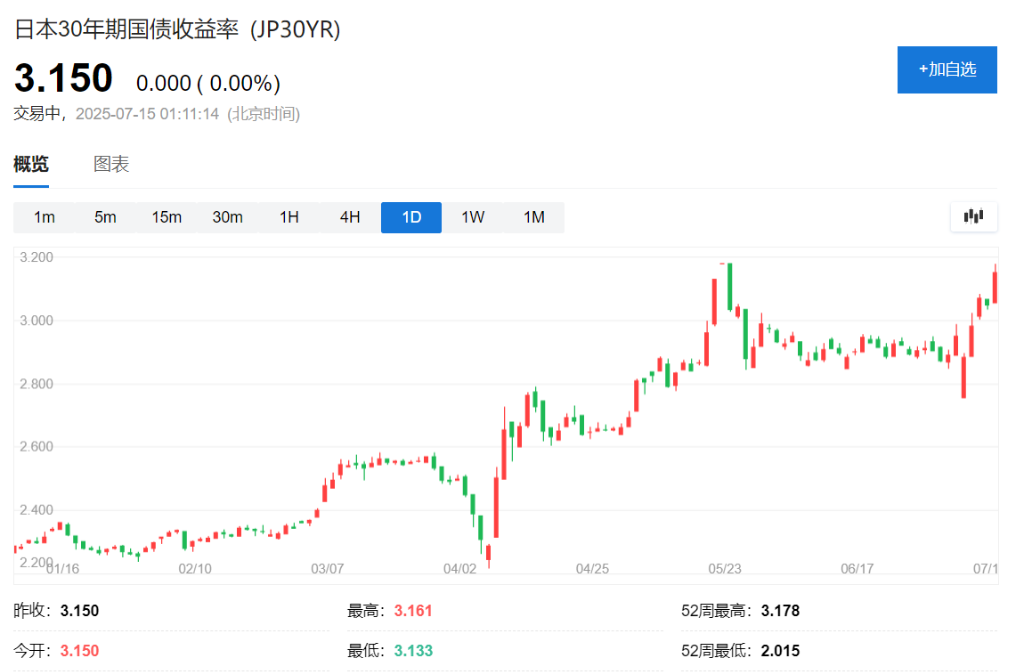
日债带头,欧美长债收益率周一全线走高
Hua Er Jie Jian Wen· 2025-07-15 01:10
Core Viewpoint - The global long-term government bonds are experiencing significant sell-offs, with rising yields across countries like Japan, Germany, the UK, and France, as concerns over fiscal deficits replace central bank policies as the main focus of the market [1][10]. Group 1: Bond Yield Trends - Japan's 10-year government bond yield rose by 2.5 basis points to 1.595%, the highest level since 2008 [1]. - The 30-year Japanese government bond yield saw its largest increase in two months, while the German 30-year bond yield approached a 14-year high [1]. - The U.S. 30-year bond yield reached a one-month high of 4.98% [1]. Group 2: Market Reactions and Concerns - Concerns over increased government debt, oversupply of bonds, and persistent inflation are driving market anxiety, particularly in light of Japan's upcoming elections and Trump's tariff threats [1][9]. - The market anticipates that election outcomes may pave the way for additional fiscal stimulus in Japan, contributing to rising long-term yields [1][6]. Group 3: Fiscal Policy Implications - Japan's ruling party is proposing cash subsidies while the opposition plans tax cuts, reflecting heightened budgetary risks as the July 20 Senate elections approach [6]. - Despite the Japanese Finance Ministry's efforts to reduce long-term bond issuance, borrowing costs continue to rise, indicating a demand gap as major insurance companies avoid ultra-long bonds [6]. Group 4: Global Impact of Japanese Bond Yields - BCA Research warns that changes in Japanese bond yields, as a significant source of global liquidity, could pose a major threat to U.S. tech stocks [2][13]. - The correlation between U.S. tech stock valuations and Japanese government bond yields suggests that a rise in Japanese yields could tighten global liquidity, impacting tech stock valuations reliant on low-cost funding [13].