全球能力中心

Search documents
印度首次举办超大规模AI峰会,25万人将涌入,仍缺全球领先大模型
Di Yi Cai Jing Zi Xun· 2026-02-17 07:05
Group 1 - The AI Impact Summit in India is the largest of its kind in the country, expecting 250,000 attendees from around the world [1] - Major tech companies like Google, Microsoft, and Amazon plan to invest a total of $68 billion in AI and cloud infrastructure in India by 2030 [1] - Key speakers at the summit include leaders from Google, OpenAI, Anthropic, and DeepMind, highlighting India's commitment to leveraging AI for human-centric missions [3] Group 2 - India has not yet developed a globally dominant AI model, with the US and China leading in large model technology [3] - The Indian government is encouraged to focus on "innovative applications" rather than investing heavily in developing new large models [3] - India has a significant potential consumer market for AI, with over 72 million daily ChatGPT users expected by the end of 2025, making it one of OpenAI's largest user markets [3] Group 3 - The Indian IT industry, valued at nearly $300 billion, faces challenges from AI adoption, with call centers potentially experiencing a 50% revenue loss by 2030 [4] - The rise of Global Capability Centers (GCCs) in India is shifting focus towards AI, data, digital engineering, and product development, with over 60% of new GCCs established in these areas [4] - It is projected that over 80% of GCCs will be AI-driven within the next 6 to 8 months [4] Group 4 - India is actively seeking to establish domestic supply chains to attract investments from major tech companies, recently approving a $18 billion semiconductor investment project [5] - Government support for technology is seen as a guarantee for multinational companies to diversify their operations in India [5] - The summit is expected to lead to significant announcements of investments in AI data centers and large-scale infrastructure agreements [5]


Proto Labs(PRLB) - 2025 Q4 - Earnings Call Transcript
2026-02-06 14:30
Financial Data and Key Metrics Changes - Fourth quarter revenue reached a record $136.5 million, up 11% year-over-year in constant currencies, marking the first sequential revenue growth from Q3 to Q4 since 2017 [18] - Full-year revenue for 2025 was a record $533.1 million, up 5.7% in constant currencies [20] - Non-GAAP gross margin for the fourth quarter was 44.8%, an increase of 140 basis points year-over-year [19] - Non-GAAP earnings per share for the fourth quarter were $0.44, up $0.06 year-over-year [20] Business Line Data and Key Metrics Changes - CNC revenue in the U.S. grew 35% in the fourth quarter and 25% year-over-year for 2025, driven by strong demand in innovation-led industries [18][21] - Injection molding revenue declined 1.9% in 2025, impacted by weakness in medical device demand [21] - 3D printing revenue declined 4.7% year-over-year, although metal 3D printing showed strength with double-digit growth [22] Market Data and Key Metrics Changes - U.S. revenue grew 9.1% year-over-year, while European revenue declined 7% in constant currencies [21] - The company noted strong momentum in data centers and aerospace and defense markets, which are expected to drive future growth [5][6] Company Strategy and Development Direction - The company aims to serve customers across the entire life cycle of a part, from prototype through production, focusing on four strategic pillars: elevate customer experience, accelerate innovation, expand production, and drive operational efficiency [6][10] - The establishment of a global capability center in India is intended to enhance innovation and support global operations [12][56] - The company plans to implement new go-to-market strategies in Europe to stabilize margins and reset the cost base for growth [14] Management's Comments on Operating Environment and Future Outlook - Management expressed confidence in the company's position for 2026, anticipating a year of transformation and growth, with expectations for revenue growth of 6%-8% [25] - The company is focused on improving customer experience and operational efficiency to drive long-term growth and profitability [10][17] Other Important Information - The company generated $74.5 million in cash from operations in 2025, leading the digital manufacturing industry in cash generation [24] - The company has no debt and ended 2025 with $142.4 million in cash and investments [24] Q&A Session Summary Question: Insights on Q4 performance and sequential growth - Management noted that Q4 saw good order volumes, but January started with a more normalized, softer demand [30] Question: Details on end markets and applications - Management confirmed strong growth in innovation-led markets such as aerospace and defense, with Protolabs positioned as a key partner [33] Question: Strategic initiatives and their timing - Management indicated that the current year is focused on transformation, with results expected to accelerate in the coming years [34] Question: Unique developers and revenue per contact - Management highlighted a focus on increasing revenue per contact, with a 23% increase in Q4 [41] Question: U.S. supply chains for defense - Management acknowledged good exposure to aerospace and defense but did not provide specifics on reshoring discussions [42][45] Question: Injection molding growth visibility - Management is pivoting towards production in injection molding, supported by new certifications and pilot programs with medical device manufacturers [52] Question: Advanced CNC capabilities impact - Management reported early positive performance from newly launched advanced CNC capabilities, indicating customer demand [54] Question: India capability center focus - The India center aims to leverage technical talent to support global business and innovation initiatives [56]

特朗普砌起“10万美元签证墙” 会压垮印度2800亿美元IT业吗?
Zhi Tong Cai Jing· 2025-09-22 08:25
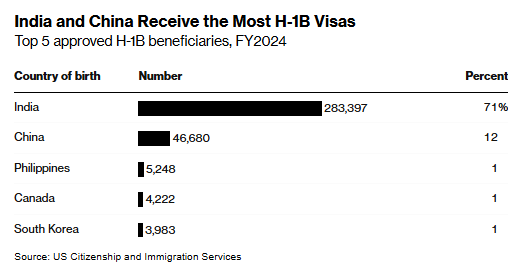
Core Viewpoint - The new H-1B visa regulations introduced by the Trump administration may reshape India's successful outsourcing industry, valued at $280 billion, which has provided core technology support to top global tech companies [1] Group 1: Impact on Indian IT Companies - The new policy requires a $100,000 fee for H-1B visa applications, forcing Indian outsourcing firms like Tata Consultancy Services and Infosys to adjust their strategies, as they have deployed thousands of engineers to U.S. clients through this visa program [1] - The stock prices of Tata Consultancy Services and Infosys fell over 3% following the announcement of the new visa regulations [1] - The Indian IT sector, already facing pressure from geopolitical tensions and economic uncertainties, is further impacted by this sudden policy change [1] Group 2: Geopolitical Context - The visa policy change exacerbates tensions in U.S.-India relations, coinciding with an Indian delegation's upcoming visit to Washington for trade negotiations [2] - The global rise of anti-immigration sentiment is also affecting India, a country with a population of 1.4 billion, and the new visa policy adds to the existing challenges [2] Group 3: H-1B Visa Statistics - In the fiscal year ending September 2023, Indian workers accounted for 72.3% of all H-1B visa holders, highlighting the significance of this visa for Indian IT firms [5] - In FY 2024, Infosys was approved for 2,504 new H-1B visas, which under the new policy would incur an additional cost of at least $250 million [5] Group 4: Industry Reactions and Future Outlook - Industry leaders, such as Chander Prakash Gurnani, suggest that while there will be short-term impacts, companies like Tata Consultancy Services have anticipated a shift away from reliance on the U.S. market in the long term [2] - The new policy may inadvertently increase costs for U.S. companies and accelerate their expansion of Global Capability Centers (GCC) in India [6] - Analysts indicate that the new fee structure could disrupt the offshore IT service model, forcing companies to reconsider their pricing strategies [9] Group 5: Legal and Regulatory Challenges - The new H-1B visa policy has already faced criticism for potentially violating U.S. federal immigration laws and is likely to be challenged in court [10] - Major tech companies, including Microsoft and Amazon, have advised employees to postpone international travel due to the uncertainty surrounding the new regulations [6]