全球资本流动格局

Search documents
美联储降息开启全球货币政策新周期: 理论逻辑、多维影响与中国方略
Jin Rong Shi Bao· 2025-11-24 02:09
Group 1 - The Federal Reserve's shift in monetary policy is expected to significantly alter the international monetary system and global financial governance structure [1][10] - The Fed's recent interest rate cuts mark a pivotal change in its monetary policy cycle, responding to both domestic economic conditions and global economic slowdowns [2][3] - The U.S. economy is experiencing a complex interplay of cyclical slowdown and structural weaknesses, leading to increased unemployment and a need for preemptive policy actions [3][4] Group 2 - The current inflation dynamics, while still above the Fed's target, show a declining trend, necessitating a balanced approach to monetary policy [4] - Political pressures are influencing the Fed's decisions, but the institution maintains its independence in policy-making, opting for a cautious approach to rate cuts [5] - The interconnectedness of the global economy means that U.S. monetary policy adjustments will have significant spillover effects on other countries [6] Group 3 - The global financial system is entering a phase of profound transformation, with opportunities for restructuring policy coordination among major central banks [7] - Emerging markets may benefit from capital inflows as the attractiveness of U.S. dollar assets diminishes, providing a window for structural reforms [8] - The sustainability of global debt levels is under scrutiny, particularly for emerging markets with significant foreign currency debt [9] Group 4 - The shift in U.S. monetary policy is likely to accelerate the diversification of the international monetary system, impacting financing costs and channels for emerging markets [10] - The Fed's actions are expected to reshape asset pricing mechanisms and market structures, influencing investor behavior and capital flows [12][14] - Commodity pricing mechanisms are undergoing changes, with precious metals benefiting from the Fed's rate cuts, while industrial commodities may see increased demand due to lower financing costs [13] Group 5 - The adjustment in global capital flows is evident, with a notable shift towards non-U.S. assets as the dollar's appeal wanes [14] - Investment strategies will need to adapt to the new monetary environment, with a focus on risk assessment and asset allocation [15] - China's monetary policy may gain more flexibility in response to the Fed's actions, allowing for more proactive economic support measures [16][17] Group 6 - The Fed's policy shift presents new opportunities for international financial cooperation and enhances China's role in global governance [19] - The internationalization of the renminbi may gain momentum in the new monetary landscape, promoting a more diversified and stable international monetary system [19]
暴涨24.4%,我国海外净资产突破3.6万亿美元,全球第三,那前两名是谁呢?
Sou Hu Cai Jing· 2025-08-12 05:11
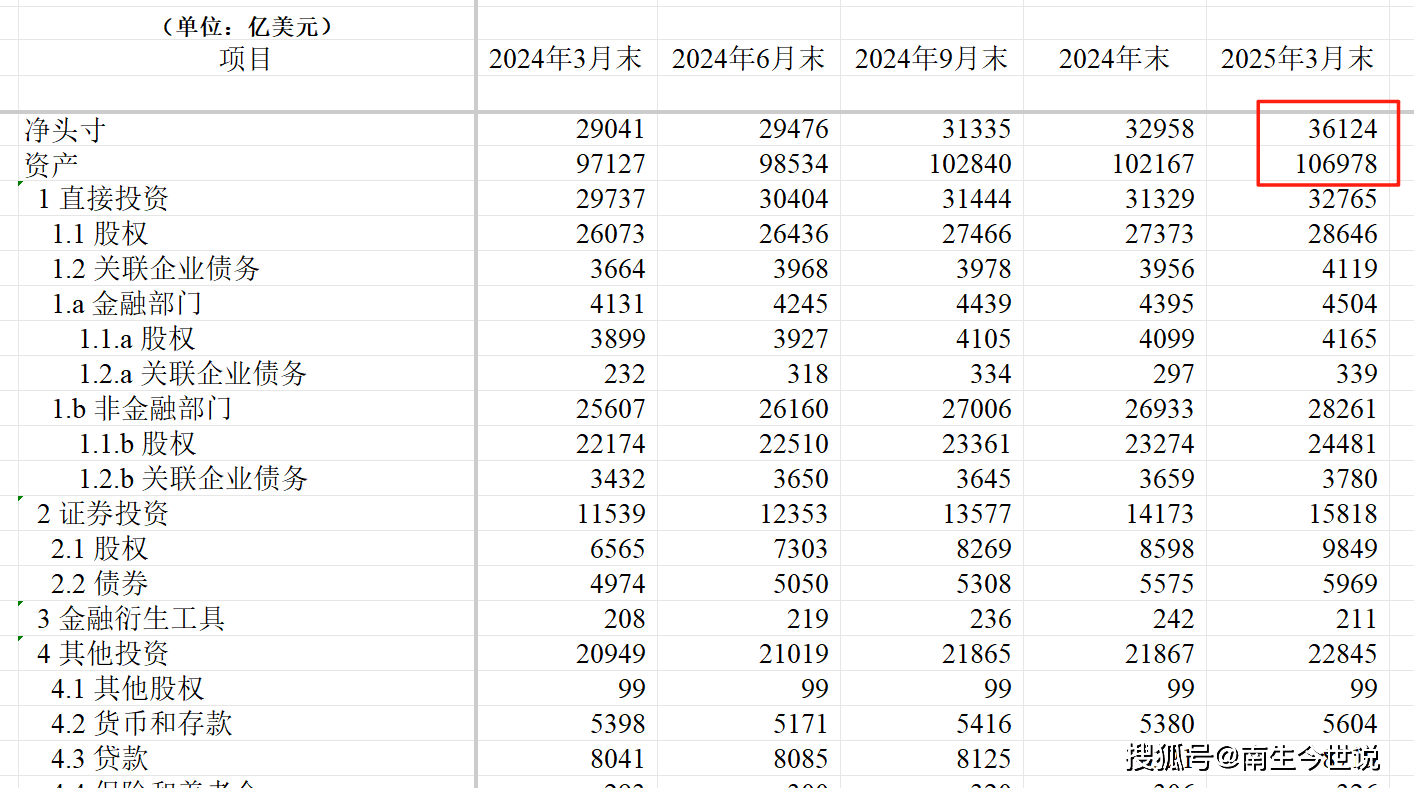
去年3月末,我国负债金额为68086亿美元,也就是"净增2768亿美元,同比增长率为4.07%"——引入的外资增速远低于我国对外投资的增速,这意味着: 我国海外净资产金额再创新高——截止到今年3月末已达到36124亿美元,与去年同期的29041亿美元相比,同比增速高达24.4%。 海外净资产增长这么快,意味着什么? | (单位:亿美元) | | | | | --- | --- | --- | --- | | 项目 | 2024年3月末 | 2024年6月末 | 2024年9月末 202 | | 净头寸 | 29041 | 29476 | 31335 | | 资产 | 97127 | 98534 | 102840 | | 1 直接投资 | 29737 | 30404 | 31444 | | 1.1 股权 | 26073 | 26436 | 27466 | | 1.2 关联企业债务 | 3664 | 3968 | 3978 | | 1.a 金融部门 | 4131 | 4245 | 4439 | | 1.1.a 股权 | 3899 | 3927 | 4105 | | 1.2.a 关联企业债务 | 232 | 318 ...