全球AI投资热潮

Search documents
1月制造业PMI为49.3%:高技术制造业持续领跑
Zhong Guo Jing Ying Bao· 2026-01-31 15:34
Group 1 - The manufacturing Purchasing Managers' Index (PMI) for January is reported at 49.3%, a decrease of 0.8 percentage points from the previous month, indicating a decline in manufacturing activity [1] - The decline in manufacturing PMI is attributed to seasonal disruptions and insufficient demand, with the upcoming Spring Festival causing early shutdowns and a slowdown in production [1][2] - Despite the drop in PMI, the production index remains at 50.6%, indicating continued expansion in manufacturing production [1] Group 2 - High-tech manufacturing PMI stands at 52.0%, remaining above 52.0% for two consecutive months, reflecting a positive development trend in this sector [2] - The growth in high-tech manufacturing is driven by supportive policies, increased R&D investment, and rising demand for high-end and new energy products [2] - High-tech manufacturing is seen as a new engine for industrial growth, enhancing the competitiveness of China's international position and creating high-value jobs [2] Group 3 - The non-manufacturing business activity index is reported at 49.4%, a decrease of 0.8 percentage points, influenced by a decline in the construction sector [2] - The service sector's business activity index is at 49.5%, showing a slight decline, while financial services remain active with indices above 65.0% [3] - The service sector's business activity expectation index has risen to 57.1%, indicating increased confidence among service enterprises regarding market development [3] Group 4 - Future trends suggest that manufacturing PMI may stabilize and recover due to the implementation of growth-stabilizing policies and the gradual recovery of market demand [4] - The manufacturing sector's performance will be influenced by changes in export growth, the real estate market, and the timing and intensity of growth-stabilizing policies [4]
受海外需求回暖、基数效应消退等影响,11月出口超预期反弹
Feng Huang Wang· 2025-12-08 12:36
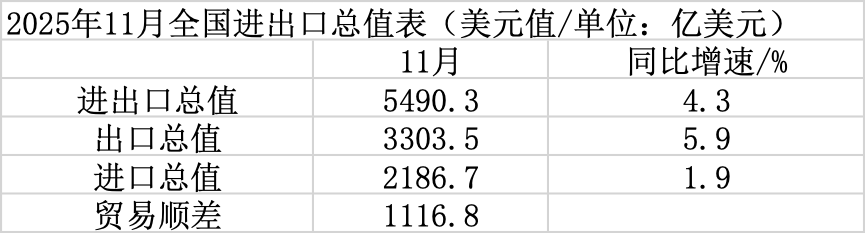
Core Insights - In November, China's total import and export value reached $549.03 billion, a year-on-year increase of 4.3% [1][2] - Exports totaled $330.35 billion, growing by 5.9% year-on-year, while imports were $218.67 billion, up by 1.9% [1][2] - The trade surplus for November was $111.68 billion [1] Summary by Category Total Trade Value - The total import and export value for the first eleven months of the year was $5.75 trillion, reflecting a year-on-year growth of 2.9% [2] - The total export value for the same period was $3.41 trillion, increasing by 5.4%, while imports were $2.34 trillion, showing a decline of 0.6% [2] Export Performance - November's export growth of 5.9% was a significant rebound, accelerating by 7.0 percentage points compared to the previous month [4] - The high base effect from the previous year diminished, contributing to the improved export figures [4] - Exports to the EU, Africa, and Latin America saw notable increases, while exports to the U.S. experienced a slight decline [4][5] Import Performance - November's import growth rose to 1.9%, an increase of 0.9 percentage points from the previous month [6] - The increase in imports was supported by a lower base from the previous year and strong export performance driving the demand for intermediate goods [6] - Despite the growth, domestic investment and consumption have slowed, impacting the demand for bulk commodities and consumer goods [6]