
全自动驾驶技术

Search documents
东莞地铁1号线一期开通试运营
Zhong Guo Xin Wen Wang· 2025-11-28 06:46
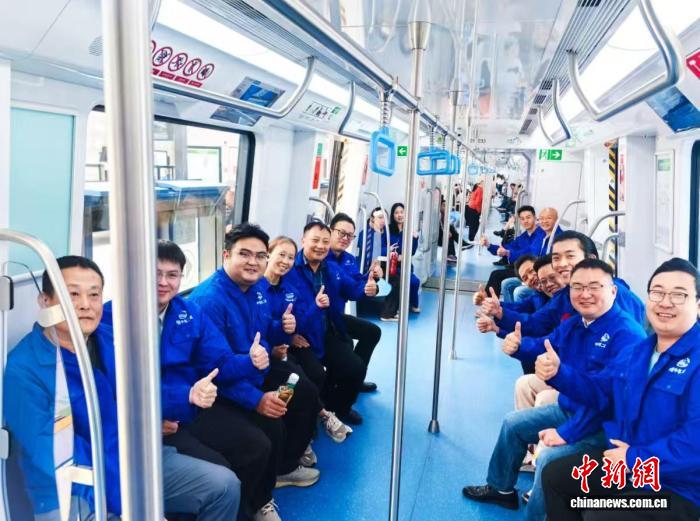
Core Viewpoint - The Dongguan Metro Line 1 Phase 1 officially commenced trial operations on November 28, marking a significant development in the city's transportation network [1]. Group 1: Project Overview - Dongguan Metro Line 1 is a crucial part of the city's rail transit system, constructed in three phases, with Phase 1 spanning 57.478 kilometers and featuring 25 stations [1][3]. - The line runs from Dongguan West Station to Meitang Station, passing through ten towns and districts, enhancing connectivity between key urban areas and towns [3]. Group 2: Transportation Impact - The opening of Line 1 improves the internal transportation network of Dongguan and enhances cross-city commuting efficiency [3]. - The Dongguan Metro Line 1 allows for seamless transfers to Dongguan Metro Line 2 at the city center station, facilitating quick access to key nodes such as the Humen High-Speed Railway Station [3]. Group 3: Technological Features - The entire line employs fully automated driving technology, providing citizens with new experiences such as elevated scenic views and smart charging [5].

轨交18号线二期开启“跑图” 冲刺年底开通初期运营
Jie Fang Ri Bao· 2025-10-01 01:57
Core Viewpoint - The Shanghai Metro Line 18 Phase II project has successfully entered the second stage of trial operation, known as "running map" rehearsal, bringing it closer to the goal of initial operation by the end of the year [1][2]. Group 1: Project Progress - The "running map" rehearsal involves empty train operations according to the future official timetable, testing the stability and coordination of key processes such as train entry and exit, turnaround, dispatch command, and signal linkage [1]. - The project is currently in the finishing stages of decoration installation, station accessories, and external supporting works, with expectations to commence initial operations by the end of the year [2]. Group 2: Technology and Systems - The most notable aspect of the Phase II project is the implementation of an LTE (Long-Term Evolution) vehicle-ground wireless communication fully automated driving system, which focuses on high levels of automation control [1]. - A temporary control center and an independent testing network have been established to ensure efficient debugging and smooth integration of multiple systems without affecting the normal operation of the first phase [1].
二季度全球销量下滑,中国成特斯拉唯一增长引擎
2 1 Shi Ji Jing Ji Bao Dao· 2025-07-07 12:35
Core Insights - Tesla's global sales faced a significant decline in Q2 2025, with a total delivery of 384,100 vehicles, marking a year-on-year drop of 13.5% [1] - In contrast, the Chinese market emerged as a growth pillar, with Tesla's Shanghai factory delivering 191,720 vehicles, accounting for 47% of global production [1] - The disparity in sales performance between regions is evident, as Tesla's new car registrations in the EU plummeted by 40.5% in May, while deliveries in China grew by 10.98% [1][4] Group 1: Market Performance - Tesla's Q2 2025 global production exceeded 410,000 electric vehicles, but the company experienced a two-quarter consecutive decline in sales [1] - The company’s reliance on the Model 3 and Model Y is evident, as these two models constituted 97.3% of total deliveries, while higher-end models contributed only 10,400 units, a 50% year-on-year decline [4] - The Cybertruck has faced quality issues, with eight recalls since its production began in 2023, leading to diminished market trust [4] Group 2: Competitive Landscape - Chinese automakers are rapidly gaining market share in Europe, with BYD's pure electric sales surpassing Tesla for the first time in April, showing a year-on-year growth of 359% [5] - Other Chinese brands like Geely and SAIC also reported significant increases in new car registrations in Europe, indicating a growing competitive threat to Tesla [5] - Tesla's market share in China has decreased from a peak of 15% in 2020 to 7.6% in 2025, despite a strong performance in Q2 [7][8] Group 3: Strategic Challenges - Tesla is facing a "triple crisis," including product lineup stagnation, regulatory hurdles for its Full Self-Driving (FSD) technology, and a decline in consumer trust due to Elon Musk's controversial public statements [4][5] - The company’s pricing strategy has come under scrutiny, as it raised prices on some Model 3 variants while competitors are offering more features at lower prices [8] - The marketing landscape is shifting, with new entrants like Xiaomi's automotive venture creating significant competition for Tesla's market share [8][9]

特斯拉,涨价!
证券时报· 2025-06-13 09:37
Core Viewpoint - Tesla has increased the prices of its Model S AWD and Model S Plaid in the U.S., indicating a trend of price adjustments in response to market conditions [2][3]. Price Adjustments - The price of the Model S AWD has risen from $79,990 to $84,990, while the Model S Plaid has increased from $94,990 to $99,990 [2]. - This is not the first price hike for the Model S AWD, which saw its price increase from $74,990 to $79,990 in December of the previous year [3]. Autonomous Driving Developments - CEO Elon Musk announced that Tesla will deliver its first fully autonomous vehicle in Austin, Texas, on June 28, featuring the latest Full Self-Driving (FSD) software [4]. - Tesla plans to initiate a pilot Robotaxi service in Austin on June 22, although the exact timing may vary for safety reasons [4]. - Tesla has been developing autonomous driving technology since 2014, initially offering the Autopilot system as an option for the Model S [4]. Hardware and Software Enhancements - The first batch of autonomous vehicles will be Model Y, equipped with the new HW5.0 hardware platform, which includes advanced sensors and a computing power of 1.1 EFLOPS, a fivefold increase from the previous HW4.0 [5]. - The FSD system has been upgraded to version 12, entering a mature application phase with enhanced capabilities for complex scenarios and human-like decision-making [5].
【美股盘前】三大期指齐跌,中概新能源车股走低;Coinbase涨近10%,将被纳入标普500指数;高盛将美联储下次降息预期时间推后至12月;美国当局要求特斯拉就奥斯汀Robotaxi计划补充信息
Mei Ri Jing Ji Xin Wen· 2025-05-13 09:30
Group 1 - U.S. stock index futures are showing declines, with Dow futures down 0.22%, S&P 500 futures down 0.39%, and Nasdaq futures down 0.56% [1] - Chinese electric vehicle stocks are experiencing pre-market declines, with NIO down nearly 4%, Xpeng down over 3%, and Li Auto down over 2%. Morgan Stanley has reduced its holdings in these companies to new lows since first acquiring them in Q1 2019 [1] - Goldman Sachs has pushed back its forecast for the next Federal Reserve interest rate cut to December, expecting three rate cuts to occur at alternating meetings rather than consecutively [1] Group 2 - Morgan Stanley's report suggests that U.S. stocks should comprise 56% to 65% of global investment portfolios, with the dollar expected to continue weakening due to various economic factors [2] - Goldman Sachs has raised its target for the S&P 500 index to 6500, up from a previous estimate of 6200, indicating an expected increase of about 11% from the recent closing price [2] - Citigroup has upgraded Pinduoduo's target price to $165 and raised its rating to "Buy," citing favorable conditions for Chinese cross-border sellers and positive impacts on Pinduoduo's international e-commerce platform, Temu [2] Group 3 - The U.S. National Highway Traffic Safety Administration has requested additional information from Tesla regarding its plans to launch a paid Robotaxi service in Austin, Texas, to assess the performance of its autonomous driving technology in adverse weather conditions [3] - McDonald's has announced a plan to hire up to 375,000 employees for its company-owned and franchised stores in the U.S. this summer [3]


