公募基金薪酬改革

Search documents
长城基金经理翁煜平转岗行业研究员,业绩大幅跑输基准
Sou Hu Cai Jing· 2025-12-22 10:33
Core Viewpoint - The recent announcement by Great Wall Fund Management regarding the resignation of fund manager Weng Yuping due to "business adjustment" has sparked discussions about the phenomenon of fund managers being "retrained," reflecting significant changes in performance assessment mechanisms amid industry salary reforms [2][8]. Group 1: Manager Transition - Weng Yuping has stepped down as the sole manager of the Great Wall Jiuyuan Flexible Allocation Mixed Fund, transitioning to a role as an industry researcher, with Lin Hao taking over management [2][4]. - The resignation is effective from December 18, 2025, and Weng has completed the necessary deregistration procedures with the China Securities Investment Fund Industry Association [4]. Group 2: Fund Performance - Under Weng's management, the Jiuyuan Fund reported a return of -49.65% for Class A and -53.25% for Class C, significantly underperforming its benchmarks by 36.63 and 56.63 percentage points, respectively [5]. - The fund's size has shrunk over 80%, from 248 million yuan to 43 million yuan, categorizing it as a "mini fund" [5]. - The fund's heavy investments in military electronics and semiconductors have resulted in consecutive losses of 31.67% and 24.64% in 2022 and 2023, ranking in the bottom 10% of its peers [5]. Group 3: Industry Trends - The trend of fund managers being "retrained" is not isolated, with several instances in the industry, including the resignation of Lu Xianhai from Baoying Fund and Ding Ge from Dongwu Fund, both transitioning to research roles after poor performance [6][7]. - The timing of Weng's transition coincides with a period of salary reform discussions in the public fund sector, which may influence performance-based compensation adjustments [8]. Group 4: Company Overview - Great Wall Fund Management, established in December 2001, has a public asset management scale exceeding 350 billion yuan as of September 30, 2025, with a net profit growth rate of 40.07% over the past three years [9]. - Despite stable overall performance, some active equity fund managers within the company have underperformed relative to their peers, with the Great Wall Core Advantage A fund showing a return of -34.96% over five years [9].


公募基金业薪酬风暴要来了?谁站在红线边缘?
Xin Lang Cai Jing· 2025-12-09 01:56
Core Viewpoint - The new performance assessment guidelines for fund management companies signify a major reform in the public fund industry, linking fund managers' compensation directly to the actual returns for investors, thereby emphasizing performance over mere management fees [1][2][31]. Group 1: Key Points of Compensation Reform - The core principle of the new guidelines is to establish a performance assessment system centered on fund investment returns, with a significant weight on long-term performance metrics [33]. - Fund managers of actively managed equity funds will face a 30% salary reduction if their performance lags the benchmark by more than 10% and the fund incurs losses over the past three years [2][32]. - The guidelines introduce quantifiable and rigid constraints to create a transparent incentive mechanism, aiming for long-term alignment of interests between fund managers and investors [2][32]. Group 2: Impact and Data Analysis - As of December 5, nearly 38.43% of 3,757 actively managed equity funds have underperformed their benchmarks by over 10% in the last three years, indicating significant challenges for fund managers [34]. - Approximately 996 fund managers are affected, managing over 1.1 trillion yuan in assets, with specific examples of funds like Guotou Ruijin's performance showing a cumulative return of -26.12%, lagging the benchmark by over 45 percentage points [35][40]. - Historical data from 2015 to 2024 shows that only 45 out of a large sample of equity funds managed to consistently outperform the benchmark by 10% over three years, suggesting that over 90% of fund managers may face salary reductions during their careers [39]. Group 3: Characteristics of Fund Managers at Risk - Fund managers at risk of salary reductions often exhibit extreme style dependence, focusing heavily on specific sectors like consumption or technology, which can lead to significant underperformance during market downturns [41][42]. - Rapid asset growth during peak performance periods has constrained the flexibility of these managers, making it difficult to adjust portfolios effectively in declining markets [43][44]. - The aggressive strategies employed by these managers conflict with the new guidelines that encourage closer tracking of benchmarks and controlled excess returns [46]. Group 4: Future Implications for Fund Managers - The new regulations are expected to shift fund managers' focus from seeking high returns to managing risks, potentially leading to a more conservative investment approach [52]. - The stringent accountability measures may result in a significant reduction in the number of top-performing fund managers remaining in the public fund sector, as many may transition to private equity or specialized accounts for better compensation opportunities [56][58]. - The industry may see an increase in trend-following strategies, which could exacerbate market volatility and lead to crowded trades, while less popular assets may receive even less attention [55].
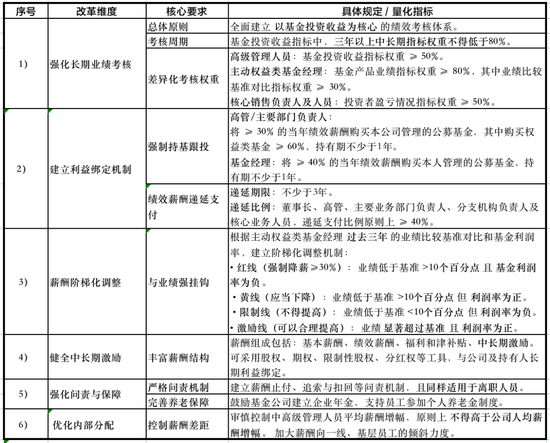
公募基金薪酬改革具体要求出炉
Jin Rong Shi Bao· 2025-12-09 01:51
Core Viewpoint - The public fund industry in China, with an asset management scale exceeding 36.7 trillion yuan, is set to implement new regulations aimed at enhancing performance assessment and compensation management for fund management companies [1]. Group 1: Performance Assessment and Compensation Management - The newly released guidelines consist of seven chapters with 32 articles, focusing on performance assessment and compensation management issues within the public fund industry [2]. - Fund management companies are required to establish a deferred payment system for performance compensation, with a minimum deferral ratio of 40% and a duration of at least three years for key personnel [2]. - Performance compensation for active equity fund managers is linked to performance benchmarks and fund profitability, with specific rules for reductions in compensation based on underperformance [2][3]. Group 2: Internal Compensation Structure - The guidelines mandate an optimization of the internal compensation structure to balance pay across different roles and levels, with a focus on reducing excessive pay disparities [3]. - There is an encouragement for diversified long-term incentives, including equity and options, to align with the long-term interests of the company and its investors [3]. Group 3: Performance Evaluation Metrics - A performance evaluation system centered on fund investment returns has been established, requiring that long-term performance indicators account for at least 80% of the evaluation metrics [4]. - Specific weightings for performance indicators have been set for different roles, ensuring a fair and scientific assessment process [4]. Group 4: Industry Implications - The guidelines aim to bind fund interests with actual investor returns, promoting a market-oriented mechanism for reward and punishment based on performance [6]. - The implementation of these guidelines is expected to improve the investment experience for investors and necessitate a redesign of internal assessment systems within fund management companies [7]. - The guidelines are anticipated to shift the industry focus from scale expansion to quality competition, encouraging firms to enhance investment capabilities rather than merely increasing size [7][8].
孙迪败走广发资源优选!“空降兵”苏文杰接管多基金迎战规模困局
Sou Hu Cai Jing· 2025-06-18 08:40
Core Viewpoint - As of January 31, 2025, GF Fund's public fund management scale reached 1.39 trillion yuan, ranking third after E Fund and Huaxia Fund, but the company faces challenges in its active equity business due to declining performance of star fund managers [14][17]. Group 1: Fund Management and Performance - GF Fund has significantly increased its focus on index investment in recent years, yet it struggles to hide the decline in its active equity business scale [14][17]. - The resignation of star fund manager Sun Di from the GF Resource Selection fund is a notable event, with Su Wenjie taking over management responsibilities [6][12]. - Sun Di's management of the GF Resource Selection fund has resulted in a net value drop of 12.66% over the past year, significantly underperforming its benchmark by over 15 percentage points [7][10]. Group 2: Fund Manager Background - Su Wenjie, the new manager of GF Resource Selection, has a strong track record, achieving an annualized return of 19.92% while managing the Jiashi Resource Selection fund, ranking 19th among 305 similar funds [5][6]. - Su Wenjie has also managed the Jiashi Carbon Neutrality theme fund, which performed well, ranking 75th among 4,120 similar funds [5]. Group 3: Concentration and Strategy Issues - The GF Resource Selection fund has a high concentration in its top ten holdings, reaching 75.80%, which is significantly above the industry average [10][12]. - The fund's strategy has been criticized for its high turnover and reliance on a limited number of stocks, which can lead to increased risk, especially in a cyclical industry [10][12]. Group 4: Historical Context and Challenges - GF Fund was once known for its "internal star-making" strategy, successfully creating star fund managers, but this has shifted to a situation where many of these managers are now facing significant performance declines [14][17]. - The company has seen a notable decline in the performance of funds managed by key figures like Sun Di and Liu Gesong, leading to redemption pressures and a potential systemic risk due to over-reliance on star managers [16][17].