
富国消费主题A

Search documents
【干货】一图看懂2025年4季报,投顾组合基金背后的投资秘诀
银行螺丝钉· 2026-01-29 14:04
Core Viewpoint - The article provides an overview of the updated active fund manager pool information for the 2025 Q4 reports, highlighting key metrics such as investment style, stock ratio, industry preference, turnover rate, valuation of major holdings, concentration of holdings, and fund size [1][2][3]. Summary by Sections Fund Manager Information - The article includes a comprehensive list of fund managers categorized by investment style, such as deep value, growth, and balanced strategies, along with their respective fund names and codes [4][5][10][11]. Investment Style - Investment styles are crucial as they reflect the types of stocks held by the funds. The article notes that different styles have their strong and weak phases, with historical data showing a rotation between value and growth styles over the years [36][40]. Industry Preference - Fund managers typically focus on specific industries where they have expertise. The article emphasizes the importance of understanding these preferences to gauge potential performance [48][50]. Stock Ratio - The article discusses the stock ratio, indicating that active funds usually maintain a stock ratio around 85% to 90%, which affects the fund's volatility [45][46]. Concentration of Holdings - The concentration of holdings, defined as the proportion of the top ten stocks in the fund's net assets, is highlighted as a significant factor influencing fund volatility [53]. Valuation of Major Holdings - The article mentions that the valuation of major holdings is assessed based on the top ten stocks disclosed in the fund's reports, which may not always reflect real-time adjustments made by fund managers [56][58]. Turnover Rate - The turnover rate, which indicates how frequently stocks are bought and sold within the fund, is discussed. A turnover rate below 200% is considered low for active funds [59][60]. Fund Size - The size of the fund is noted as a critical factor, with larger funds potentially facing challenges in achieving excess returns due to management complexities [62][64]. Fund Manager's Perspective - The article emphasizes the importance of the fund manager's insights, which can provide valuable context regarding past performance and future market outlooks [70][74].


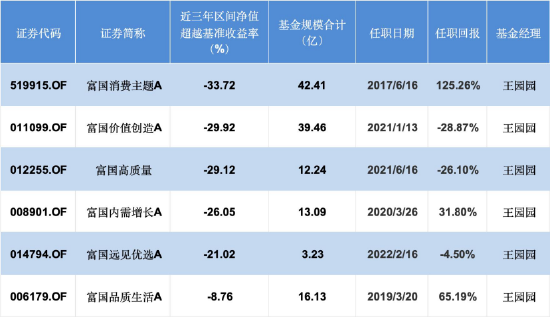
薪酬新规透视 | 富国王园园旗下6只产品近三年全线跑输基准,5只跑输超21%,富国消费主题A跑输近34%
Xin Lang Cai Jing· 2025-12-10 09:33
Core Viewpoint - The fund industry is undergoing significant reform in its compensation system, with nearly a thousand fund managers facing potential salary reductions due to underperformance over the past three years [1][3]. Group 1: Compensation Reform - New regulations from the Asset Management Association of China stipulate that if a fund manager's product returns are more than 10 percentage points below the performance benchmark and the fund's profit is negative, their performance-based compensation must be reduced by at least 30% [1][3]. - Fund companies are required to assess fund managers managing multiple products based on weighted performance evaluations considering fund size and management duration, excluding funds managed for less than one year from the assessment [1][3]. Group 2: Performance of Wang Yuanyuan's Funds - Wang Yuanyuan manages six funds with a total scale of 12.657 billion yuan, but all of them have underperformed their respective benchmarks over the past three years [4][6]. - Specifically, the fund "Fuguo Consumption Theme A" has underperformed its benchmark by 33.72%, while "Fuguo Value Creation A" and "Fuguo High Quality" have underperformed by 29.92% and 29.12%, respectively [5][6]. - The relatively better-performing fund, "Fuguo Quality Life A," has underperformed its benchmark by 8.76%, with a performance gap of over 24 percentage points compared to the worst-performing fund [6]. Group 3: Fund Size and Impact - Among the funds that underperformed by more than 20 percentage points, "Fuguo Consumption Theme A" has a scale of 4.241 billion yuan, and "Fuguo Value Creation A" has a scale of 3.946 billion yuan, together accounting for nearly two-thirds of Wang Yuanyuan's total managed scale [6]. - If the funds managed by Wang Yuanyuan have negative profit margins, five of the six funds will trigger the salary reduction clause due to their significant underperformance [6].
富国基金女将手握170亿,基民却有点急了
Sou Hu Cai Jing· 2025-11-22 15:15
Core Insights - The article highlights the significant growth in assets under management (AUM) for certain fund managers, particularly noting the rise of manager Fan Yan from 3.4 billion to 17.1 billion within a year, attributed to institutional investments and the launch of new funds [2][3][5]. Fund Performance and Management - Fan Yan's management of the "Fuguo Stable Growth Fund" saw AUM increase from 520 million to 3.4 billion shortly after she took over, with the fund's performance historically poor before her arrival [2][3]. - The fund's institutional ownership surged from 0% to 80.64% over a year, indicating strong institutional interest [3]. - Despite the AUM growth, Fan Yan's fund performance has been underwhelming compared to peers, with a one-year return of 20.73%, significantly trailing the average return of 26.46% for similar funds [5][6]. Comparison with Peers - Other fund managers, such as Lan Xiaokang from China Europe Fund, have outperformed Fan Yan, achieving returns of 38.93% over the same period [6][7]. - Newer fund managers like Ren Jie from Yongying Fund have seen explosive growth, with returns of 196.95% and AUM increasing from 25.2 million to 11.5 billion [6][7]. Investment Strategy - Fan Yan's investment strategy is characterized by a balanced and diversified approach, with the top ten holdings only accounting for 14.20% of the fund's net value, which contrasts with peers who have higher concentrations in their top holdings [9][10]. - The diversified nature of her portfolio, while aimed at risk mitigation, has resulted in less aggressive performance compared to more concentrated strategies employed by other successful fund managers [10]. Company Performance - Fuguo Fund, despite its historical success, has faced declining profits, with net profit dropping from 25.64 billion in 2021 to 1.75 billion by the end of 2024 [14]. - The company has been actively recruiting well-known fund managers to improve performance, but the results have yet to reflect a significant turnaround [12][14].

金融产品每周见:消费行业基金:从投资能力分析到基金经理画像-20251107
Shenwan Hongyuan Securities· 2025-11-07 15:30
1. Report Industry Investment Rating No relevant content provided. 2. Core Views of the Report - Based on fund holdings, consumption - related funds can be classified into five types, with most fund managers adopting the "segmented track (mainly liquor)" strategy [3]. - Consumption - related funds can generate relatively stable excess returns in the long - term compared to the sector index, are relatively good at stock - picking in certain industries, and it's difficult to identify their stock - picking ability for consumer stocks compared to all - industry funds [3]. - When comparing consumption - related funds with different style characteristics from seven dimensions, high turnover may lead to high returns recently, high - ROE style funds usually have high dividend attributes, etc. [3]. - To screen the observation list of consumption - related funds, quantitative indicators such as excess performance momentum, performance in favorable and unfavorable environments, stock - picking ability, etc. can be referred to [3]. 3. Summary According to the Directory 3.1 Classification of Consumption - Related Funds - The classification method is based on the fund's full - position data and heavy - position stock data in a certain sector. For consumption funds, some Hong Kong stocks are additionally included. Most of the top 10 consumption - related funds in terms of scale have some commonalities in allocation [6]. - Consumption - related funds are classified into five types: consumption + satellite, sector rotation, segmented track, consumption rotation, and consumption equilibrium, with "segmented track (mainly liquor)" being the most commonly adopted strategy [3]. 3.2 Holding Characteristics: Can Consumption - Related Funds Create Positive Excess Returns? - As a whole, consumption - related funds have similar performance to the consumption sector index before 2025, and have achieved certain excess returns compared to the index since this year [22]. - Consumption - related funds are relatively good at stock - picking in industries such as household appliances, textile and apparel, agriculture, forestry, animal husbandry and fishery, etc., and have prominent excess returns in some industries during certain periods [23][26]. - It's difficult to determine whether consumption - related fund managers have stronger stock - picking ability for consumer stocks compared to all - industry funds [28]. - Consumption - related funds prefer to allocate liquor in food and beverage, and their individual - stock allocation is relatively stable. They had positions in new - consumption stocks earlier [36]. - Through cluster analysis, different types of consumption - related funds can be identified, such as those focusing on agriculture, forestry, animal husbandry and fishery, those focusing on liquor investment, etc. [39] 3.3 Comparison of Consumption - Related Funds with Different Style Characteristics - In terms of turnover trading, high - turnover consumption - related funds have better short - term performance recently, and some liquor - themed funds with low turnover have return drag. In the long - term, both high - and low - turnover funds have excellent performers [42][44]. - In terms of holding style, funds with high ROE generally have high dividend attributes. Different segmented tracks have significant differences in market - value styles [48][52]. - In terms of holding popularity, the structure of market - preferred stocks in the consumption sector has changed significantly, and there are excellent performers in various types of products [53]. - In terms of left - and right - side investment, consumption - related funds are generally on the right side of the market median, and there are excellent performers on both sides [59]. - In terms of stock - picking ability, by calculating the skewness, kurtosis, and mean/standard deviation of stock - picking returns, funds with strong stock - picking ability can be found [60][62]. - In terms of adaptability to different market environments, different types of products show different adaptability results, and there are products with strong performance in favorable or unfavorable environments [63][65]. - In terms of segmented - track rotation, there are both products with good and poor rotation effects among consumption - related funds [71]. 3.4 Observation List of Consumption - Related Funds - The screening of the observation list refers to quantitative indicators such as excess performance momentum, performance in favorable and unfavorable environments, stock - picking ability, left - and right - side investment ability, and segmented - track rotation effect. Other factors such as the fund manager's tenure and fund scale are also considered [75]. - The observation list includes funds like E Fund Long - Term Value, Cathay Pacific Consumption Optimization, Changxin Multi - Benefit, etc. [3][76]