共识交易

Search documents
暴涨、火爆、崩盘——金银领衔主演,2026年市场“开年大戏”格外精彩
Sou Hu Cai Jing· 2026-01-31 08:25
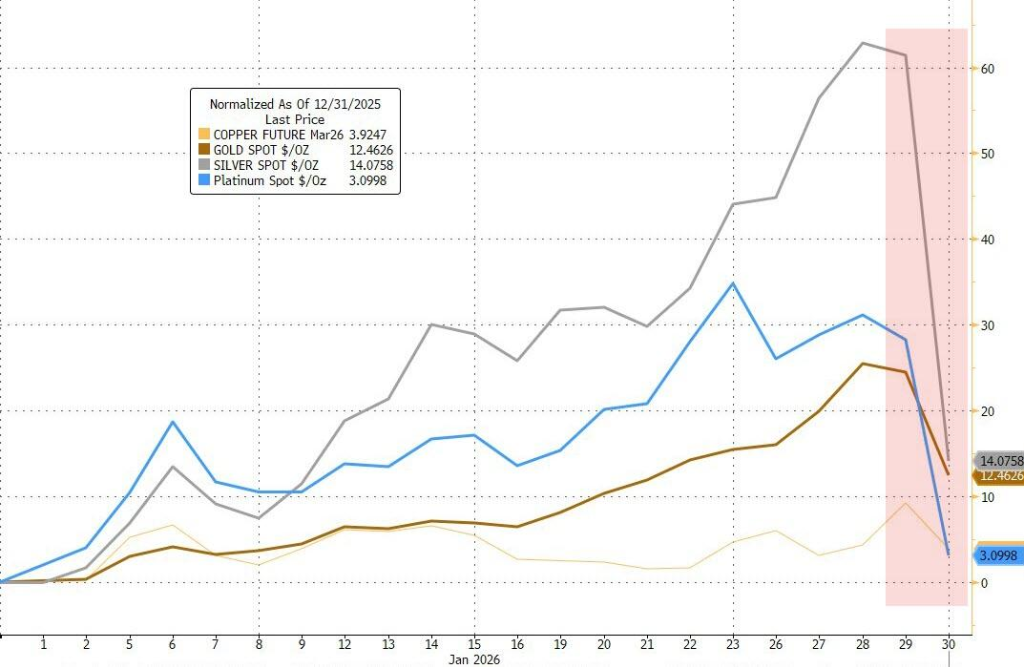
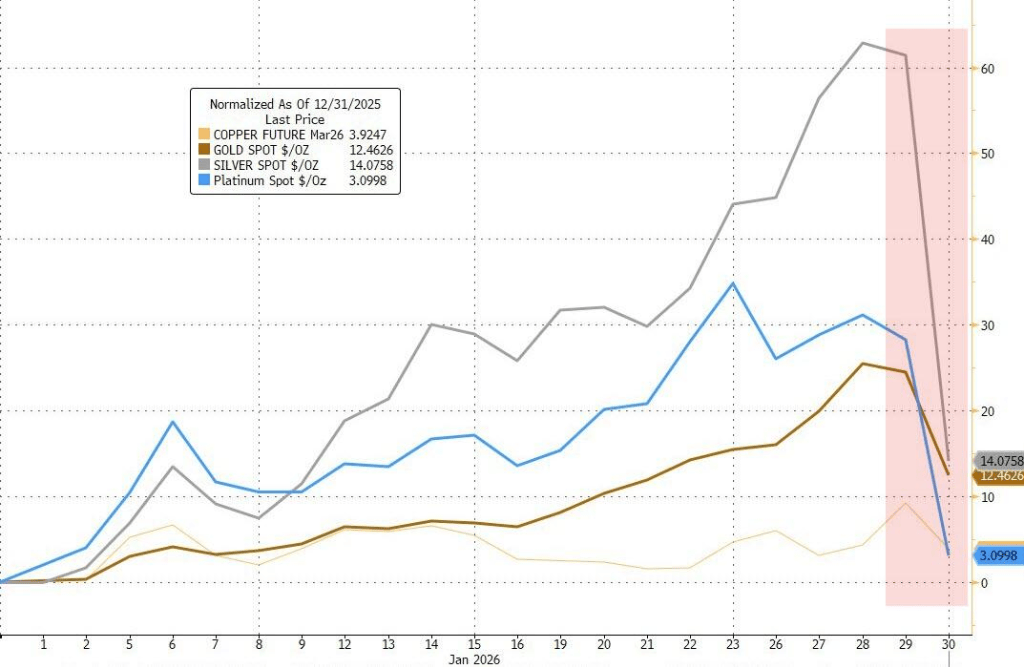
Core Viewpoint - The recent market turmoil highlights the fragility of consensus in a crowded trading environment, where even minor fluctuations can lead to significant volatility, particularly in precious metals following Trump's nomination of Waller as Fed Chair [1]. Group 1: Precious Metals Market - Gold prices plummeted by 10%, erasing $5 trillion in market value over two days, while silver and platinum saw declines of 37% and over 16% respectively [1]. - The market was already showing signs of overcrowding before the drop, with a Bank of America survey indicating that long positions in gold were the most crowded trade globally, with prices exceeding long-term trend lines by 44%, a level not seen since 1980 [4]. - The silver sentiment index reached its highest level since 1998, indicating extreme bullish sentiment [5]. Group 2: Broader Market Implications - The dollar index experienced its largest single-day gain since May, negatively impacting short positions on the dollar, while emerging market stocks underperformed relative to U.S. equities, marking the worst performance since 2022 [3][6]. - The crowded trading environment is evident across multiple markets, with significant leverage accumulating beneath the surface, leading to potential for sharp declines [6]. - The recent volatility in precious metals serves as a warning for other crowded trades, as consensus can often be misleading in extreme market conditions [14]. Group 3: Investor Sentiment and Strategy - The market's momentum-driven nature raises questions about the viability of contrarian investors, with some, like Rich Weiss, maintaining a position favoring U.S. equities despite recent underperformance against international markets [15]. - Weiss believes that growing profits will enable U.S. companies to outperform their foreign counterparts, despite current trends not aligning with his strategy [16]. - The recent market fluctuations have prompted some investors to reconsider their positions, questioning how much further prices can decline and whether exiting early could mean missing out on future gains [17].

暴涨、火爆、崩盘--金银领衔主演,2026年市场“开年大戏”格外精彩
华尔街见闻· 2026-01-31 06:28
Core Viewpoint - The recent nomination of Walsh as the Federal Reserve Chair by Trump has triggered a significant sell-off in precious metals, leading to a market loss of $5 trillion in just two days, with gold prices plummeting by 10% and silver by 37% [1] Group 1: Market Dynamics - The market for precious metals was already showing signs of being overcrowded, with record levels of bullish positions and extreme leverage, making it susceptible to a "gamma squeeze" [3] - The dollar index experienced its largest single-day increase since May, negatively impacting investors who were shorting the dollar [4] - A significant amount of capital has rapidly flowed through the markets, leaving little room for error in positioning, which could lead to sharp declines [5] Group 2: Overcrowded Trades - A Bank of America survey indicated that being long on gold was the most crowded trade globally, with gold prices exceeding long-term trend lines by 44%, a level not seen since 1980 [8] - The dollar has faced selling pressure for three consecutive months, marking its worst start to the year in eight years, while also reaching its lowest level against other currencies since July 2022 [9] Group 3: Broader Market Implications - The collapse in precious metals serves as a warning for other crowded trades that have remained stable [16] - The MSCI Emerging Markets Index has outperformed the S&P 500 Index to an extent not seen since 2022, while momentum stocks in the U.S. have recently faced corrections [12] - The Russell 2000 Index, after outperforming the S&P 500 for 14 consecutive trading days, has underperformed in the last six days [14] Group 4: Investor Sentiment and Strategy - The recent market volatility has raised questions about the viability of contrarian investors in a momentum-driven market [17] - Some investors, like Rich Weiss, have maintained a contrarian stance despite unfavorable trends, believing that growing profits will allow U.S. companies to outperform their international counterparts [18] - Despite the downturn in gold prices, some investors are hesitant to exit their positions too early, fearing they might miss out on future opportunities if prices rebound [20]

暴涨、火爆、崩盘--金银领衔主演,2026的市场“开年大戏”格外精彩
Hua Er Jie Jian Wen· 2026-01-31 02:04
Core Viewpoint - The recent market volatility highlights the fragility of consensus, as extreme trading positions can lead to significant price swings even with minor fluctuations [1]. Group 1: Market Dynamics - The market experienced a dramatic sell-off in precious metals, with gold dropping 10% and erasing $5 trillion in market value over two days [1]. - Silver saw a sharp decline of 37%, while platinum fell over 16%, and copper reversed all gains from the previous day [1]. - The market is characterized by crowded long positions and record levels of bullish options, creating a potential for "gamma squeeze" [3]. Group 2: Investor Sentiment - A Bank of America survey indicated that being long on gold is currently the most crowded trade globally, with gold prices exceeding long-term trend lines by 44%, a level not seen since 1980 [4]. - The silver sentiment index reached its highest level since 1998, indicating extreme bullish sentiment among investors [4]. Group 3: Broader Market Implications - The dollar index experienced its largest single-day gain since May, negatively impacting investors who were short on the dollar [3]. - Emerging market equities have underperformed relative to U.S. stocks, marking the worst performance since 2022 [3]. - The recent volatility in precious metals serves as a warning for other crowded trades across various markets [10]. Group 4: Investment Strategies - The current market environment raises questions about the viability of contrarian investors, as momentum-driven trading dominates [11]. - Some investors, like Rich Weiss, have maintained a contrarian stance, favoring U.S. equities over international markets despite recent underperformance [11]. - Concerns are growing among investors about whether the recent market fluctuations signal an early warning for exiting crowded trades [11].