
动量交易

Search documents
The momentum trades of 2026 are breaking with gold, silver and South Korea down big
CNBC· 2026-03-03 15:30
Core Insights - The current market for gold, silver, and South Korea is experiencing significant declines due to concerns over the prolonged conflict in Iran [1][2] Group 1: Market Performance - Gold prices have decreased by more than 5%, with spot gold at $5,041.81 per ounce and futures at $5,049, despite being up over 16% year-to-date [4] - Silver futures have fallen more than 8% to $81.23 per ounce, although they remain 15% higher year-to-date [4] - The iShares MSCI South Korea ETF (EWY) has dropped 14%, yet it is still up nearly 30% year-to-date [4] Group 2: Investor Sentiment - Investors had previously favored gold, silver, and South Korea as alternatives to U.S. large-cap tech stocks, which have seen a cumulative rise of 64% over the last three years but are down 1% this year [2] - There is optimism regarding gold's potential to exceed $6,000 per ounce as central banks diversify away from the U.S. dollar [3] - Silver is anticipated to benefit from tight supply-demand dynamics and its industrial applications, particularly in AI [3]


美股前瞻 | 三大股指期货齐涨,软件股反弹
智通财经网· 2026-02-06 12:54
Market Overview - US stock index futures turned positive before the market opened on February 6, with Nasdaq futures up 0.51%, S&P 500 futures up 0.52%, and Dow futures up 0.60% after previously dropping over 1.6% [1] - European indices also showed gains, with Germany's DAX up 0.33%, UK's FTSE 100 up 0.54%, France's CAC40 up 0.23%, and the Euro Stoxx 50 up 0.34% [2][3] Oil Prices - WTI crude oil rose by 1.39% to $71.99 per barrel, while Brent crude oil increased by 1.34% to $75.66 per barrel [3] Employment and Economic Data - The US non-farm payroll report for January has been delayed to February 11, and the CPI report has been postponed to February 13, which may lead to market volatility [4] Stock Market Trends - Momentum trading strategies have faced significant setbacks, with a notable sell-off in the software sector, which has seen declines exceeding 20% due to concerns over AI applications potentially displacing certain companies [5] - Despite the sell-off, sectors such as apparel retail, travel, and home goods manufacturing have seen stock price increases, indicating a shift towards value stocks [5] Cryptocurrency Market - Bitcoin experienced a sharp decline, dropping 12% to around $63,000 before rebounding above $66,000. The drop was attributed to position liquidations rather than fundamental issues [6] AI and Software Sector - The narrative of a "software stock apocalypse" has led to widespread sell-offs in the SaaS and broader software sectors, although some institutional investors are beginning to buy the dip, believing that the market has overreacted [7] - Wistron, a supplier for Nvidia, stated that AI is not a bubble but the beginning of a new era, with orders expected to grow significantly [8] Automotive Industry - Toyota raised its full-year profit guidance, expecting net profit to reach 3.57 trillion yen, up from a previous estimate of 2.93 trillion yen, aided by a weak yen and cost-cutting measures [13] - Stellantis announced a €22 billion write-down due to high costs and weak electric vehicle sales, indicating a significant restructuring of its business [14] Semiconductor Supply Issues - Intel and AMD have notified Chinese customers of a CPU supply shortage, with delivery times extending up to six months, leading to price increases of over 10% for Intel's server products in the Chinese market [15]



美股常胜策略突然失效!动量交易遭遇历史性回撤:资金从科技撤离,价值股成新宠
Zhi Tong Cai Jing· 2026-02-06 12:08
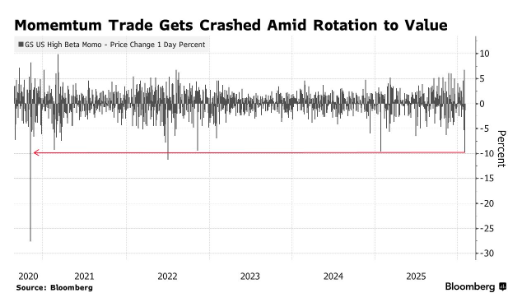
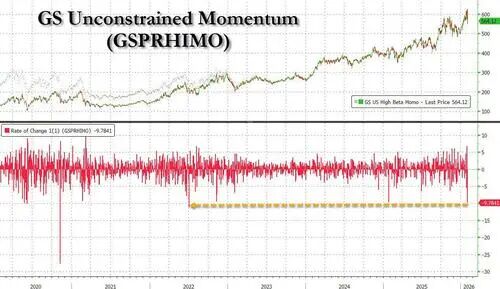
Group 1 - The momentum trading strategy, which has been a consistent approach in the stock market, suddenly failed in the past week, experiencing its second-largest single-day drop since the pandemic in 2020, surpassing declines from previous market sell-offs [1] - The decline in momentum stocks erased all gains for sectors such as storage chips, metals, rare earth mining, and technology application development for the year [1] - The sell-off was part of a broader downturn in the U.S. stock market, primarily triggered by volatility in the software sector, with concerns that AI applications could replace certain companies, leading to a drop of over 20% in that sector [1] Group 2 - Investors noted a significant rise in stock prices for clothing retail, travel companies, and home goods manufacturers, indicating a broad style shift in the market as funds moved from technology stocks to sectors more closely linked to economic recovery [3] - The UBS value stock long-short strategy basket has increased by 20% since last week, while Barclays' value stock relative to growth stock factor index recorded one of its largest excess returns in history on Thursday [3] - Despite the style shift, the significant drop in the technology sector and its high weight in the index has not been offset by the gains from the style switch, with the S&P 500 index down 1.2% on Thursday and a cumulative decline of 0.7% since 2026 [3] Group 3 - Technology stocks have become synonymous with momentum trading, particularly with software companies experiencing significant declines in the recent downturn [4] - Recent earnings reports from major tech companies have heightened market caution, with Google showing steady revenue growth but projecting capital expenditures for 2026 to exceed market expectations, while Qualcomm's revenue outlook appeared weak [4] - The current market exposure to momentum stocks is at the 99th percentile over the past year and has reached the 100th percentile over the past five years, indicating extreme volatility in momentum factors compared to historical levels [4] Group 4 - Goldman Sachs' trading team indicated that for investors considering positioning during the pullback, historical experience suggests that corrections in momentum stocks can present good buying opportunities in the medium term [5] - The team also advised that given the significant prior increase in momentum stocks and the current high levels of holdings, short-term hedging remains a reasonable choice [5]
大摩量化警告:动量崩塌、杠杆ETF大量抛售美股 接盘的散户寥寥无几!
智通财经网· 2026-02-05 13:41
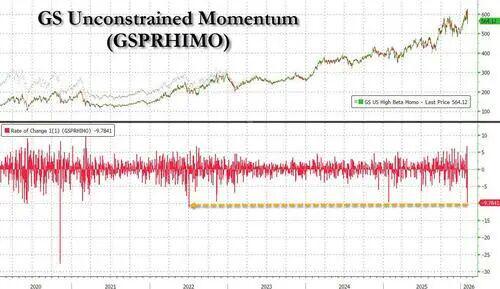
Core Viewpoint - Momentum consensus trading experienced a "collapse-like" reversal on February 5, driven by concentrated long position liquidation and passive selling from leveraged ETFs, leading to a rapid amplification of declines, with a notable absence of retail buying support [1][5][7] Group 1: Market Dynamics - The recent decline exhibited a structural characteristic of "index relative restraint, internal market volatility," with selling pressure concentrated in the Nasdaq, technology, and semiconductor sectors, which had previously led the market [1][5] - Goldman Sachs noted that nearly three-quarters of stocks outperformed the S&P 500 during the decline, indicating that the pain points were concentrated in a few crowded momentum trades [2][3] Group 2: Trading Behavior - Morgan Stanley's data showed that the momentum index MSZZMOMO fell approximately 7.7% in a single day, marking an extreme volatility event, primarily driven by long positions [5] - The selling pressure was heavily focused on previously leading sectors such as AI, national security, and Bitcoin mining stocks, while cyclical, chemical, and banking sectors showed relative strength [5] Group 3: Leveraged ETF Impact - Morgan Stanley's quantitative team estimated that leveraged ETF rebalancing contributed approximately $18 billion in selling pressure in the U.S. stock market, significantly impacting the Nasdaq and technology sectors [6] - The risk of continued selling pressure from leveraged ETFs remains, with an estimated $10 billion in potential future sales due to high volatility and historical leverage levels [6] Group 4: Retail Investor Behavior - Retail buying, which typically acts as a buffer during price declines, was notably absent, with net buying intensity at its lowest in the past year [7][9] - Institutional selling was high, further exacerbating the lack of support for consensus long positions during critical moments [7] Group 5: Future Outlook - Morgan Stanley suggests that while a technical rebound may occur, it is advisable to sell into any rebound due to ongoing deleveraging and the absence of retail investors as marginal buyers [10][13] - Historical data indicates that significant declines in the momentum index often lead to negative stock performance in the following 1-2 months, with a median decline of approximately 22% [10][13]

一文读懂:华尔街“抛AI”妖风祸从何来?
Xin Lang Cai Jing· 2026-02-05 13:15
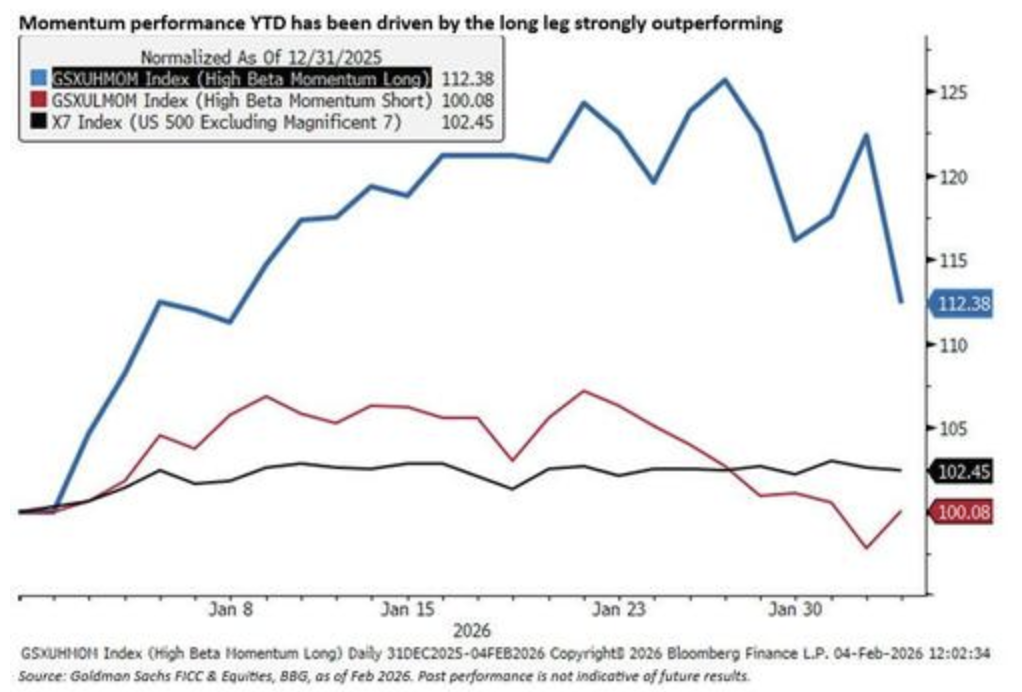
Core Viewpoint - Momentum traders experienced significant losses, marking one of the worst days since mid-2022, primarily driven by a sell-off in high-beta stocks and a shift in market dynamics [1][6][19]. Group 1: Market Dynamics - The sell-off on Wednesday was attributed to fundamental factors and position adjustments, revealing underlying volatility despite a seemingly stable S&P 500 index [3][5]. - The average volatility of S&P 500 constituents was approximately seven times that of the index itself, indicating sharp movements in individual stocks [5]. - Goldman Sachs noted that the sell-off was largely driven by the underperformance of long positions in high-beta stocks, which had previously been market leaders [6][10]. Group 2: Sector Performance - The market saw a reversal from crowded themes such as AI and high-beta stocks, with early-cycle stocks and defensive sectors performing well [8][10]. - High-performing sectors like memory chips and non-profitable tech stocks experienced significant pullbacks, while negative momentum themes rebounded [15][19]. - The sell-off was characterized by extreme factor reversals, with momentum factors facing their worst drawdown in over three years [8][19]. Group 3: Trading Behavior - The market's behavior on Wednesday was marked by a disconnection between index performance and individual stock movements, with nearly three-quarters of stocks outperforming the S&P 500 [14]. - Retail participation was notably absent during the sell-off, contrasting with aggressive buying during previous rebounds [14]. - The pressure from leveraged ETFs was significant, with an estimated $18 billion in selling pressure on that day, particularly affecting tech and semiconductor stocks [12][19]. Group 4: Future Outlook - Historical patterns suggest that such momentum stock pullbacks can present mid-term buying opportunities, although caution is advised due to potential further downside risks [17][19]. - Analysts from Morgan Stanley and Goldman Sachs agree that the current market conditions may lead to further adjustments, but they also see potential for short-term rebounds [17][19].


大摩量化警告:动量崩塌、杠杆ETF大量抛售美股,接盘的散户寥寥无几!
Hua Er Jie Jian Wen· 2026-02-05 13:04
Core Viewpoint - Momentum consensus trading experienced a "collapse-like" reversal on February 5, driven by concentrated long position liquidation and passive selling from leveraged ETFs, leading to a rapid amplification of declines, with a notable absence of retail buying support [1][4][5] Group 1: Market Dynamics - The recent decline exhibited a structural characteristic of "index relative restraint, internal market volatility," with selling pressure concentrated in the Nasdaq, technology, and semiconductor sectors, which had previously led the market [1][4] - Approximately 75% of stocks outperformed the S&P 500 during the decline, indicating that the pain was concentrated in a few crowded momentum trades rather than a broad market downturn [2] - The momentum index MSZZMOMO fell about 7.7% in a single day, marking an extreme volatility event, primarily driven by long positions [4] Group 2: Sector Performance - Selling pressure was heavily focused on previously leading sectors such as AI, national security, and Bitcoin mining stocks, while cyclical, chemical, and banking sectors showed relative strength, indicating a rotation away from high-beta themes [4][5] - The leveraged ETF rebalancing contributed approximately $18 billion in selling pressure, particularly affecting the Nasdaq and technology sectors, with significant impacts on several popular stocks [5] Group 3: Retail Investor Behavior - Retail buying was notably absent, with net buying intensity at its lowest in the past year, primarily occurring during market rebound periods [6][7] - The lack of retail participation has directly suppressed momentum factors, as the stocks favored by retail investors overlap significantly with those used in momentum strategies [9] Group 4: Future Outlook - Short-term technical rebounds may occur, but Morgan Stanley suggests a "sell on the rebound" strategy due to ongoing deleveraging and weak retail demand ahead of the tax season, which could exacerbate future selling pressure [1][10][13] - Historical data indicates that after significant declines in the momentum index, stock performance tends to be negative in the following 1-2 months, with a median decline of approximately 22% [10]
比DeepSeek风暴还惨烈,华尔街“抛AI”妖风祸从何来?
3 6 Ke· 2026-02-05 09:02
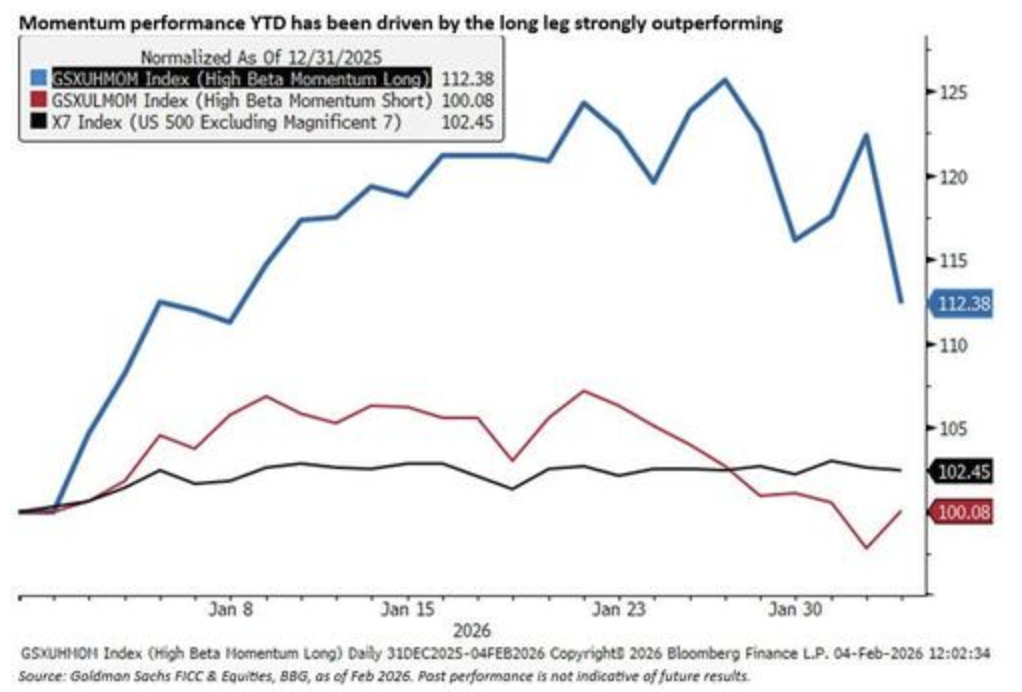
Core Insights - Momentum traders experienced significant losses, marking one of the worst days since mid-2022, as high-beta stocks faced severe declines [1][6][15] - The S&P 500 index components exhibited an average volatility approximately seven times that of the index itself, indicating underlying market turbulence despite a seemingly stable index [2][4] - The sell-off was primarily driven by fundamental factors and position adjustments rather than panic selling, with a notable absence of retail participation [5][14] Group 1: Market Dynamics - The recent market downturn was characterized by extreme factor reversals, with momentum factors suffering their worst drawdown in over three years [8] - High-beta stocks, particularly in sectors like AI and technology, faced significant selling pressure, while previously lagging sectors rebounded strongly [10][15] - The market's structure amplified volatility, with leveraged ETFs contributing to substantial selling pressure, estimated at around $18 billion on that day [12] Group 2: Investment Strategies - Goldman Sachs noted that the high-beta winners from the past year are experiencing a sharp reversal, with many momentum-heavy portfolios declining [15][16] - Historical patterns suggest that such momentum stock pullbacks can present mid-term buying opportunities, although caution is advised due to potential further downside risks [17][19] - Morgan Stanley's analysis echoed similar sentiments, indicating that crowded positions in AI and storage sectors faced significant sell-offs, while their short momentum strategy gained [17][19]

全球顶尖交易员点评:黄金白银何时反弹?
Hua Er Jie Jian Wen· 2026-02-03 08:13
Core Viewpoint - The recent volatility in gold prices is driven by underlying factors such as central bank purchases, ongoing de-dollarization, and persistent inflation expectations, despite short-term speculative pressures leading to excessive trading and increased volatility [1] Short-term Analysis - The current market is characterized by high volatility, which may require a cleansing of positions before any rebound can occur [3] - Goldman Sachs emphasizes the need for re-evaluation of volatility and clearing of positions, noting that the market has mispriced volatility, leading to increased trading costs and potential chain reactions upon stop-loss triggers [4] Medium-term Outlook - Goldman Sachs maintains its price target of $5,400 per ounce for gold by December 2026, based on assumptions of sustained central bank gold purchases, two rate cuts by the Federal Reserve, and no further diversification in private sector gold allocations [5][6] - The upward risks remain significant due to ongoing macroeconomic uncertainties and the low allocation of gold in private investment portfolios [5] Market Sentiment - There is a divergence in sentiment between traders reducing risk exposure and physical market participants experiencing strong demand, with some gold bars already sold out weeks in advance [6] - Some institutional investors view the recent price surge as driven by momentum trading rather than fundamental factors, indicating a potential for a market correction [6] Trading Strategy - Goldman Sachs' trading team has significantly reduced directional risk exposure, focusing on volatility dynamics and adjusting position sizes due to the increased nominal value and volatility of gold [7] - The trading strategy now involves smaller positions and a focus on the mispricing of short-term volatility, suggesting opportunities for contrarian trades as the market normalizes [7]
当买盘变“炸药”:复盘上周五的金银大屠杀,下一个关键时间点已锁定
美股研究社· 2026-02-02 11:06
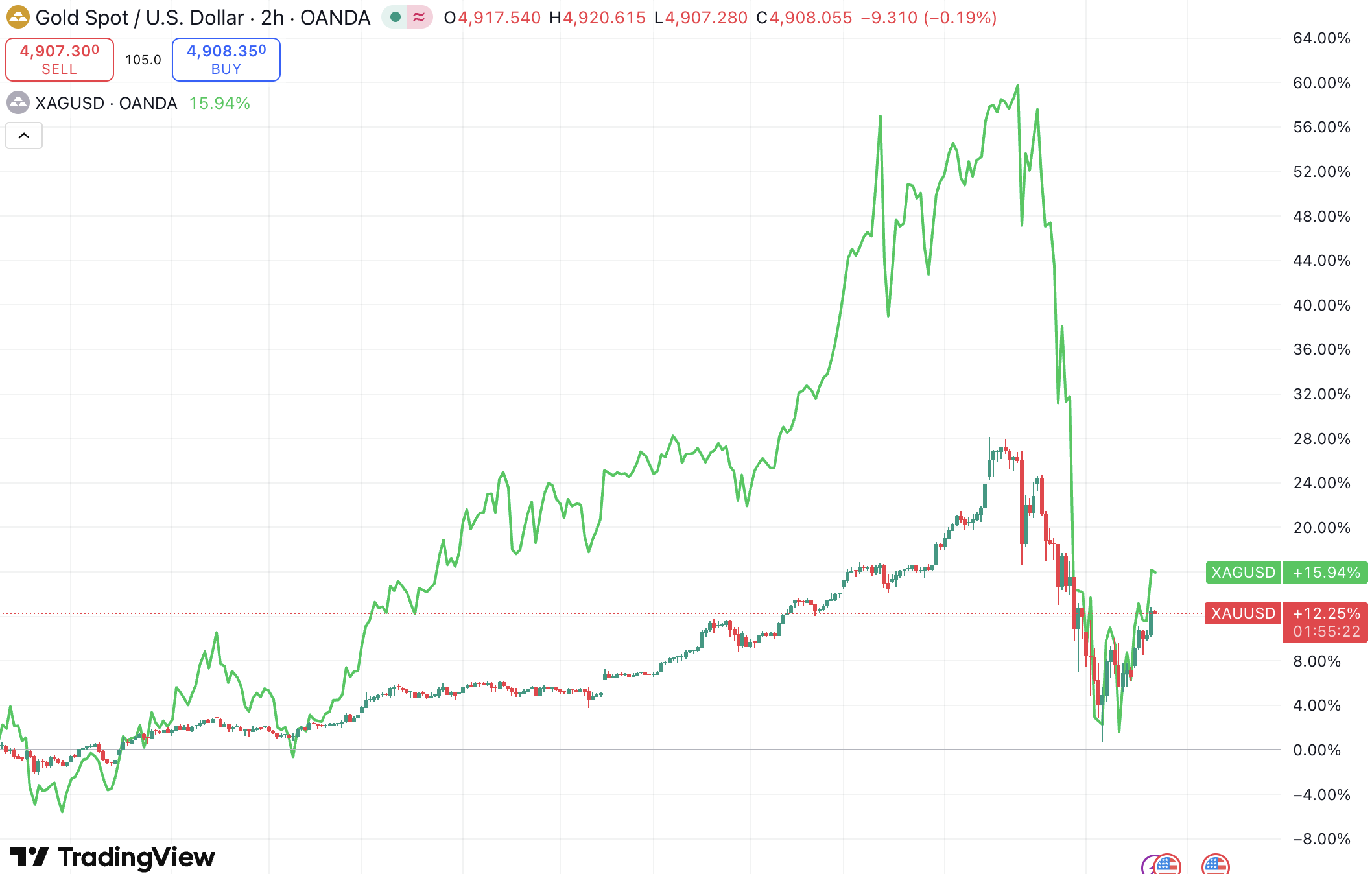
Core Viewpoint - The article discusses the dramatic fluctuations in the precious metals market, particularly focusing on the unprecedented drop in silver and gold prices, which were driven by speculative trading and external market influences, including U.S. political developments [4][6][10]. Group 1: Market Dynamics - Silver prices experienced a historic drop of 26% in one day, marking the largest decline ever recorded, while gold fell by 9%, representing its worst single-day performance in over a decade [4]. - The surge in metal prices prior to the crash was attributed to speculative buying from various investors, including individual traders and large commodity funds, pushing prices to record highs [6][10]. - The trading environment was described as "parabolic" and "frenzied," with significant volatility observed, particularly during Asian trading hours [5][6]. Group 2: Influencing Factors - The immediate trigger for the price drop was the announcement of President Trump's intention to nominate Kevin Warsh to lead the Federal Reserve, which strengthened the U.S. dollar and led to profit-taking among investors [4][13]. - Concerns over the independence of the Federal Reserve and geopolitical tensions contributed to the rising prices of metals, as investors sought alternatives to the U.S. dollar [6][10]. - The trading volume for the iShares Silver Trust (SLV) surged to over $40 billion, making it one of the most actively traded securities globally, compared to its previous daily volume of less than $2 billion [7][10]. Group 3: Future Outlook - The market's recovery may depend on China's demand for metals following the recent sell-off, with traders observing the opening of the Shanghai Futures Exchange for signs of renewed interest [14]. - Despite the recent downturn, there is potential for a rebound as retail investors are expected to enter the market ahead of the Lunar New Year, although there is a cautious sentiment surrounding silver [14]. - New measures announced by several Chinese banks to mitigate risks associated with personal gold accumulation products may impact the broader trends in the global metals market [14].

金银暴跌之后,所有目光都盯着周一中国开盘
Hua Er Jie Jian Wen· 2026-02-02 00:42
Core Viewpoint - The global precious metals market is experiencing significant volatility, with a historic drop in silver and gold prices, largely influenced by market reactions to potential changes in U.S. Federal Reserve leadership and the role of Chinese investors [1][2]. Group 1: Market Reactions - Silver prices plummeted by 26% in less than 20 hours, marking the largest single-day decline in history, while gold fell by 9%, the worst performance in over a decade [1]. - The surge in the U.S. dollar, driven by news of Trump's potential nomination of Kevin Walsh as the next Fed chair, is seen as a direct trigger for the market downturn [1]. - Traders are now focusing on the performance of the Shanghai Gold Exchange and the Shanghai Futures Exchange to gauge China's demand for precious metals following the sell-off [1]. Group 2: Trading Environment - The market has been described as "wild" and "untradeable," with significant volatility expected to characterize January 2026 as one of the most tumultuous months in precious metals history [2]. - The sell-off was exacerbated by profit-taking from Chinese retail investors and private equity funds, who had previously driven prices up due to geopolitical tensions and expectations of diminished Fed independence [2]. Group 3: Market Fundamentals - Prior to the crash, signs of overheating were evident, with the price surge driven more by speculative capital from China rather than traditional industrial demand [3]. - Data indicates that while global prices soared, there was a net outflow from silver ETFs outside of China since December, suggesting a disconnect between price movements and fundamental demand [3]. - Analysts have noted that the recent price increases were more reflective of momentum trading rather than fundamental value, leading to expectations of a market correction [3]. Group 4: Physical Market Dynamics - Despite turmoil in the futures market, the Shenzhen Shui Bei market for physical precious metals has remained relatively stable, with no panic selling observed [4][5]. - There has been a slight easing in the tight supply of silver, with more selling than buying, but traditional demand for physical gold remains strong as consumers prepare for the upcoming Spring Festival [5]. Group 5: Regulatory Responses - In response to market volatility, Chinese financial institutions are tightening risk controls, with measures such as increasing minimum investment amounts for gold accumulation and limiting transaction volumes during holidays [6]. - These actions aim to guide investors towards more rational participation and prevent excessive speculation in the precious metals market [6]. Group 6: Future Outlook - The key question remains whether traditional physical demand ahead of the Spring Festival can offset the impact of retreating speculative funds [7]. - The market is at a crossroads, determining whether this unprecedented volatility will subside or if it will lead to a reorganization after adjustments [8].