
关键资源供应链

Search documents
分水岭时刻:2025年,A股表现跑赢美股!
Hua Er Jie Jian Wen· 2026-01-01 11:14
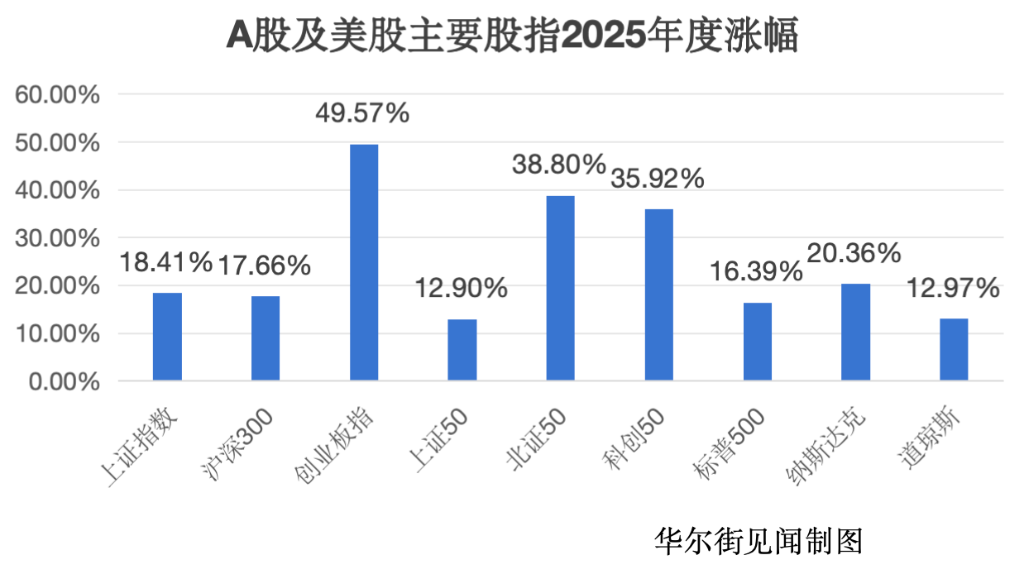
Market Performance - A-shares major indices showed strong performance in 2025, with the CSI 300 index rising by 17.66%, the ChiNext index by 49.57%, and the SSE 50 index by 12.9% [1] - The North Stock 50 index increased by 38.8%, and the Sci-Tech 50 index rose by 35.92%, with the Shanghai Composite Index surpassing 4000 points for the first time in nearly a decade on October 28 [1] - In comparison, the S&P 500 index in the US recorded a 16.39% annual increase, while the Nasdaq managed a 20.36% rise, and the Dow Jones increased by 12.97% [2] Comparative Analysis - A-shares outperformed US benchmarks in 2025, with the CSI 300 index slightly exceeding the S&P 500 index, while indices focused on technology and growth, such as ChiNext and Sci-Tech 50, significantly outperformed the Nasdaq [5] - The A-share market exhibited a more balanced and diversified growth pattern, driven by multiple sectors including materials (+57.67%), information technology (+47.18%), and industrials (+30.03%) [8] Sector Dynamics - The A-share market's growth is characterized by a dual-engine structure focusing on advanced manufacturing and critical resource supply chains, contrasting with the US market's heavy reliance on a few tech giants [9] - The US market's growth is primarily driven by major tech companies, with the "Magnificent Seven" accounting for nearly 40% of the S&P 500's total market capitalization, indicating a concentrated market structure that poses risks [6] Notable Stocks - In 2025, two stocks in the A-share market achieved over tenfold increases, with Shangwei New Materials leading at 1689.13% and Tianpu Co. at 1645.4% [12] - Shangwei New Materials' surge was attributed to its transformation from traditional chemicals to humanoid robots, supported by a change in control to Zhiyuan Robotics [13] US Market Trends - The US tech sector saw significant differentiation among the "Magnificent Seven," with Google and Nvidia outperforming the market, while other giants like Microsoft and Meta lagged behind [21] - Data storage companies emerged as major winners in the S&P 500, with top performers like Western Digital and Micron benefiting from increased AI infrastructure investments [18] Investment Themes - The investment narrative in the US shifted from potential AI concepts to profit realization capabilities, impacting the valuation of tech companies based on their ability to demonstrate revenue growth and cost advantages [22] - Nvidia's strong performance is attributed to its dominant position in the AI computing supply chain, with consistent quarterly earnings exceeding market expectations [23]



日本“看向”中亚,背后有何考量
Xin Lang Cai Jing· 2025-12-20 02:38
Group 1 - The core focus of Japan's diplomatic engagement with Central Asia is to secure energy resources, particularly uranium, to support its nuclear power restart and carbon neutrality goals [1] - Japan aims to align its strategy with the U.S. approach towards Central Asia, particularly in building critical resource supply chains, following the recent U.S. summit with Central Asian leaders [1][2] - The construction of the "Trans-Caspian" corridor is seen as essential for facilitating trade between Central Asia and the Middle East, which is crucial for Japan's economic cooperation with the region [2] Group 2 - Japan's historical engagement with Central Asia has been limited, with only two prime ministers visiting the region in over three decades, indicating a lack of high-level diplomatic activity [3] - The geopolitical complexity of Central Asia, influenced by Russia and China's interests, poses challenges for Japan in enhancing its influence and cooperation in the region [4] - Japan's proposed "Trans-Caspian" underwater tunnel project faces significant investment and logistical challenges, highlighting the difficulties in balancing investment and returns [3][4]