内生经济增长理论

Search documents
宏观调控精准施策 护航经济高质量发展——对话中欧国际工商学院经济学与金融学教授、中国首席经济学家论坛研究院院长盛松成
Shang Hai Zheng Quan Bao· 2026-02-13 17:04
Core Insights - The article discusses the importance of precise macroeconomic policies to support high-quality economic development during a critical transition period for the economy [2] - It emphasizes the need for effective coordination between fiscal and monetary policies to address current economic challenges, including boosting domestic demand and stabilizing the real estate market [2][5] Fiscal and Monetary Policy Coordination - The viewpoint that "reducing the reserve requirement is preferable to lowering interest rates" is highlighted, indicating that reducing reserve requirements aligns better with China's current economic conditions [3][4] - A "gradual reduction in reserve requirements and interest rates" is suggested to manage uncertainty, as monetary policy effects often have a time lag [3] - The article notes that China's financial institutions have a higher reserve requirement compared to Western countries, allowing for more room to reduce reserve requirements [4] Real Estate Market Stabilization - Recent policies aimed at stabilizing the real estate market include adjustments to housing purchase restrictions and lowering housing fund loan interest rates, which have led to a reduction in the decline of key real estate indicators [7][8] - The importance of improving liquidity in the real estate market is emphasized, as it is crucial for enhancing the effectiveness of existing policies [8] Investment in Human Capital - The article argues for a shift from "investment in physical assets" to "investment in human capital," focusing on improving public services such as education, healthcare, and social security to drive economic growth [9][11] - It highlights the need for fiscal spending to be redirected towards improving living standards and public services, with current spending on social welfare being below that of developed countries [12] Consumption Activation - The article suggests that enhancing consumption through fiscal transfer payments, such as subsidies and tax reforms, is essential for stimulating domestic demand [13][14] - It proposes specific measures to guide consumer demand towards service sectors like elder care and childcare, which have significant growth potential [15][18]


复旦六学者谈2025诺贝尔经济学奖:从创新机制到中国路径
Xin Lang Cai Jing· 2025-10-22 06:59
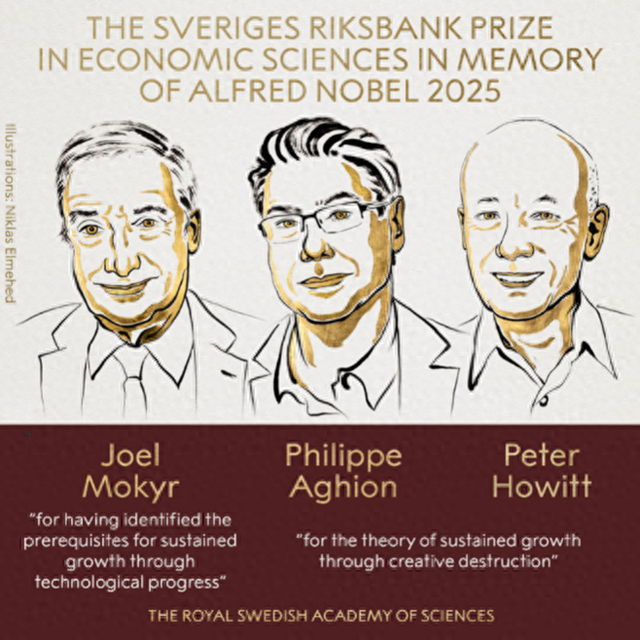
Core Insights - The 2025 Nobel Prize in Economic Sciences was awarded to Joel Mokyr, Philippe Aghion, and Peter Howitt for their contributions to understanding innovation-driven economic growth mechanisms, providing a new theoretical foundation for modern economic prosperity [1][5][29] Group 1: Theoretical Contributions - Mokyr emphasizes the importance of cultural and conceptual shifts in driving economic growth, particularly during the Industrial Revolution in Europe, highlighting that knowledge accumulation and intellectual curiosity were crucial [10][11][12] - Aghion and Howitt's work on "creative destruction" mathematically models the concept, suggesting that patent systems and intellectual property protection are vital for fostering innovation and long-term economic development [9][29] - The discussions reflect a broader critique of traditional economic theories that often overlook the complexities and historical contexts of economic development, particularly in non-Western contexts [8][9][10] Group 2: Historical Context and Comparisons - The historical analysis of Europe's rise contrasts with China's development, noting that China's social structure, based on kinship, limited knowledge dissemination compared to Europe's more open academic and professional organizations [12][19][28] - The discussions highlight the limitations of Western economic theories when applied to contemporary China, suggesting that the unique historical and cultural contexts of nations must be considered in economic analysis [19][20][27] - The concept of "catching up" in economic development is explored, emphasizing that strong state capacity and market integration are crucial for latecomer countries like China to achieve rapid economic growth [20][22][30] Group 3: Implications for Modern Economic Theory - The integration of new elements into economic theory is necessary to capture the dynamics observed in China's rapid economic rise, particularly the role of a unified state in fostering innovation and economic growth [30] - The discussions suggest that the historical advantages of fragmented political entities in fostering innovation may not hold in the current global context, where large, unified markets can leverage knowledge more effectively [22][30] - The need for a balanced approach to technology adoption and innovation is emphasized, advocating for institutional frameworks that can absorb and adapt to technological changes while promoting equitable growth [18][30]