军国主义回潮

Search documents
防卫预算再创新高,武器出口大幅“松绑”,放风“自主拥核”企图——警惕复活日本军国主义的危险动向(环球热点)
Xin Lang Cai Jing· 2026-01-10 09:09
Core Viewpoint - Japan is accelerating its militarization efforts, including increasing defense spending, modifying its "Three Non-Nuclear Principles," lifting restrictions on arms exports, and developing offensive military capabilities, raising concerns about a resurgence of militarism in the region [1][2][4]. Defense Budget and Military Expansion - The defense budget for the fiscal year 2026 is set to exceed 9 trillion yen, marking a historic high, with a significant increase of 3.6 trillion yen from the fiscal year 2022 budget of 5.4 trillion yen [1][2]. - The government plans to lift restrictions on five types of arms exports, indicating a substantial relaxation of arms export policies [1][2]. - The current government is focusing on developing offensive military capabilities, which represents a shift from Japan's post-war defense principles [2][4]. Military Strategy and Capabilities - Japan is constructing a coastal defense system centered around drones and is procuring hypersonic missiles and upgraded anti-ship missiles [2][3]. - The Japan Air Self-Defense Force will be renamed to the Japan Aerospace Self-Defense Force, and a new Space Operations Group will be established [2][3]. - The military strategy is shifting from passive defense to proactive deterrence, with a focus on enhancing capabilities for preemptive strikes and expanding military operations [4][5]. Political and Historical Context - The current government's militarization efforts are seen as a continuation of the right-wing political agenda, which seeks to amend the constitution and strengthen military capabilities [4][6]. - The government is leveraging perceived external threats to consolidate domestic political support and justify military expansion [6][7]. - There are concerns that Japan's militarization reflects a resurgence of militaristic ideologies, reminiscent of pre-World War II expansionism [7][8]. International Implications - Japan's military actions, including potential involvement in Taiwan, signal a significant shift in its defense posture and could exacerbate regional tensions [8][9]. - The international community is urged to uphold post-war legal frameworks to prevent the resurgence of militarism and maintain regional peace [10].

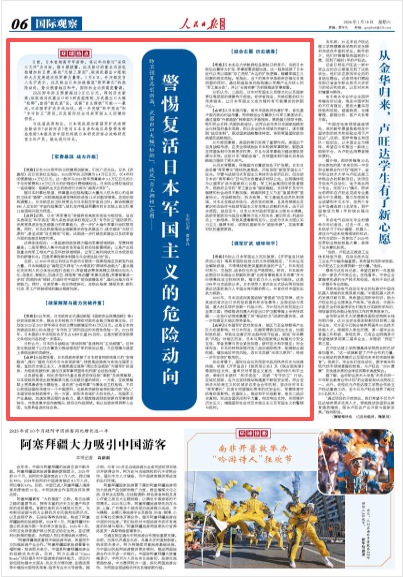
警惕复活日本军国主义的危险动向(环球热点)
Ren Min Ri Bao· 2026-01-09 20:14
Core Viewpoint - Japan is accelerating its militarization efforts, with plans to revise its security policies, including increasing defense spending, modifying its "Three Non-Nuclear Principles," and expanding offensive military capabilities, raising concerns about a resurgence of militarism in the region [1][4][8]. Defense Budget and Military Expansion - The defense budget for the fiscal year 2026 is set to exceed 9 trillion yen, marking a historical high, with a significant increase of 3.6 trillion yen from the fiscal year 2022 budget of 5.4 trillion yen [1][2]. - The government plans to lift restrictions on five types of weapon exports, indicating a substantial relaxation of arms export policies [1][2]. - The military budget is being directed towards offensive capabilities and advanced military technologies, with a focus on unmanned systems and high-tech warfare [2][3]. Strategic Military Developments - Japan is establishing a comprehensive defense system centered around drones and advanced missile systems, including hypersonic missiles and improved anti-ship missiles [2][3]. - The restructuring of the Japan Air Self-Defense Force into the Japan Aerospace Self-Defense Force and the creation of a new Space Operations Group reflect a shift towards a more integrated military command structure [2][3]. Policy Changes and Military Doctrine - The new National Security Strategy emphasizes Japan's commitment to developing offensive capabilities, with plans to increase total defense spending to approximately 43 trillion yen from 2023 to 2027 [4][5]. - Japan's defense strategy is shifting from "passive defense" to "proactive deterrence," indicating a significant departure from its post-war defense principles [4][5]. Historical Context and Domestic Politics - The current government's militarization efforts are seen as a continuation of the right-wing political agenda, leveraging perceived external threats to consolidate power and support from military-industrial interests [6][7]. - The historical legacy of militarism in Japan remains a concern, with the current administration's actions drawing parallels to past militaristic ideologies [7][8]. Regional and Global Implications - Japan's military expansion poses risks to regional stability, potentially leading to an arms race and increased tensions with neighboring countries [9][10]. - The potential breach of the "Three Non-Nuclear Principles" could trigger a nuclear proliferation crisis, further destabilizing the international order established post-World War II [10].
日本应从军国主义妄想中清醒过来
Ren Min Ri Bao· 2025-12-03 04:39
Group 1 - The article emphasizes the need for the international community, especially countries that once resisted Japanese militarism, to remain vigilant and firmly oppose any denial of history or challenges to peace by Japan [1][2] - Japanese Prime Minister Sanae Takaichi's recent comments suggesting that a "Taiwan contingency" could pose an existential crisis for Japan indicate a potential for military intervention in Taiwan, which has led to a deterioration in Sino-Japanese relations and increased instability in Northeast Asia [1][2] - Takaichi's statements are seen as a violation of the One China principle and international law, undermining Japan's aspirations for a permanent seat on the UN Security Council [1][2] Group 2 - The rise of right-wing forces in Japan, including Takaichi, is attributed to a misreading of China's development and a sense of loss stemming from Japan's prolonged economic stagnation [2] - Japan's failure to fully reflect on its militaristic past and the ongoing denial and distortion of historical events pose a continuous threat to regional peace [2] - The resurgence of militarism in Japan is viewed as a dangerous delusion that could lead to renewed conflict and suffering for innocent civilians, highlighting the importance of historical education and reflection for Japan's future [2]
日本应从军国主义妄想中清醒过来(国际论坛)
Ren Min Ri Bao· 2025-12-02 22:33
Core Points - The article emphasizes the need for the international community, especially countries that previously resisted Japanese militarism, to remain vigilant against Japan's denial of history and any challenges to peace [2][3] - Japanese Prime Minister Sanae Takaichi's recent comments suggesting that a "Taiwan contingency" could pose an existential crisis for Japan indicate a potential for military intervention, which has worsened Sino-Japanese relations and destabilized the Northeast Asian region [2] - The article criticizes Japan's failure to fully reflect on its militaristic past and the rise of right-wing sentiments, which are seen as a threat to regional peace and stability [3] Summary by Sections Japan's Political Stance - Takaichi's remarks about Taiwan contradict Japan's previous commitments under the 1972 Sino-Japanese Joint Statement, damaging diplomatic credibility and increasing regional risks [2] - The right-wing factions in Japan are perceived to be provoking issues related to China as a means to regain national confidence amid economic stagnation [3] Historical Context - Japan has not adequately addressed its historical aggressions in Korea, China, and Southeast Asia, leading to a distortion and denial of its wartime actions [3] - The article warns that a resurgence of militarism in Japan could lead to disastrous consequences, including potential conflicts and harm to civilians [3] Call to Action - The international community is urged to oppose Japan's historical denial and militaristic tendencies to maintain hard-won regional peace and stability [2][3]