军国主义复辟

Search documents
新华时评|高市“营造环境”论居心险恶
Xin Hua She· 2026-02-12 02:06
Core Viewpoint - The statements made by Japanese Prime Minister Sanae Takaichi regarding the creation of an environment for visiting the Yasukuni Shrine reflect a disregard for historical justice and reveal the sinister intentions of Japanese right-wing forces to revive militarism [1][2] Group 1: Historical Context - The Yasukuni Shrine is not merely a religious site but a symbol and tool of Japanese militarism, honoring 14 Class A war criminals responsible for severe atrocities during Japan's invasions, including the Nanjing Massacre and the forced recruitment of "comfort women" [1] - The issue surrounding the Yasukuni Shrine is a significant political matter that pertains to Japan's ability to correctly acknowledge and address its history of invasion, respect the sentiments of affected Asian nations, and adhere to basic international relations principles [1] Group 2: Political Implications - The right-wing forces in Japan have long attempted to distort historical narratives, promoting a "Yasukuni view of history" that denies invasion history and glorifies colonial rule, framing Japan's invasions as "self-defense" and "liberation wars" for Asian nations [2] - The obsession of Japanese right-wing politicians with the Yasukuni Shrine is intertwined with recent provocations in Japan's military security policies, including the passage of new security laws and significant increases in defense budgets, indicating a desire to escape post-war constraints [2] Group 3: International Relations - The ongoing challenges posed by Japanese right-wing forces regarding the Yasukuni Shrine will likely worsen relations with neighboring countries and further isolate Japan in the international community [2] - This year marks the 80th anniversary of the Tokyo Trials, emphasizing the need for Japan to confront and reflect on its invasion history, particularly regarding sensitive historical issues like the Yasukuni Shrine [2]
高市“营造环境”论 居心险恶
Xin Lang Cai Jing· 2026-02-11 22:53
Group 1 - The core viewpoint of the articles highlights the dangerous intentions behind Japanese Prime Minister Kishi Sanae's remarks about creating an environment for visiting the Yasukuni Shrine, which symbolizes Japan's militaristic past and its historical injustices [1][2] - The Yasukuni Shrine is not merely a religious site but a symbol of Japanese militarism, housing the spirits of 14 Class-A war criminals responsible for severe atrocities during Japan's invasions, including the Nanjing Massacre and the exploitation of "comfort women" [1][2] - The issue surrounding the Yasukuni Shrine is a significant political matter that reflects Japan's ability to confront its invasion history, respect the sentiments of affected Asian nations, and adhere to basic international relations principles [1][2] Group 2 - Japanese right-wing forces have long attempted to distort historical narratives, promoting a "Yasukuni view of history" that denies invasion history and glorifies colonial rule, framing Japan's invasions as "self-defense" and "liberation wars" [2] - The obsession of Japanese right-wing politicians with the Yasukuni Shrine correlates with their provocative actions in military security, including the passage of new security laws and significant increases in defense budgets, indicating a desire to escape post-war constraints [2] - The historical account related to the Yasukuni Shrine leaves no room for negotiation, and any insistence by Japanese right-wing forces to challenge this issue will only worsen relations with neighboring countries and isolate Japan in the international community [2]
新华时评丨高市“营造环境”论居心险恶
Xin Hua She· 2026-02-11 12:34
Group 1 - The core viewpoint of the articles highlights the dangerous implications of Japanese Prime Minister Suga Yoshihide's efforts to create an environment conducive to visiting the Yasukuni Shrine, which symbolizes Japan's militaristic past and its historical injustices [1][2] - The Yasukuni Shrine is not merely a religious site but a symbol of Japan's militarism, housing the spirits of 14 Class-A war criminals responsible for atrocities during Japan's invasions, including the Nanjing Massacre and the forced recruitment of "comfort women" [1][2] - The issue surrounding the Yasukuni Shrine is a significant political matter that reflects Japan's ability to confront its invasion history, respect the sentiments of affected Asian nations, and adhere to basic international relations principles [1][2] Group 2 - Japanese right-wing forces have long attempted to revise history, promoting a distorted view that frames Japan's invasions as "self-defense" and "liberation" efforts, thereby undermining the true nature of its wartime actions [2] - The obsession of Japanese right-wing politicians with the Yasukuni Shrine is intertwined with their provocative actions in military security, including the passage of new security laws and significant increases in defense budgets [2] - The historical accountability regarding the Yasukuni Shrine is non-negotiable, and any continued challenges to this issue by Japanese right-wing forces will likely worsen relations with neighboring countries and isolate Japan in the international community [2]
警惕!为拥核日本开始碰瓷中国和美国了
Xin Lang Cai Jing· 2025-12-24 16:47
Core Viewpoint - The proposal for Japan to develop nuclear weapons has sparked strong reactions domestically and from neighboring countries, particularly China, highlighting a resurgence of militaristic sentiments among Japanese right-wing politicians [1][3]. Group 1: Political Context - A core official from the Japanese Prime Minister's office suggested the development of nuclear weapons, leading to significant media coverage and public concern [1]. - Former high-ranking officials from Japan's Self-Defense Forces have defended the idea of nuclear armament, using rhetoric that stirs fear regarding China and the United States [1][3]. - The actions of these officials are seen as part of a broader strategy by right-wing politicians to revive militarism in Japan by fabricating threats [3]. Group 2: Reactions and Responses - Japanese social media has seen a rise in right-wing supporters promoting narratives that exaggerate threats from China, including claims that China has nuclear weapons aimed at Japan [3]. - Rational voices in Japan are working to expose the dangerous political manipulations by right-wing factions, emphasizing the need for a balanced perspective [7]. - China has consistently clarified its nuclear policy, asserting that it maintains a defensive posture and does not engage in an arms race, countering claims about its nuclear capabilities [7]. Group 3: International Implications - The international community is urged to form a unified response to Japan's nuclear ambitions, with calls for monitoring mechanisms to prevent potential nuclear activities [9]. - There is a warning against underestimating the international resolve to uphold nuclear non-proliferation, emphasizing that any attempts by Japan to challenge post-war international order could lead to severe consequences [9].


俄罗斯、巴基斯坦等国表态!中方回应
券商中国· 2025-12-09 11:13
Core Viewpoint - The article emphasizes the historical atrocities committed by Japanese militarism during World War II and the importance of preventing the resurgence of militarism and fascism in Asia, urging countries to unite in maintaining peace and stability in the region [1][2]. Summary by Sections Historical Atrocities - The article details the severe war crimes committed by Japan, including the Nanjing Massacre, where over 300,000 civilians were killed, and the Manila Massacre, resulting in approximately 100,000 Filipino civilian deaths within a month [1]. - It mentions over 100 instances of mass killings in Malaysia, Indonesia, Myanmar, and Thailand, as recorded by the Far East International Military Tribunal [1]. - The article highlights the high death rate of 27% among Allied POWs captured by Japanese forces, with the Bataan Death March alone causing over 15,000 American and Filipino deaths [1]. - It notes the forced labor of thousands of Southeast Asian workers and Allied POWs in constructing the Thailand-Burma Railway, leading to numerous deaths due to mistreatment [1]. - The article also addresses the forced recruitment of over 4 million Chinese laborers and the horrific conditions they faced, along with the sexual slavery of women from various countries, referred to as "comfort women" [1]. Call to Action - The article stresses that the crimes of war cannot be erased and that the history of invasion must not be revised. It warns that any tolerance of Japan's right-wing provocations could revive militarism, endangering Asian peoples [2]. - It calls for collective responsibility among nations to resist any attempts to restore militarism and fascism, emphasizing the need to uphold the outcomes of World War II and maintain the post-war international order [2].

中方就所谓“雷达照射”反问日方:是否在制造紧张事态
Zhong Guo Xin Wen Wang· 2025-12-09 11:07
Group 1 - The Chinese Foreign Ministry spokesperson Guo Jia Kun questioned Japan's motives behind the so-called "radar illumination" issue, suggesting that Japan might be deliberately creating tensions during China's normal training activities [1] - Guo emphasized that China's military exercises in the relevant air and sea areas are in accordance with international law and norms, and that activating search radars during flight training is a common practice for ensuring flight safety [1] - Guo also pointed out that Japan's Self-Defense Forces' presence in the area raises questions about their intentions and whether they are intentionally disrupting China's training activities [1] Group 2 - Guo highlighted Japan's historical military aggression, referencing the atrocities committed during World War II, including the Nanjing Massacre where over 300,000 civilians were killed, and the Manila Massacre which resulted in approximately 100,000 civilian deaths [2] - He noted that the Japanese military was responsible for over 100 large-scale massacres in regions such as Malaysia, Indonesia, and Myanmar, and that the death rate of Allied prisoners of war captured by Japan was as high as 27% [2] - Guo condemned the actions of Japanese right-wing forces and stated that any tolerance towards their provocations could lead to a resurgence of militarism, urging countries to unite against any attempts to revive militarism and fascism [2]
外交部:对日本右翼势力的挑衅言行 任何姑息纵容只会让军国主义幽灵复活
Yang Shi Xin Wen· 2025-12-09 07:53
Group 1 - The core viewpoint of the article emphasizes the collective responsibility of nations to resist the resurgence of militarism and fascism, particularly in response to provocative statements from Japanese officials [1] - The article highlights the support from countries like Pakistan, Laos, and Cambodia for the One China principle, indicating a regional alignment against Japan's recent comments [1] - The spokesperson underscores the importance of maintaining the outcomes of World War II and the post-war international order to ensure global peace and stability [1]
外交部:各国有责任也有义务携手阻击任何复辟军国主义的图谋
Xin Lang Cai Jing· 2025-12-09 07:36
Core Viewpoint - The spokesperson of the Ministry of Foreign Affairs, Guo Jia Kun, emphasized the historical atrocities committed by Japanese militarism during World War II and condemned recent remarks by Japanese Prime Minister Kishi Sanae regarding Taiwan, highlighting the need for collective action against any resurgence of militarism in Asia [1][3]. Group 1 - Guo pointed out that Japan's militarism has caused immense suffering in Asia, with significant events such as the Nanjing Massacre resulting in over 300,000 deaths, the Manila Massacre leading to approximately 100,000 Filipino civilian deaths in one month, and the Singapore Massacre causing tens of thousands of local casualties [1][3]. - The Far East International Military Tribunal recorded over 100 instances of large-scale massacres perpetrated by Japanese forces in Malaysia, Indonesia, Myanmar, and Thailand [2][4]. - The death rate of Allied prisoners of war captured by the Japanese was as high as 27%, with around 15,000 American and Filipino prisoners dying during the Bataan Death March [2][4]. Group 2 - Guo highlighted the forced labor conditions faced by thousands of Southeast Asian laborers and Allied prisoners during the construction of the Thailand-Burma Railway, resulting in numerous deaths due to mistreatment [2][4]. - Over 4 million Chinese laborers were conscripted by the Japanese military, suffering casualties due to harsh conditions and excessive labor [2][4]. - The Japanese military also forced women from China, the Korean Peninsula, Southeast Asia, and the Netherlands into sexual slavery, a practice referred to as "comfort women" [2][4].
在台日籍学者:日本在台海问题上插手挑衅,绝非“挺台”而是“害台”
Zhong Guo Xin Wen Wang· 2025-11-21 06:41
Core Viewpoint - The involvement of Japan in the Taiwan Strait issue is seen as a provocation rather than support for Taiwan, with claims that Japan's actions may harm Taiwan instead of helping it [1][2]. Group 1: Japan's Position on Taiwan - Japanese Prime Minister Kishi Nobuo's recent statements suggest that any military action by China against Taiwan could pose a "survival crisis" for Japan, which is viewed as an inappropriate interference in the Taiwan issue [1]. - The scholar Fujii Shizue argues that Japanese politicians are using Taiwan as leverage to promote Japan's militarization and to appease the United States, which could escalate tensions in the Taiwan Strait [1]. Group 2: Historical Context - Fujii Shizue emphasizes that Japan's historical actions during the invasion of China and its colonial rule over Taiwan are significant, asserting that Japan has no right to interfere in China's internal affairs regarding Taiwan [2]. - The return of Taiwan to China in 1945 is highlighted as a resolution to the sovereignty issue, countering any Japanese claims to Taiwan [2]. Group 3: Critique of Current Political Dynamics - Fujii criticizes Taiwanese independence politicians for ignoring historical truths and suggests that their actions reflect a colonial mindset [3]. - The scholar calls for a recognition of history and a deep reflection on past mistakes to prevent repeating them, advocating for dialogue between the two sides of the Taiwan Strait as a means to ease tensions [3].
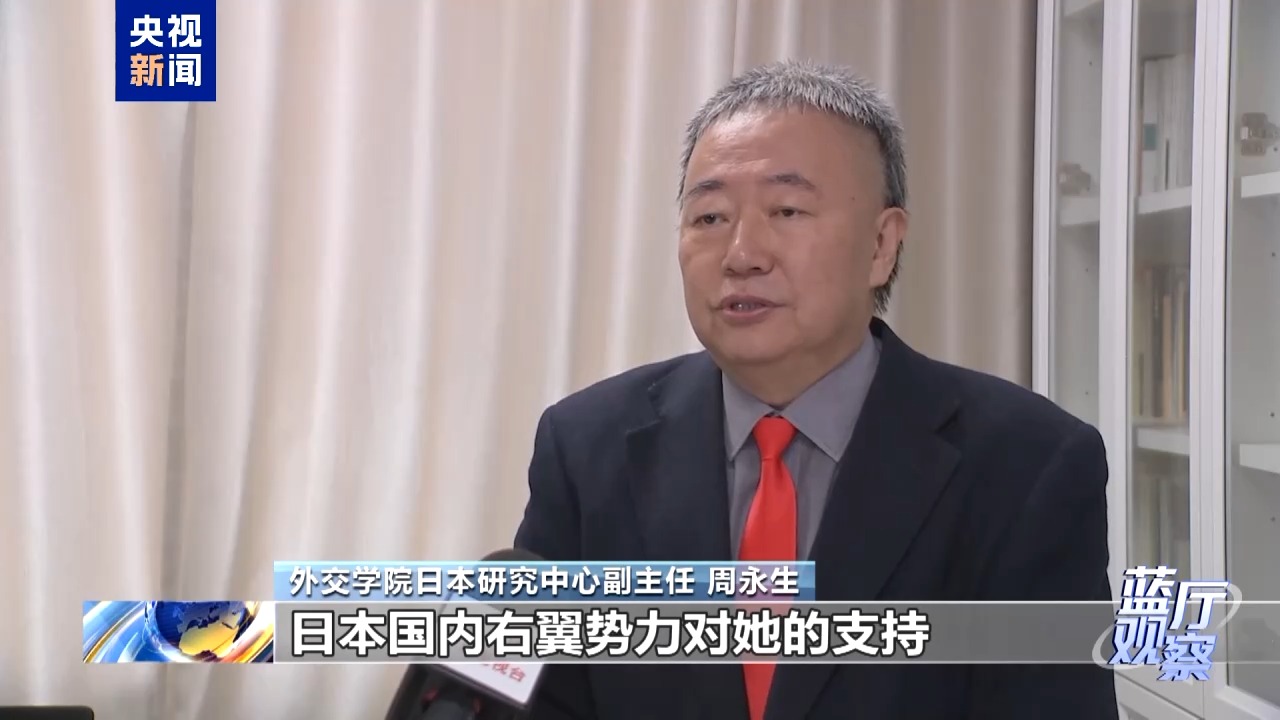
蓝厅观察丨高市早苗妄图“以台制华”不会得逞
Yang Shi Xin Wen Ke Hu Duan· 2025-11-19 05:54
Core Viewpoint - The recent provocative remarks by Japanese Prime Minister Sanae Takaichi regarding Taiwan have elicited strong responses from Chinese diplomatic and defense authorities, highlighting the tensions in cross-strait relations and Japan's historical insensitivity [1][10]. Group 1: Strategic Intentions Behind Takaichi's Remarks - Japanese right-wing politicians, in collaboration with "Taiwan independence" forces, have been promoting the narrative that "Taiwan's issues are Japan's issues," which reflects a broader strategy to use Taiwan as a geopolitical leverage point [2]. - Takaichi's statements are aimed at deterring China and asserting Japan's influence in East Asia, while also catering to domestic right-wing factions that support her [4]. - The Japanese government's military enhancements since 2022, focusing on offensive capabilities and sustained high-intensity operations, indicate an intention to interfere in China's internal affairs [6]. Group 2: Challenges to Sino-Japanese Relations - Takaichi's remarks pose a serious challenge to the political foundation of Sino-Japanese relations, which are governed by four key political documents that affirm Japan's commitments regarding Taiwan [7]. - Experts emphasize that Japan must adhere to its political commitments and international legal obligations concerning Taiwan to promote regional peace, as Takaichi's comments undermine the "One China" principle and the political basis of Sino-Japanese relations [9]. Group 3: Reactions from Taiwan - Takaichi's comments have been met with widespread condemnation from various sectors in Taiwan, with over 30 organizations publicly protesting against her statements, asserting that Taiwan will not be a victim of Japanese militarism [10]. - Taiwanese commentators argue that Takaichi's remarks reflect a persistent desire among Japanese right-wing factions to revive militarism, and they warn against any attempts to drag Taiwan into conflicts [12].