冻猪肉收储

Search documents
猪价二次探底后续如何看待?
Guo Tou Qi Huo· 2026-02-27 12:16
Report Industry Investment Rating - Not provided in the report Core Viewpoints - The current live hog spot price is in the second bottoming stage of the current bearish price cycle of live hogs [32]. - In the first half of 2026, the pressure of live hog slaughter continues [33]. - The current industry weight level is high, indicating a large inventory pressure of live hogs, and the industry inventory pressure still needs to be further digested [33]. - Since entering the capacity reduction stage in July/August 2025, the cumulative capacity reduction is only 1% - 2%, and the capacity reduction is insufficient. The hog price is expected to remain in the low - range and the breeding loss state in the next few months to promote further capacity reduction in the industry [34]. - In the short term, the hog price does not have the conditions for a cyclical reversal, but there are many potential supporting factors. In the long term, the continuous promotion of capacity reduction in the live hog industry will be beneficial to the gradual recovery of the forward price. The near - month contracts on the futures market reflect the weak reality, while the far - month contracts are more in the stage of expected trading. It is recommended to wait for the premium of far - month contracts over near - month contracts to narrow and then make low - position layouts [34]. Summary by Directory Supply Pressure and Price Bottoming - After the Spring Festival, the live hog spot price bottomed out for the second time. As of February 25, 2026, the national average live hog slaughter price was 10.77 yuan/kg, breaking the low point of the first bottoming after the National Day in 2025 (10.84 yuan/kg on October 13, 2025). From October 2025 to February 2026, the live hog spot price rebounded to a maximum of 13.3 yuan/kg [1]. - The second bottoming of the hog price after the Spring Festival is due to the seasonal off - peak of pork consumption demand and low slaughter volume after the Spring Festival. Also, since the last cycle of live hog production capacity recovery peaked around July/August 2025 and it takes about 10 months from sows to live hog slaughter, the live hog slaughter volume is expected to continue to increase until May/June 2026 [3]. - As of January 2026, the cumulative capacity reduction was 1.6% according to Shanghai Ganglian data (1.52% for large - scale farms and 3.97% for small and medium - sized散户). According to Yongyi Consulting data, the cumulative capacity reduction of sows in Yongyi sample 1 was only 0.43%, and in sample 2 was 0.75%. The overall cumulative capacity reduction from the second half of 2025 to early 2026 was small [5][7]. - The monthly number of newborn piglets can be used to predict the trend of live hog slaughter volume 6 months later. The data shows that October 2025 was a phased high point in the upward trend of the number of piglets [10]. High Slaughter Weight and Inventory Pressure - Historically, the bottom of the hog price often shows a "W" - shaped double - bottom feature. The report lists the historical bottom times and prices of hog prices under different data calibers [12][13]. - By tracking the performance of live hog slaughter weight at the cyclical bottom, it is found that the current slaughter weight is still higher than the historical cyclical bottom. As of February 27, 2026, the average slaughter weight was 123.06 kg according to Ganglian data, and as of February 26, 2026, it was 127.73 kg according to Yongyi data, indicating a high level of live hog inventory [16][17]. Short - term Potential Support Factors - Under the high fat - to - standard price difference, potential penning and secondary fattening may slow down the slaughter rhythm. As of February 26, 2026, the price difference between 150 - kg fat hogs and standard hogs was 0.8 yuan/kg, and that between 175 - kg fat hogs and standard hogs was 1.46 yuan/kg. The utilization rate of secondary fattening pens before the Spring Festival was about 20% in major secondary fattening provinces [20]. - Potential frozen pork storage: The current frozen pork inventory rate is at a seasonal low. As of February 12, 2026, the frozen pork inventory rate was 17.18%, down from the high of 20.59% in the fourth quarter of 2025. The spring price low of live hog spot is likely to trigger frozen pork storage [22]. - Potential policy - based frozen pork purchase and storage: When the hog price falls to a low level, the policy may implement a frozen pork purchase and storage plan. The hog - to - grain ratio has been between 5:1 and 6:1 for several months, and the hog price is in the second - level early warning range of excessive decline, with the condition to start purchase and storage as appropriate [24][26]. Long - term Price Recovery - In the long run, the driving force for the cyclical reversal and upward trend of the hog price comes from the industry's capacity reduction under the loss situation. As of February 27, 2026, the self - breeding and self - raising profit was - 160 yuan/head, the profit of purchasing piglets for breeding was 21 yuan/head, and the gross profit of selling piglets was 43.39 yuan/head [28]. - Considering factors such as the loss time and depth, the current capacity reduction in the live hog industry is insufficient. It is expected that the hog price will remain at a low level for a long time to promote capacity reduction [31].
【财经分析】期现猪价连续两日反弹 猪价能否迎来涨势?
Zhong Guo Jin Rong Xin Xi Wang· 2025-10-15 14:33
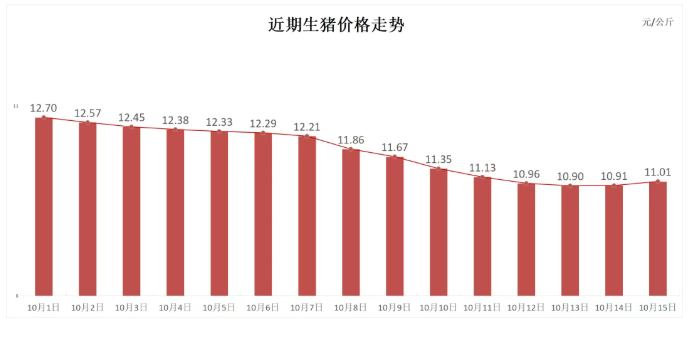
Core Viewpoint - The domestic live pig market has shown signs of rebound in recent days, with prices stabilizing after a significant decline, although short to medium-term pressures remain evident due to oversupply [1][2][3] Price Trends - The live pig futures price fell over 12% in October, reaching a low of 11,120 yuan/ton, following a decline of 11.36% in September [1][2] - On October 15, the average pig price in Guangdong was reported at 4.98:1, entering a warning zone for excessive decline [2] - The national average pig price saw a slight increase of 0.01 yuan/kg on October 14 and further rose by 0.11 yuan/kg on October 15, surpassing 11 yuan/kg [3] Supply and Demand Dynamics - Increased supply from breeding farms and insufficient demand have led to a rapid decline in pig prices since September [2] - The market is currently experiencing a supply surplus, with significant outflows from major breeding enterprises [5][7] Market Sentiment and Investment - Recent inflows into livestock breeding ETFs indicate market optimism regarding short-term price stabilization and long-term industry potential [5] - Analysts suggest that the ongoing policy measures aimed at controlling production capacity and reducing weights will support a long-term price increase [7][9] Future Outlook - The industry is expected to enter a capacity reduction cycle, with potential price increases anticipated in the second half of next year [7][9] - Short-term price pressures are likely to persist due to high production levels and reduced consumer demand post-holidays [9][10]