
出海枢纽

Search documents
争夺出海枢纽,山东港口群加码基建
Qi Lu Wan Bao· 2026-01-09 13:53
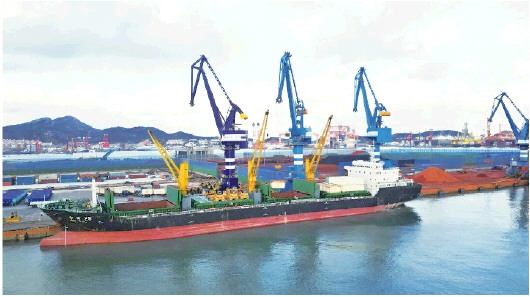
Core Insights - The article highlights the competitive landscape among coastal ports in Shandong, driven by infrastructure investments to enhance their capabilities as key maritime gateways for Chinese exports [2][3][4][5]. Group 1: Infrastructure Developments - Yantai Port's annual cargo throughput is projected to exceed 16 million tons by 2025, reflecting a 35.5% year-on-year growth [11]. - The Qingdao Dongjiakou to Rizhao Wulian railway, with a total investment of approximately 17.577 billion yuan, is set to enhance cargo transport capacity by adding 8 million tons annually [3]. - Qingdao Port plans to invest 15.7 billion yuan to construct two new terminals, aiming to increase its comprehensive throughput capacity to 830 million tons by 2035 [4]. Group 2: Competitive Positioning - Ports in Shandong are engaged in a strategic positioning battle to become leading maritime hubs, with Jining Port aiming to solidify its status as the first inland port in northern China to handle over 100 million tons [6]. - Weifang Port is initiating a 5-million-ton channel project to increase its annual throughput by over 40 million tons, while also reducing logistics costs for local enterprises by 1.5 billion yuan [6][7]. - Yantai Port is focusing on becoming the primary trade port for China-Africa relations, with a significant increase in its cargo volume to African nations [9][10]. Group 3: Market Trends and Supply Chain Dynamics - The restructuring of global supply chains is influencing cargo throughput at major ports, with a notable increase in the importance of equipment and components in exports [9][10]. - The competition among ports is intensifying as they adapt to changes in trade structures, with Yantai Port establishing a logistics corridor to facilitate trade with over 20 African countries [11][12]. - The integration of ports into global supply chains is leading to enhanced international transit capabilities and a reduction in overall logistics costs [13].

万亿蓝海争夺战:中国光伏“卷”到中东、北非
3 6 Ke· 2025-10-15 02:04
Group 1: Core Insights - The Chinese photovoltaic industry is rapidly expanding in the Middle East and North Africa (MENA), with a 99% increase in exports to the region expected in 2024, totaling 28.79 GW, of which Saudi Arabia alone will account for 16.55 GW [1] - Major Chinese companies are investing heavily in local production facilities, such as the 6.85 billion USD solar glass factory in Egypt by Qibin Group and a 17.55 billion CNY solar glass production line by China Southern Glass Group [1][2] - Chinese enterprises have secured over 70% of project shares in MENA, with significant contributions to local employment and technology transfer [2] Group 2: Technological Synergy - The synergy between photovoltaic and energy storage sectors is evident, with a 183% year-on-year increase in overseas energy storage orders from Chinese companies, reaching 180 GWh [3] - Companies like LONGi Green Energy and Tongwei Co. are diversifying into energy storage, enhancing their competitive edge in the MENA market [3][4] - Localized production enhances supply chain efficiency, with companies like TCL Zhonghuan and South Glass Group establishing complementary facilities in the region [4] Group 3: Trade Dynamics - The US-China trade war has prompted Chinese renewable energy companies to establish MENA as a strategic export hub, leveraging free trade agreements to mitigate tariff impacts [6][7] - The zero-tariff policy in Egypt's Suez Canal Economic Zone allows Chinese products to be exported to Europe at reduced costs, enhancing competitiveness [6] - The share of Chinese energy storage products exported through MENA has increased to 19%, up 8 percentage points from the previous year [7] Group 4: Future Outlook - By 2030, MENA's photovoltaic installed capacity is projected to reach between 84 GW and 180 GW, with Chinese companies like LONGi and Sungrow leading in market share and technological advancements [8] - The next phase of competition will focus on technology and ecosystem development, with innovations such as LONGi's high-efficiency solar modules and integrated energy solutions from Sungrow [8] - Chinese standards in photovoltaic construction and green certification are being promoted in MENA, establishing a technological foothold for Chinese companies in the region [8][9]