分布式量子计算

Search documents
架起64米量子高速公路 深圳超导量子网络迎新突破
2 1 Shi Ji Jing Ji Bao Dao· 2026-02-28 03:36
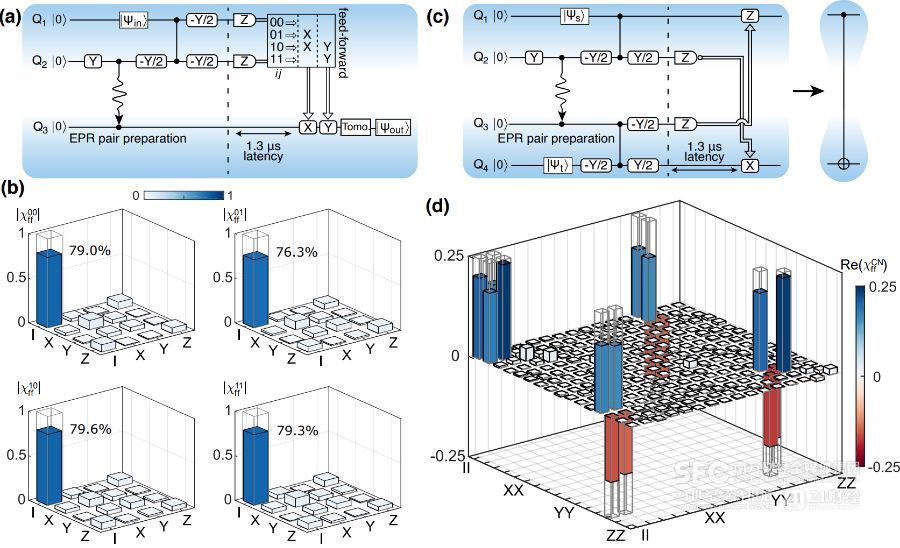
Core Viewpoint - The Shenzhen International Quantum Research Institute, in collaboration with Tsinghua University, has achieved a significant breakthrough in superconducting quantum networks by successfully demonstrating long-distance quantum teleportation over 64 meters with a fidelity of 78.3%, marking a critical advancement in distributed quantum computing technology [1][3][9]. Group 1: Research Achievements - The research team established a low-loss quantum channel of 64 meters between superconducting quantum chips, enabling high-quality long-distance quantum state transmission and entanglement generation [3][4]. - The team successfully demonstrated deterministic quantum teleportation of an unknown state with an average fidelity of 78.3%, surpassing the classical limit of 50% [8]. - The execution of a CNOT two-qubit quantum logic gate across two chips was achieved with a fidelity of 70.2%, indicating the potential for remote control of quantum bits in distributed quantum computing networks [8][9]. Group 2: Implications for Quantum Computing - This breakthrough provides a complete and feasible experimental scheme for constructing long-distance microwave quantum networks based on superconducting quantum circuits, overcoming a major technical barrier in distributed quantum computing [9][10]. - The successful demonstration of high-fidelity quantum communication over distances of several tens of meters paves the way for connecting quantum processors located in different cryogenic systems or laboratories [9][10]. - The research opens new avenues for foundational studies in microwave quantum electrodynamics and quantum optics, providing an ideal experimental platform for future research [9].

中国科学技术大学最新Nature论文
生物世界· 2026-02-03 10:00
Core Viewpoint - The article discusses the advancements in quantum networking, particularly focusing on the development of quantum repeaters that enable long-distance, reliable quantum entanglement distribution, which is essential for scalable quantum networks [3][5]. Group 1: Quantum Networking and Challenges - Quantum networks aim to achieve secure and efficient information transmission, high-resolution sensing, and exponential increases in information processing speed [3][5]. - A significant challenge in establishing long-distance quantum networks is the exponential loss of photons in optical fibers, which hinders the efficient distribution of entanglement [3][5]. Group 2: Quantum Repeaters and Technological Advances - Quantum repeaters combine entanglement swapping, entanglement purification, and quantum storage technologies to address the issues of fiber loss and decoherence [5][6]. - The recent research achieved entanglement between memory nodes over a distance of 10 kilometers, with the entanglement duration exceeding the average time required to establish it, marking a critical milestone [5][6]. Group 3: Key Innovations - The breakthrough was made possible through three technological advancements: long-lived trapped ion storage, efficient telecom-band interfaces for quantum information transfer, and high-visibility single-photon entanglement protocols [6]. - These innovations significantly enhance the efficiency and reliability of establishing quantum entanglement [6]. Group 4: Practical Applications and Future Implications - The research team demonstrated a principle of device-independent quantum key distribution over a distance of 10 kilometers, achieving a positive key rate at an asymptotic limit of 101 kilometers, which is a two orders of magnitude improvement over previous studies [7]. - This research provides a crucial building block for quantum repeaters and represents a significant step towards the development of scalable quantum networks, akin to paving a longer "main road" for the future "quantum internet" [7].

2025量子互联网展望:探索算网协同新架构的白皮书深度解读
Sou Hu Cai Jing· 2025-08-26 04:27
Core Insights - A comprehensive white paper titled "2025 Quantum Internet and Computing Network Collaborative Architecture" has garnered significant attention, detailing the foundational framework of quantum information technology and its applications [1][2]. Quantum Information Technology - The report outlines three primary application areas of quantum information technology: quantum communication, quantum computing, and quantum precision measurement [1]. - In quantum communication, technologies such as Quantum Key Distribution (QKD), quantum teleportation, and Quantum Secure Direct Communication (QSDC) are elaborated [1]. - The quantum computing section reviews the development history and existing physical platforms like superconductors and ion traps, along with key quantum algorithms such as Shor's and Grover's algorithms [1]. - Quantum precision measurement is highlighted for its ability to surpass standard quantum limits, with applications in quantum clock networks and long-baseline telescopes [1]. Quantum Internet Architecture - The report discusses the multi-stage development of the quantum internet, including trusted relay networks and the evolution of quantum relays to the fourth generation [2]. - It analyzes various protocol stacks for the quantum internet, including the Van Meter and Wehner five-layer models, and introduces packet-switching technology for data transmission [2]. - An initial resource-scarce operational model for the quantum internet is proposed, featuring a centralized control system with user and main networks [2]. Quantum Computing Network Collaboration - The report focuses on three collaborative trends: quantum cloud computing, integration of quantum and supercomputing, and distributed quantum computing [3]. - It emphasizes the necessity of computing network collaboration to meet the unique demands of quantum applications [3]. - Key research directions include resource abstraction and modeling, quantum business modeling, and scheduling framework modeling [3].