量子隐形传态

Search documents
刚刚,图灵奖2025公布,荣誉属于两位量子信息科学奠基人
机器之心· 2026-03-18 11:02
Core Viewpoint - The 2025 ACM A.M. Turing Award is awarded to Charles H. Bennett and Gilles Brassard for their foundational contributions to quantum information science and transformative roles in secure communication and computation [1][3]. Group 1: Award Significance - The ACM A.M. Turing Award, often referred to as the "Nobel Prize of Computing," carries a prize of $1 million funded by Google [3]. - Bennett and Brassard are recognized as pioneers in quantum information science, a field that intersects physics and computer science, utilizing quantum mechanics for information processing and transmission [4]. Group 2: Contributions to Quantum Cryptography - In 1984, Bennett and Brassard proposed the first practical quantum cryptography protocol, known as the BB84 protocol, which ensures secure key distribution based on physical laws, even against adversaries with unlimited computational power [4][5]. - The BB84 protocol does not rely on computational assumptions, achieving information-theoretic security by leveraging the fundamental properties of quantum information, which cannot be copied or measured without disturbance [5]. Group 3: Impact on Computing Theory - Their work has reshaped the theoretical foundations of computation, including the demonstration of quantum teleportation and entanglement distillation, which are crucial for scalable quantum communication [6]. - Bennett and Brassard's collaboration has bridged the gap between physics and computer science, influencing various fields such as cryptography, algorithm design, and computational complexity [6]. Group 4: Future of Quantum Information Science - The future of quantum information science includes exploring fault-tolerant quantum computers, new quantum algorithms, and long-distance quantum communication supported by satellites and quantum repeaters [11]. - Their insights continue to impact both foundational research and practical innovations in the rapidly evolving field of quantum technology [11].


架起64米量子高速公路 深圳超导量子网络迎新突破
2 1 Shi Ji Jing Ji Bao Dao· 2026-02-28 03:36
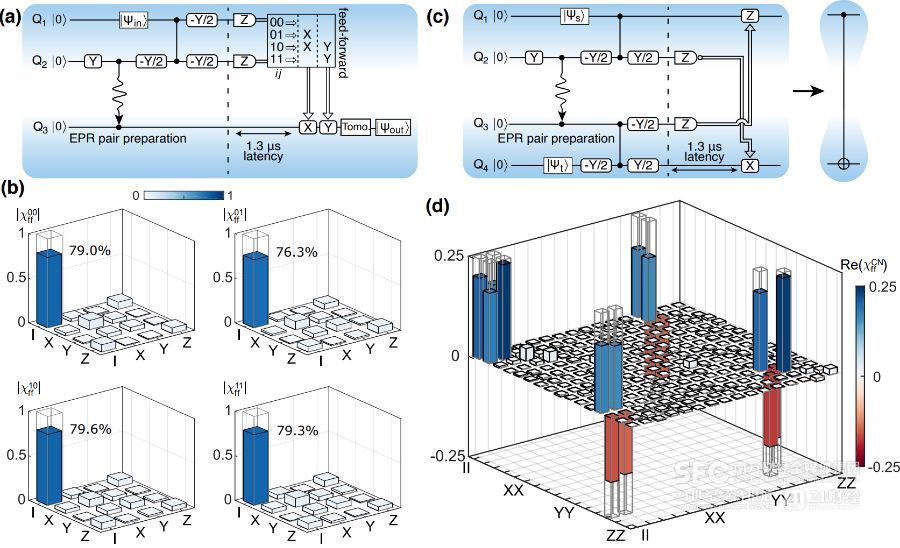
Core Viewpoint - The Shenzhen International Quantum Research Institute, in collaboration with Tsinghua University, has achieved a significant breakthrough in superconducting quantum networks by successfully demonstrating long-distance quantum teleportation over 64 meters with a fidelity of 78.3%, marking a critical advancement in distributed quantum computing technology [1][3][9]. Group 1: Research Achievements - The research team established a low-loss quantum channel of 64 meters between superconducting quantum chips, enabling high-quality long-distance quantum state transmission and entanglement generation [3][4]. - The team successfully demonstrated deterministic quantum teleportation of an unknown state with an average fidelity of 78.3%, surpassing the classical limit of 50% [8]. - The execution of a CNOT two-qubit quantum logic gate across two chips was achieved with a fidelity of 70.2%, indicating the potential for remote control of quantum bits in distributed quantum computing networks [8][9]. Group 2: Implications for Quantum Computing - This breakthrough provides a complete and feasible experimental scheme for constructing long-distance microwave quantum networks based on superconducting quantum circuits, overcoming a major technical barrier in distributed quantum computing [9][10]. - The successful demonstration of high-fidelity quantum communication over distances of several tens of meters paves the way for connecting quantum processors located in different cryogenic systems or laboratories [9][10]. - The research opens new avenues for foundational studies in microwave quantum electrodynamics and quantum optics, providing an ideal experimental platform for future research [9].
【新华社】我国科学家在可扩展量子网络研究方面取得重大突破
Xin Hua She· 2026-02-06 02:13
Core Insights - The research team from the University of Science and Technology of China has made significant breakthroughs in scalable quantum network research, constructing the basic module of a scalable quantum repeater for the first time internationally, making long-distance quantum networks a realistic possibility [1][2] - They achieved high-fidelity entanglement between single atom nodes over long distances and successfully extended the transmission distance of device-independent quantum key distribution beyond 100 kilometers, improving previous international experimental levels by more than two orders of magnitude [2] Group 1 - The ultimate goal of quantum information science is to build efficient and secure quantum networks, with long-distance deterministic quantum entanglement distribution as a fundamental element [1] - The inherent loss in optical fibers leads to an exponential decay in the efficiency of quantum entanglement transmission with distance, posing the greatest challenge in constructing scalable quantum networks [1] - The quantum repeater scheme is an effective solution to address the transmission loss in optical fibers, potentially enhancing the efficiency of entanglement distribution over 1000 kilometers by 10^20 times compared to direct transmission [1] Group 2 - The research team developed long-lived trapped ion quantum memory, high-efficiency ion-photon communication interfaces, and high-fidelity single-photon entanglement protocols, achieving long-lived quantum entanglement that significantly exceeds the time required to establish entanglement [2] - This breakthrough marks a transition from theoretical concepts of fiber-based quantum networks to realistic possibilities, indicating progress towards practical applications of quantum entanglement technology [3]
【科技前沿】我们离量子互联网越来越近了,但它究竟是什么?
Sou Hu Cai Jing· 2025-10-16 17:44
Core Insights - The development of a quantum internet represents a significant advancement in technology, potentially revolutionizing how information is exchanged and processed in the future [1][3][10] - Quantum internet will not replace the current internet but will serve as a complementary system, addressing many existing issues such as security vulnerabilities [3][5] Group 1: Quantum Internet Development - In February 2020, researchers achieved quantum entanglement in a 52-mile quantum ring network, marking a crucial step towards a more powerful internet [1] - Quantum bits (qubits) will enable the quantum internet to offer greater bandwidth and connect powerful quantum computers, facilitating large-scale applications that are currently unfeasible [1][3] Group 2: Security and Communication - Quantum internet promises enhanced security against hacking and cybercrime, as quantum information transmitted via photons is immune to interception [5] - Unlike traditional encryption methods that rely on mathematical complexity, quantum communication is based on the principles of quantum physics, making it inherently more secure [5] Group 3: Potential Applications - Once fully realized, the quantum internet could achieve speeds significantly faster than current technology, improving GPS accuracy and enabling detailed gravitational field mapping [8] - It could facilitate the creation of a global network of super-powerful quantum computers, allowing for complex simulations and advancements in drug development and understanding of molecular behavior [8] Group 4: Challenges Ahead - Significant challenges remain in constructing a quantum internet, including the need for new hardware and the difficulty of maintaining quantum information without degradation [10] - Current quantum systems often require extremely low temperatures or vacuum environments to function, complicating the development process [10] - Predictions suggest that a fully operational quantum internet could be realized as early as 2030, according to some researchers [10]