
刚柔并济执法

Search documents
法治经纬|从“事后查处”到“全程护航 ” ——看广州从化持续提升自然资源执法能力的探索与实践
Zhong Guo Zi Ran Zi Yuan Bao· 2026-02-26 03:13
Core Viewpoint - The Guangzhou Planning and Natural Resources Bureau's Conghua District has shifted from a traditional "post-event investigation" model to a proactive approach of "service first, integrated law enforcement," achieving a balance between resource protection and development [1][8]. Group 1: Proactive Service - The Conghua District has implemented a proactive service model by engaging with major construction projects early in the planning phase, providing policy guidance to help businesses avoid risks and navigate legal requirements [3][4]. - Law enforcement personnel actively visit project sites with planning documents to clarify legal land and mineral use requirements, marking ecological protection zones and permanent basic farmland to ensure compliance from the outset [3][4]. Group 2: Problem-Solving and Support - The district has adopted a "one-stop case handling" approach, resolving historical illegal land use issues swiftly, with some cases being resolved in as little as 15 days, thereby facilitating the completion of land use procedures [5][6]. - A specialized task force has been established to address significant illegal land use cases, customizing solutions for each case and coordinating with various departments to resolve complex issues [5][6]. Group 3: Long-Term Capacity Building - The Conghua District conducts regular training sessions for local officials to enhance their understanding of land protection laws and improve their enforcement capabilities, fostering a culture of compliance and awareness [7][8]. - Continuous internal training for law enforcement personnel focuses on practical case studies and procedural knowledge, enhancing their legal reasoning and operational effectiveness [7][8].
规范涉企行政执法推动理念更新
Xin Lang Cai Jing· 2026-01-24 22:40
Core Insights - The article emphasizes the shift in administrative law enforcement from "passive regulation" to "active service," focusing on proactive measures to address the needs of enterprises and improve operational efficiency [2][4][8] Group 1: Innovations in Administrative Law Enforcement - Various regions are implementing innovative practices to enhance administrative law enforcement, focusing on source governance and systematic policies [2] - The third batch of typical cases released by the Ministry of Justice showcases innovations in enforcement models, optimization of approval services, and strengthening of rights protection [2][4] Group 2: Case Studies of Effective Practices - In Heilongjiang's Nenjiang City, the government streamlined agricultural machinery inspections, reducing the average inspection time from 3 days to 0.5 days, saving enterprises over 410,000 yuan [3] - A collaborative approach in Shandong's Linyi County resolved a pharmaceutical company's equipment issues within 5 days, preventing economic losses exceeding 200,000 yuan [4] Group 3: Balancing Enforcement and Service - The article highlights the importance of balancing strict enforcement with supportive services to prevent abuse of power and ensure market order [5][6] - In Jilin's Liaoyuan City, the government improved truck parking conditions by adding 763 parking spaces instead of imposing fines for minor violations, leading to better order [5] Group 4: Enhancing the Business Environment - Administrative enforcement should prioritize public needs, as demonstrated by the expedited construction project in Puyang City, which alleviated local business disruptions [7] - The introduction of a unified inspection mechanism in Fujian's Yongchun County reduced enterprise inspection frequency by 59.6%, significantly easing the burden on businesses [7] Group 5: Future Directions - The Ministry of Justice plans to guide localities in further innovating enforcement concepts and practices, aiming to transform effective measures into long-term institutional mechanisms [8]

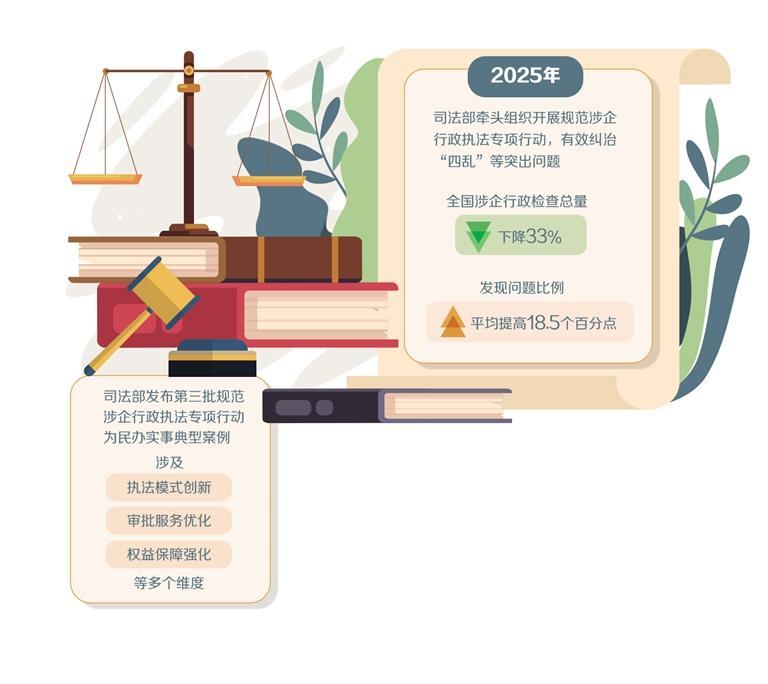
从被动监管向主动服务转变——规范涉企行政执法推动理念更新
Jing Ji Ri Bao· 2026-01-24 21:55
Core Viewpoint - The article emphasizes the shift in administrative law enforcement from "passive regulation" to "active service," focusing on proactive measures to address the urgent needs of enterprises and improve operational efficiency [1][3][8]. Group 1: Innovations in Administrative Law Enforcement - Various regions are implementing innovative practices to enhance administrative law enforcement, focusing on source governance and systematic strategies to alleviate issues faced by enterprises [1][3]. - The third batch of typical cases released by the Ministry of Justice showcases successful examples of optimizing approval services and strengthening rights protection [1][8]. Group 2: Case Studies of Effective Practices - In Heilongjiang's Nenjiang City, the government has streamlined agricultural machinery inspections, reducing the average inspection time from 3 days to 0.5 days, saving enterprises over 410,000 yuan in transportation costs [2]. - In Shandong's Linyi City, a collaborative approach resolved a pharmaceutical company's equipment safety issue within 5 days, preventing over 200,000 yuan in economic losses [3]. Group 3: Balancing Enforcement and Service - The core value of administrative law enforcement lies in maintaining market order while preventing abuse of power, as demonstrated by the identification of 96 malicious compensation cases in Yunnan [4]. - Jilin's Liao Yuan City improved truck parking order by constructing new parking facilities and focusing on education rather than punishment for minor violations [4][5]. Group 4: Enhancing the Business Environment - Administrative law enforcement should prioritize public needs, as seen in Puyang City, where a construction project delay was addressed to minimize disruption to local businesses [6][7]. - In Fujian's Yongchun County, a new joint inspection mechanism reduced the frequency of enterprise inspections by 59.6%, significantly easing the burden on businesses [7]. Group 5: Future Directions - The Ministry of Justice aims to continue guiding localities in transforming effective practices into long-term institutional mechanisms, enhancing the standardization and precision of administrative law enforcement [8].
刚柔并济,让执法兼具力度和温度
Zhong Guo Huan Jing Bao· 2025-08-08 01:46
Group 1 - The core viewpoint of the articles emphasizes the importance of a balanced enforcement approach, combining both "rigid" and "flexible" measures in environmental law enforcement to effectively address pollution issues while supporting compliance among businesses [1][2][3] Group 2 - In response to pollution detection exceeding standards at gas stations, the Taiyuan Ecological Environment Protection Comprehensive Administrative Law Enforcement Team conducted one-on-one discussions and support for three non-compliant gas stations, highlighting the need for strict environmental responsibility [1] - The enforcement team utilized direct methods such as restoring detection processes and presenting data reports to help business leaders understand the root causes of pollution and the associated health and ecological risks [1] - There is a recognition that some regions misunderstand the concept of flexible enforcement, focusing too much on either the educational aspect or the rigid enforcement aspect, which can lead to ineffective compliance [2] - To enhance enforcement capabilities, it is crucial for law enforcement personnel to improve their ability to apply both rigid and flexible measures effectively, ensuring that environmental protection responsibilities are upheld [3] - The articles stress the necessity of clear communication regarding standards, requirements, and deadlines for compliance, while also addressing severe violations with strict legal actions [3]