利他

Search documents
人生七大底层逻辑,不要搞反了
洞见· 2026-02-27 06:10
Core Insights - The article emphasizes the importance of understanding underlying logic in various aspects of life, suggesting that recognizing the correct order of actions is crucial for success [3][29] Group 1: Life Lessons and Business Insights - The story of Levi Strauss illustrates that instead of competing in saturated markets, one should identify unique opportunities to provide value, leading to success [6][8] - The concept of "interest closure" in relationships highlights that long-lasting connections are built on mutual benefits, and when one party can no longer provide value, the relationship may dissolve [11][12] - Reflective practices, as demonstrated by Kazuo Inamori, are essential for personal growth and avoiding repetitive mistakes, which can lead to a more fulfilling life [15][18] Group 2: Health and Well-being - The article stresses the importance of preventive health measures, advocating for a proactive approach to wellness rather than waiting for issues to arise [23][24] - A solid financial foundation is presented as a critical element for stable relationships, particularly in marriage, where economic stability can prevent conflicts [26][27] Group 3: Personal Development and Success - The narrative suggests that a strong foundational logic leads to greater capabilities and achievements, emphasizing the need to establish the correct order of priorities before taking action [29]


一个人的顶级魅力,就是放大格局
洞见· 2026-02-07 12:36
Core Viewpoint - The article emphasizes the importance of having a broad mindset and the ability to forgive and let go in personal and professional relationships, suggesting that true charm and respect come from one's inner character rather than superficial traits [6][7][48]. Group 1 - The story of artist Xu Huijun illustrates how a generous mindset can lead to admiration and respect from others, as he chose not to pursue the person responsible for damaging his valuable artwork [6][7]. - The anecdote about Mei Lanfang's selflessness in allowing a fellow artist to shine during a performance highlights the value of humility and the positive outcomes of prioritizing others' success over personal glory [12][18]. - The article discusses the negative impact of being overly competitive and the importance of humility in fostering good relationships, as seen in the example of a person who relentlessly pursues others for minor grievances [25][28]. Group 2 - The narrative of Liu Run and his experience with Luo Zhenyu emphasizes the significance of generosity in business relationships, where Luo's willingness to cover expenses fostered goodwill and future collaborations [48]. - The example of Hu Yong, a pharmaceutical dealer who adjusts prices to ensure his clients remain profitable, illustrates the long-term benefits of a generous approach in business, leading to a strong market position [48][49]. - The article concludes that those who are willing to let go of small gains for the sake of others will ultimately build stronger relationships and earn respect, reinforcing the idea that true charm comes from a generous and broad-minded attitude [50][51].

西贝道歉,老罗却突然收手:我瞬间明白了他能还清8亿巨债的原因
Xin Lang Cai Jing· 2025-09-16 20:14
Core Viewpoint - The article discusses the character and actions of Luo Yonghao, emphasizing his decision to withdraw from a legal battle against Xibei's founder to protect the livelihoods of nearly 20,000 employees, showcasing his altruistic nature and moral integrity [2][5][38]. Group 1: Character and Actions of Luo Yonghao - Luo Yonghao is portrayed as a strong and principled individual who has previously taken bold actions against large corporations, demonstrating his willingness to fight for consumer rights [4][19]. - His decision to step back from the lawsuit against Xibei is framed as a strategic choice rooted in compassion rather than fear, highlighting his concern for the employees affected by the conflict [6][38]. - The article emphasizes that true strength lies in knowing when to hold back, which Luo Yonghao exemplifies through his actions [7][8]. Group 2: Consumer Advocacy and Trust - Luo Yonghao's advocacy is characterized by a focus on consumer interests rather than personal gain, which has garnered public support for his initiatives [10][11]. - He has committed to continuing legal support for consumers and monitoring the situation at Xibei, indicating his ongoing dedication to consumer rights [11][12]. - The article notes that Luo Yonghao's ability to repay 800 million in debt is attributed to the trust he has built with consumers through his consistent and genuine actions [23][32]. Group 3: Societal Implications - The article suggests that individuals like Luo Yonghao, who are willing to stand up against injustices, are rare and essential for societal progress [34][35]. - It highlights the importance of having outspoken individuals in society to challenge complacency and corporate negligence, which can lead to a more accountable business environment [34][36]. - The narrative concludes that true wealth is measured not in financial terms but in the trust and respect earned from others [41].

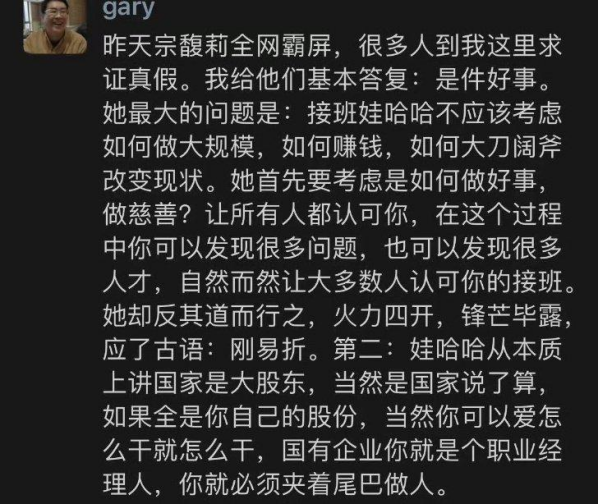
全网都在替宗馥莉出主意
Hu Xiu· 2025-07-14 09:39
Core Viewpoint - The article discusses the ongoing crisis faced by the Wahaha Group and its leader, Kelly Zong, highlighting the internal family disputes and the implications for the company's future [1][2][4]. Group 1: Legal Issues - The crisis revolves around two lawsuits: one in Hong Kong concerning a $2.1 billion family trust, and another in Hangzhou regarding the inheritance rights to a 29.4% stake in Wahaha held by Zong Qinghou [3][4]. - These legal battles indicate a breakdown in family relations, which could have been resolved privately but have now become public disputes [4][5]. Group 2: Company Operations and Internal Dynamics - Wahaha has publicly stated that these family matters do not affect its business operations [5]. - The internal family conflicts have been ongoing for years, with public incidents often reflecting deeper issues within the family [5][9]. - The company is described as having a strong cash flow and business moat, allowing it sufficient room for gradual changes without immediate decline [9]. Group 3: Leadership and Management Strategies - There are suggestions for Kelly Zong to adopt a more altruistic approach in her leadership style, emphasizing the importance of patience and long-term thinking in resolving family and business conflicts [6][8]. - The article suggests that to maximize benefits, Zong should consider sacrificing short-term gains for greater power and efficiency in the long run [8]. - The current situation is characterized as a lose-lose scenario, with no clear winners emerging from the ongoing disputes [10].
人生七大底层逻辑,不要搞反了
洞见· 2025-06-05 10:28
Core Viewpoint - The article emphasizes the importance of understanding underlying logic in various aspects of life and business, suggesting that success comes from recognizing and following the correct order of actions rather than blindly following the crowd [3][27]. Group 1: Historical Examples - The article recounts the Gold Rush in 1853, highlighting how a young man, Levi Strauss, shifted from gold mining to selling durable work clothes, illustrating the value of identifying unique opportunities rather than competing in saturated markets [6][7]. - It mentions the story of Ho Hung San, who faced rejection from relatives during tough times but later saw them return when he regained wealth, emphasizing the transactional nature of relationships based on mutual benefit [10][11]. Group 2: Personal Development - The article discusses the practice of self-reflection as a means to personal growth, citing the example of Kazuo Inamori, who reflects daily on his actions to improve himself [13]. - It stresses the importance of listening to others to build relationships, using the story of Carnegie successfully engaging a botanist to secure an invitation to a dinner as an example [15]. Group 3: Health and Well-being - The article advises on the importance of preventive health measures, likening it to not waiting for problems to arise before taking action, thus promoting a proactive approach to health [20][21]. - It suggests that a solid foundation of health enables individuals to pursue their desired life paths effectively [21]. Group 4: Financial Stability - The article asserts that financial stability is crucial for maintaining healthy relationships, particularly in marriage, where economic issues can lead to conflicts [23][24]. - It concludes that all happiness must be earned through hard work and dedication, reinforcing the idea that effort is necessary for achieving personal and financial goals [25][26].