利率下行风险

Search documents
投资前景预期偏乐观 权益资产继续受青睐
Sou Hu Cai Jing· 2026-01-13 23:10
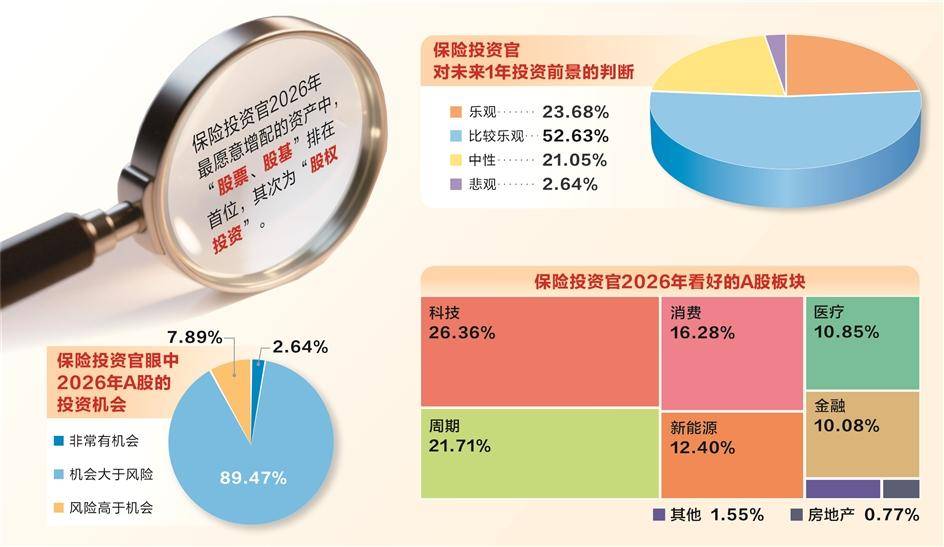
Core Viewpoint - The insurance investment officers are generally optimistic about the investment outlook for 2026, with over 70% expressing a positive sentiment, indicating a significant improvement compared to early 2025 [5][8]. Investment Sentiment - 38 insurance investment officers participated in the survey, managing over 26 trillion yuan in assets, which accounts for more than 70% of the total insurance funds [5]. - 34 out of 38 officers believe that the opportunities in the A-share market outweigh the risks, with 89.47% holding this view [11]. - The majority of investment officers expect to increase their allocation to equity assets, with 68.42% anticipating a slight increase and 2.63% expecting a significant increase [22]. Sector Preferences - The sectors that insurance investment officers are most optimistic about for 2026 include technology (26.36%), cyclical (21.71%), and consumer sectors (16.28%) [25]. - The investment officers also see potential in renewable energy (12.40%) and healthcare (10.85%) sectors [25]. Investment Environment - There is a divergence in opinions regarding the investment environment for 2026 compared to 2025, with 36.84% of officers believing it will weaken, while 23.68% expect it to improve [10]. - Concerns about geopolitical risks are prevalent, with nearly 40% of officers identifying it as the biggest uncertainty for 2026 [15]. Risk Factors - The primary concern for investment officers is stock market volatility, with over 50% indicating it as their top risk [17]. - Credit risk remains a significant concern, with 23.68% of officers highlighting it as a worry, particularly in the context of local debt and small financial institutions [17]. Future Earnings Targets - About 60% of investment officers plan to maintain stable investment return targets over the next 1-3 years, while 31.58% are considering adjustments [12][14]. Investment Opportunities in Hong Kong - A growing number of investment officers view Hong Kong stocks favorably, with 63.16% believing there are significant opportunities, particularly due to favorable valuations compared to A-shares [26].

高盛:予友邦保险(01299)90港元目标价 评级“买入”
智通财经网· 2025-06-19 07:28
Core Viewpoint - Goldman Sachs has set a 12-month target price of HKD 90 for AIA Group (01299) based on an 8x forward new business multiple, implying a 1.6x P/E for 2026, while adjusting the EV/VONB metrics to reflect current 10-year government bond yields in China [1] Group 1: Business Performance and Market Conditions - The impact of a weaker US dollar is primarily seen in translation effects rather than direct business impacts, with the report metrics benefiting from this currency movement [2] - Year-to-date, bond yields in China and the US have remained stable, while Thailand's rates have decreased, affecting business performance differently across regions [2] - AIA's new business value (VNB) is expected to show healthy growth through Q2, supported by recent stock market gains and a stable interest rate environment in China [2] Group 2: Product Strategy and Sales Dynamics - AIA has shifted its sales focus in mainland China from savings products to participating (dividend-paying) products, which typically have lower profit margins but are more resilient to interest rate declines [3] - The year-on-year decline of 7% in mainland China's VONB is partially attributed to a high base effect from strong sales in the first half of 2024, with expectations for easier comparisons in the second half of 2025 [3] - AIA aims to increase the number of agents in new branches to over 1,000 within 1.5-2 years of opening, with plans for further expansion into other cities in the provinces where new branches are established [3] Group 3: Regional Insights and Future Outlook - In Thailand, promotional activities in Q1 have driven significant growth in VONB, but growth is expected to stabilize for the remainder of the fiscal year [4] - Downside risks include a slowdown in mainland China, particularly for high-margin protection products, delays in regulatory approvals for new provinces, and tightening capital controls that could negatively impact sales and policy renewals in Hong Kong [4]