剩者为王

Search documents
中国海外宏洋集团(00081):港股公司首次覆盖报告:中海品牌铸就下沉龙头,低线布局“剩者为王”
KAIYUAN SECURITIES· 2026-01-15 09:23
Investment Rating - The report assigns a "Buy" rating for the company, marking its first coverage [2][7]. Core Insights - China Overseas Macro Group is establishing itself as a leader in the quality residential market in lower-tier cities, leveraging the brand strength of its parent company, China Overseas Property [7][19]. - The company has developed a comprehensive value chain in real estate development, covering land acquisition, planning, construction, marketing, after-sales service, and property management [19]. - The company is expected to see a gradual recovery in profitability, with projected net profits of 330 million, 436 million, and 628 million RMB for 2025, 2026, and 2027 respectively, alongside corresponding EPS of 0.09, 0.12, and 0.18 RMB [7][10]. Summary by Sections 1. Company Overview - China Overseas Macro Group is a flagship enterprise under China Overseas Group, focusing on mid-to-high-end residential development in second and third-tier cities [19]. - The company has a strong backing from its parent company, which enhances its brand credibility and resource access [28]. 2. Market Positioning - The company is positioned to benefit from the exit of less competitive firms from lower-tier markets, allowing it to increase market share [8][44]. - The strategic focus on lower-tier cities is expected to optimize supply-demand dynamics in the mid-to-high-end market [44]. 3. Financial Performance - In the first half of 2025, the company reported a revenue of 14.54 billion RMB, a decrease of 33.45% year-on-year, with a net profit of 284 million RMB, down 67.91% [9]. - The average financing cost has decreased, with a reported 2.9% in the first half of 2025, indicating improved financial health [9]. 4. Sales and Market Trends - The company achieved a contract sales amount of 40.11 billion RMB in 2024, a slight decline of 6.3% year-on-year, but significantly better than the average decline of 34% in the cities it operates [49]. - Monthly sales data shows signs of recovery, with a notable increase in sales amounts and areas in the second quarter of 2025 [73]. 5. Land Acquisition Strategy - The company has adopted a cautious investment strategy, focusing on acquiring land in core locations of strong third-tier cities, with a total land reserve of 1.1892 million square meters in 2024 [79]. - The land acquisition strategy emphasizes "mainstream cities, mainstream locations, and mainstream products," ensuring a competitive edge in the market [79].
私募机构“注销潮”迎来行业变局
2 1 Shi Ji Jing Ji Bao Dao· 2025-10-15 00:01
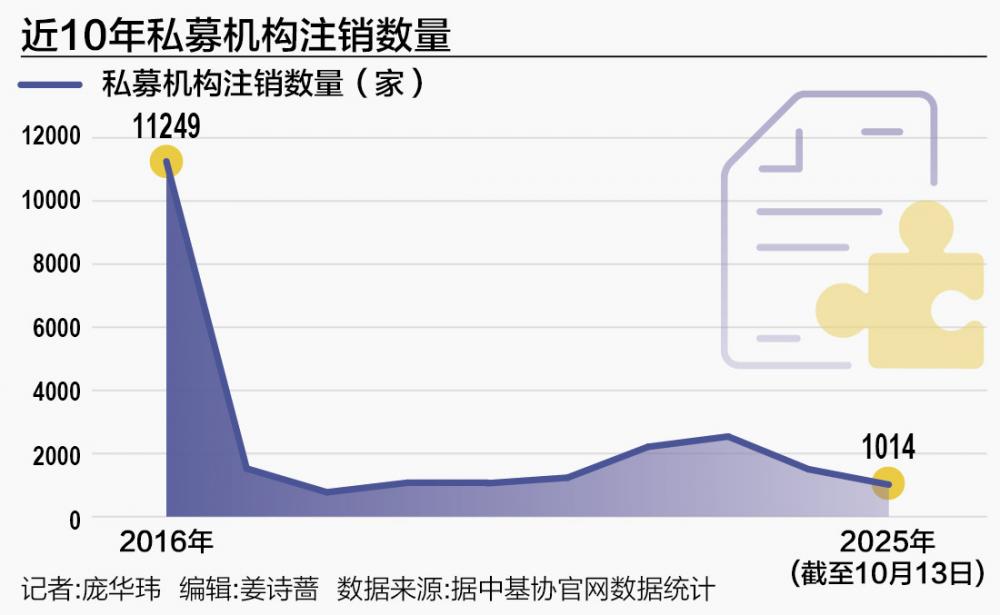
Core Viewpoint - The private equity industry in China is undergoing a significant cleansing process, with over 24,000 private fund managers having been deregistered in the past decade, marking a transition from a chaotic era to a more mature phase characterized by stronger players surviving and thriving [1][3][15]. Group 1: Industry Overview - As of October 13, 2023, there are 19,614 active private fund managers in China, including 7,684 private securities fund managers and 11,740 private equity and venture capital fund managers [3]. - The number of private fund managers has been steadily declining over the past decade, with 1,014 deregistrations occurring in 2023, a decrease of 22% compared to the previous year [4][7]. - The deregistration wave began in 2016, with a peak of 11,249 deregistrations that year, primarily due to the crackdown on "shell private equity" firms [5][8]. Group 2: Regulatory Environment - The recent deregistration trend is attributed to a combination of regulatory pressure and market conditions, with the introduction of stringent regulations raising compliance costs and operational thresholds for private fund managers [9][10]. - The new regulations, effective May 1, 2023, have significantly increased the capital and operational requirements for private equity firms, effectively elevating the bar to a level comparable to public funds [9][10]. - The regulatory environment has led to a systematic elimination of non-compliant and underperforming firms, with a focus on enhancing the quality of the remaining players in the industry [13][19]. Group 3: Market Dynamics - The current market conditions are described as a "frozen period," with significant challenges for private equity firms, particularly those in the equity sector, due to reduced IPO activity and increased exit difficulties [10][12]. - The operational costs for maintaining a private equity license have escalated, with annual expenses ranging from 1 million to several million yuan, further straining smaller firms [10][11]. - The industry is witnessing a trend where larger, more established firms are likely to dominate, while smaller firms face diminishing survival prospects, leading to increased market consolidation [15][17]. Group 4: Future Outlook - Experts predict that the trend of deregistration will continue, but at a slower pace, with estimates suggesting that the number of deregistrations may not reach the levels seen in previous years [14]. - The future competition in the private equity sector will focus on specialization, compliance, and brand strength, with larger firms likely to expand while smaller firms may struggle to survive [17][18].