劳森判据

Search documents
核聚变产业进度分享
2026-03-30 05:15
Summary of Fusion Industry Conference Call Industry Overview - The conference call focused on the **nuclear fusion industry**, particularly advancements in high-temperature superconducting tokamaks and other fusion technologies [1][2][3]. Key Points and Arguments Technological Advancements - High-temperature superconducting tokamaks are identified as a **deterministic trend**, with magnetic field strength improvements potentially leading to a **fourfold increase** in device performance, significantly reducing size and cost [1]. - The **superconducting magnet** is a core value component, accounting for **40%-50%** of total investment, with **REBCO high-temperature superconducting tape** being the most critical cost item [1][13]. - The **stellarator route** shows potential for long-pulse steady-state operation, especially with breakthroughs in domestic 3D manufacturing technology, positioning it as a potential competitor to tokamaks [1]. Commercialization Progress - Overseas private companies have ambitious goals for power generation by **2030**, which may be overly optimistic, while the domestic **BEST device** is expected to achieve plasma discharge around **2028-2029** [1][2][12]. - The evolution of the technical path follows a clear sequence: **plasma discharge** -> **deuterium-tritium combustion experiments (BEST/ITER)** -> **demonstration reactors (DEMO)** -> **commercial power plants** [1][3]. Key Projects and Timelines - The period from **2026 to 2029** is anticipated to be a peak for nuclear fusion device tenders, with projects like **BEST** and **Honghuang 170** expected to reach scales of **1 billion to 10 billion** [1][12]. - The **BEST project** has already released over **2 billion yuan** in tenders, with future tenders expected to reach several billion [12]. Industry Dynamics - Domestic capabilities in high-precision component manufacturing and a low-cost industrial chain provide a competitive advantage in areas such as magnets, vacuum chambers, heating, and cryogenic systems [1][10]. - The **commercialization potential** of various routes, including the stellarator, is highlighted, with the latter benefiting from the advantages of tokamak technology while also presenting unique engineering challenges [5][8]. Investment and Financing Environment - Domestic private fusion companies have secured financing in the range of **hundreds of millions to billions**, often backed by government support [11]. - The optimistic timelines proposed by U.S. commercial fusion companies may contain elements of **bubble** due to the challenges of execution and the complexity of fusion systems [12]. Additional Important Insights - The **Lawson criterion**, which measures the ability to maintain fusion reactions, is a critical standard for evaluating technology routes, with traditional low-temperature superconducting tokamaks currently being the most mature [5][6]. - The **REBCO tape** is a significant cost driver within the superconducting magnet category, with domestic companies actively developing this technology [14]. - The potential for shared systems across different fusion technologies, such as superconducting magnets and heating systems, indicates a level of interoperability that could benefit the industry as a whole [14]. This summary encapsulates the key discussions and insights from the conference call, providing a comprehensive overview of the current state and future prospects of the nuclear fusion industry.
可控核聚变新进展不断,市场想象空间“乱花迷人眼”
Shang Hai Zheng Quan Bao· 2026-01-14 00:02
Group 1 - The Wande Fusion Concept Index rose by 4.97% on January 12, with several stocks reaching their daily limit, and the index has accumulated a nearly 20% increase in just six trading days this year [1] - Recent news indicates that controlled nuclear fusion devices are entering the engineering phase, attracting attention from superconducting material companies, commercial fusion companies, and national research teams [1][2] - Controlled nuclear fusion is considered the "ultimate energy" due to its abundant raw materials, environmental cleanliness, high safety, and low cost, with global investment in this field accelerating since 2025 [2] Group 2 - Energy Singularity announced the successful excitation of its self-developed high-temperature superconducting magnet to 20.8 Tesla, demonstrating its capability for stable operation [2][3] - The Lawson Criterion is identified as a key indicator for energy gain in fusion energy research, emphasizing the importance of magnetic field strength for plasma confinement [2] - Energy Singularity has developed a measurement platform capable of testing superconducting materials in environments exceeding 20 Tesla, addressing the limitations of existing commercial measurement systems [3] Group 3 - The first fully high-temperature superconducting Tokamak fusion experimental device, Honghuang 70, achieved 120 seconds of steady-state long-pulse plasma operation, validating its engineering reliability [4] - The Chinese Academy of Sciences' EAST device confirmed the existence of a density-free zone, providing important physical evidence for high-density operation in magnetic confinement fusion devices [4] - Both national teams and commercial companies are making significant advancements in Tokamak technology and superconducting magnets [4] Group 4 - Several stocks are being categorized as "dual concept stocks" in both commercial aerospace and controlled nuclear fusion, potentially boosting the nuclear fusion sector [5][6] - Companies like Western Superconducting and AVIC Optoelectronics are involved in both nuclear fusion and commercial aerospace, indicating a cross-industry synergy [6] - Experts agree that global fusion energy research has entered a new engineering phase, with upstream raw material suppliers and midstream equipment manufacturers poised to benefit [6] Group 5 - The FRC (Field-Reversed Configuration) route is gaining popularity among commercial fusion companies due to its significant advantages [7] - Nova Fusion announced a 500 million yuan angel round financing, with notable investors supporting its development of a small modular reactor using the FRC technology [7] - Han Hai Fusion is also pursuing the FRC route, with plans to achieve revenue breakthroughs in nuclear medicine and neutron imaging by 2025 [7] Group 6 - The FRC route's emergence in China is influenced by advancements from US company Helion Energy, which is constructing the world's first fusion power plant, aiming to deliver fusion electricity by 2028 [8]
可控核聚变新进展不断,相关概念股走强
Shang Hai Zheng Quan Bao· 2026-01-13 00:15
Group 1 - The concept of controlled nuclear fusion is gaining significant attention due to its potential as a "ultimate energy" source, characterized by abundant raw materials, environmental cleanliness, high safety, and low costs [2][5] - The Wande Nuclear Fusion Concept Index rose by 4.97% on January 12, with several stocks reaching their daily limit, and the index has seen a cumulative increase of nearly 20% in just six trading days [1] - Recent advancements in nuclear fusion technology include the successful excitation of a high-temperature superconducting magnet to 20.8 Tesla by Energy Singularity, marking a significant milestone in the field [2][3] Group 2 - Energy Singularity has developed a 20 Tesla material performance measurement platform, which allows for efficient testing of superconducting materials, addressing the limitations of existing commercial measurement systems [3] - The East Experimental Fusion Reactor, known as the "artificial sun," has confirmed the existence of a density-free zone, providing important physical evidence for high-density operation in magnetic confinement fusion devices [4] - Companies like Xibu Superconductor and China Aviation Optical-Electrical are positioning themselves within the nuclear fusion supply chain, with Xibu supplying materials for international fusion projects and China Aviation Optical-Electrical developing components for fusion systems [6][7] Group 3 - The FRC (Field-Reversed Configuration) approach is gaining traction among domestic and international commercial fusion companies, with notable advancements from Nova Fusion and Hanhai Energy, which are focusing on modular reactor designs [7][8] - Nova Fusion has completed a 500 million yuan angel round of financing, indicating strong investor interest in the FRC technology route [7] - Helion Energy, a U.S. company utilizing the FRC approach, has accelerated its progress with plans to construct the world's first fusion power plant, aiming to deliver fusion electricity by 2028 [8]


中国“人造太阳”突破密度极限,聚变点火迎来新路径 | Science子刊
量子位· 2026-01-03 04:44
Core Viewpoint - The research led by Professor Zhu Ping from Huazhong University of Science and Technology and Associate Professor Yan Ning from the Hefei Institute of Physical Science has made significant breakthroughs in the study of the Tokamak device, confirming the existence of a "density-free regime" and providing new pathways for fusion ignition [1][4][48]. Summary by Sections Breakthroughs in Tokamak Research - The study validates the boundary plasma-wall interaction self-organization (PWSO) theoretical model, confirming the mechanisms behind the long-standing density limit in Tokamak operations [3][4]. - The research demonstrates that the density limit, traditionally viewed as a hard boundary, can be surpassed, allowing for higher plasma density and improved fusion efficiency [4][41]. Understanding Density Limit - The density limit is a critical challenge in magnetic confinement nuclear fusion, as it directly impacts the conditions necessary for fusion reactions to occur, according to the Lawson Criterion [5][6]. - The Greenwald density limit, an empirical scaling law, has historically constrained Tokamak operations, with most devices operating below 1.0 times this limit [10][14]. PWSO Theory and Its Implications - The PWSO model shifts the perspective from viewing core plasma as an isolated fluid to a coupled self-organizing system with the device walls, highlighting the importance of plasma-wall interactions [16][18]. - The model introduces a new critical density limit that incorporates plasma transport parameters and wall interaction physics, revealing a complex relationship between critical density and various physical factors [22][23]. Experimental Validation - The EAST (Experimental Advanced Superconducting Tokamak) utilized its tungsten wall to conduct experiments that successfully crossed the Greenwald limit, maintaining electron density between 1.3 to 1.65 times the limit without experiencing disruptions [41][42]. - The experiments showed that under specific high-pressure conditions, increasing heating power led to a decrease in plasma temperature, effectively triggering the "switch" to enter the density-free regime [43][46]. Future Implications - The findings suggest that future fusion reactors could achieve high-density steady-state operations without the need for impurity injection, paving the way for breakthroughs in achieving fusion ignition and sustainable energy [47][48].


全球核聚变竞赛,欧美急什么
Hu Xiu· 2025-10-16 00:11
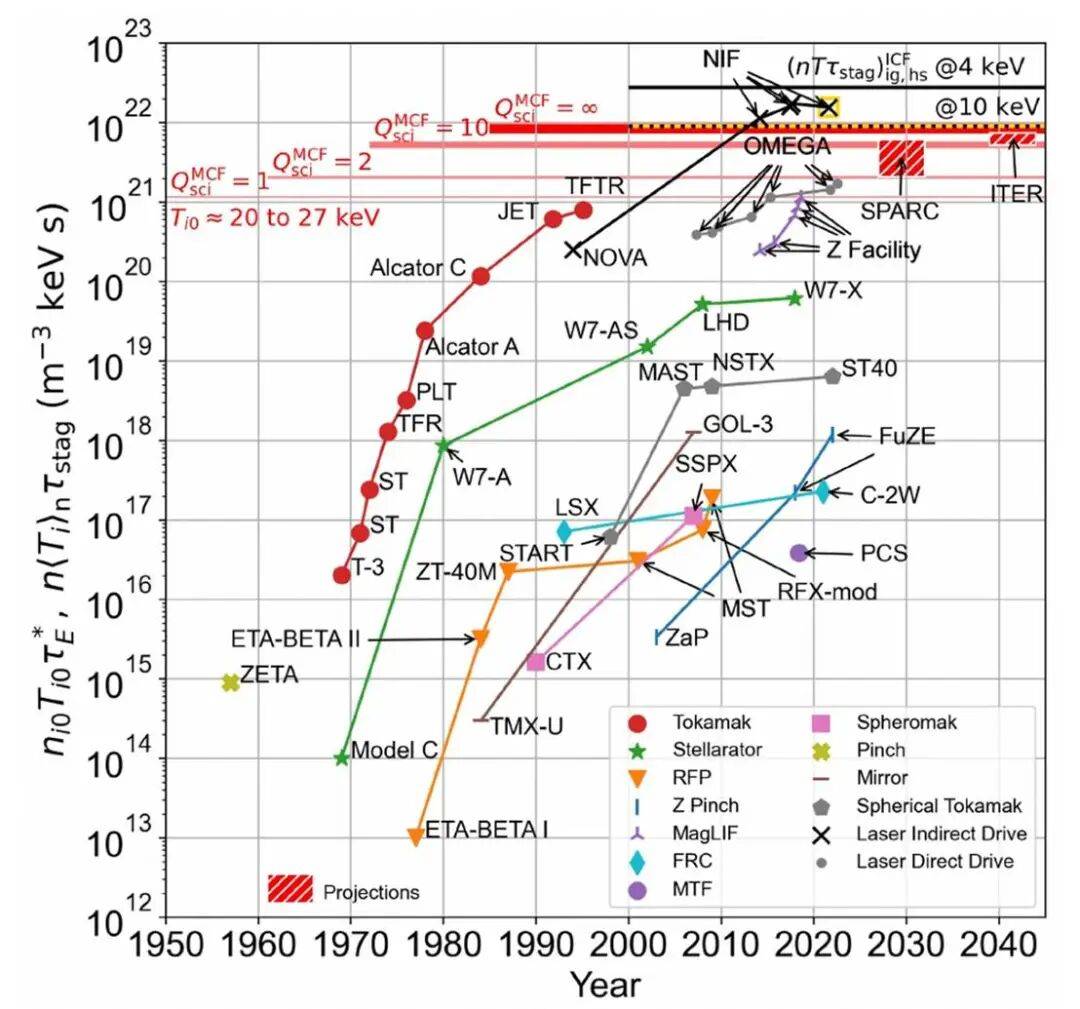
Core Insights - The International Atomic Energy Agency (IAEA) has released the "Fusion Energy Outlook 2025," indicating that global fusion energy exploration has entered a decisive new phase in 2023 [1] - Significant milestones have been achieved in fusion energy, particularly by the United States and China, with the U.S. National Ignition Facility (NIF) claiming a Q value greater than 4 and China's BEST project entering the assembly phase [1][2] - The report highlights a growing competition between the U.S. and China in the fusion energy sector, with increasing investments and advancements in technology [12][21] Investment and Funding - Global funding for fusion enterprises has surpassed the total amount raised in the previous year, reaching a historical high by September 2023 [13] - China's cumulative funding in fusion energy, approximately $5 billion, is still less than the U.S.'s $7.5 billion, but since 2023, China's annual funding has exceeded that of the U.S. [14] - The U.S. report indicates that China has mobilized up to $13 billion for fusion infrastructure since 2023, significantly outpacing U.S. investments [17] Technological Advancements - Fusion performance has improved tenfold over the past decade, with projections indicating that the 2030s will be a critical decade for fusion power generation [3][6] - The Lawson criteria, which determines the energy gain of fusion systems, shows that the three-product (temperature, fuel density, and confinement time) is improving at a rate of one order of magnitude every ten years [4][5] Global Competition - The U.S. and China are positioned as the primary competitors in the commercial fusion energy race, with both countries' projects nearing operational status [12][21] - The report notes that 27% of the papers submitted to the IAEA Fusion Energy Conference in 2025 are from China, surpassing the combined contributions from the U.S. and Japan [21] Supply Chain Concerns - The U.S. faces significant challenges regarding supply chain security in the fusion sector, particularly in critical minerals and components where China holds a dominant position [23][26] - Key materials such as tungsten and lithium-6 are primarily produced by China and Russia, raising concerns for U.S. energy independence [26][27] Strategic Recommendations - The U.S. report emphasizes the urgency for increased government funding and subsidies to maintain competitiveness in the fusion energy sector [28]