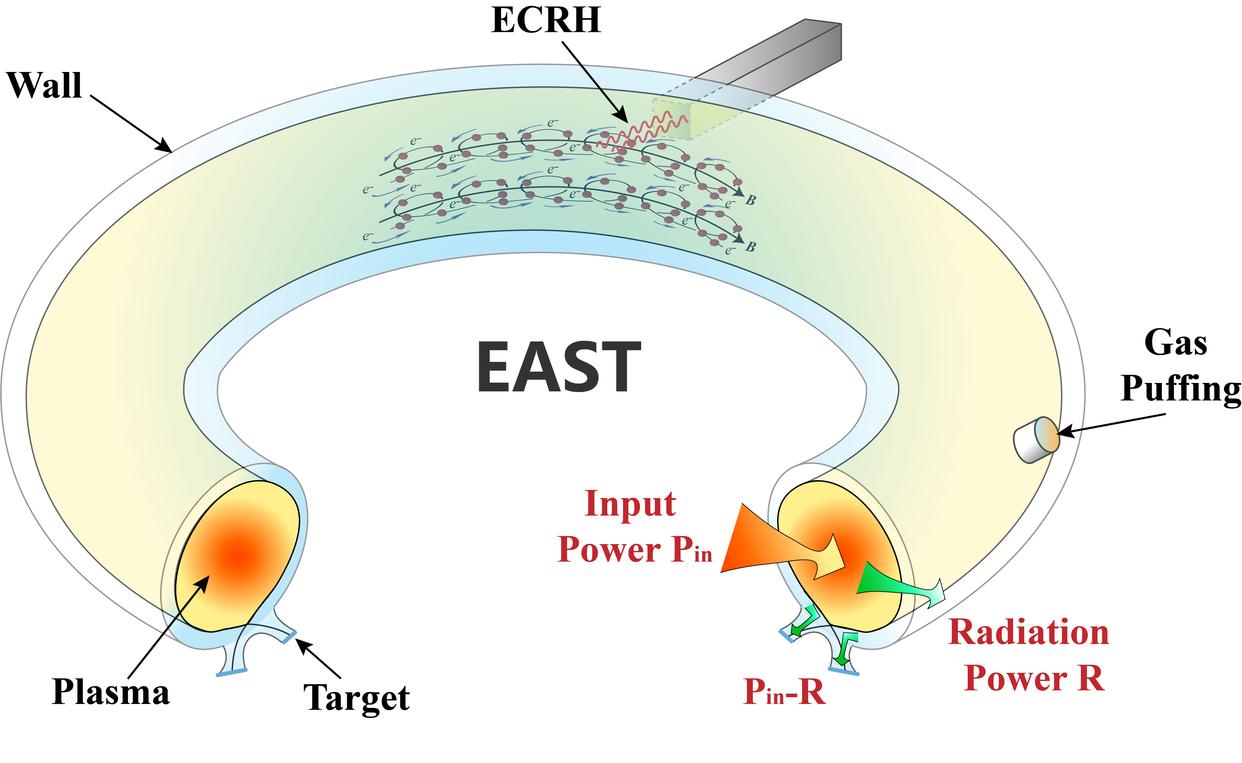
边界等离子体与壁相互作用自组织(PWSO)理论模型

Search documents
中国“人造太阳”找到突破密度极限新方法
Ren Min Ri Bao· 2026-01-09 22:12
Core Viewpoint - The "artificial sun" known as the Experimental Advanced Superconducting Tokamak (EAST) has achieved significant results in plasma physics experiments, confirming the existence of a density free zone in tokamak operations [1] Group 1: Experimental Achievements - The EAST device utilizes magnetic confinement to achieve controlled nuclear fusion, functioning as a circular apparatus that locks high-temperature plasma [1] - The research team developed a theoretical model called the Plasma-Wall Self-Organization (PWSO) model, highlighting the critical role of boundary radiation in triggering density limits [1] - The experimental results align closely with the predictions made by the PWSO theory, marking the first confirmation of the existence of a density free zone in tokamak operations [1]
【新华社】中国“人造太阳”实验找到突破密度极限的方法
Xin Hua She· 2026-01-04 01:23
Core Viewpoint - The research team from the Hefei Institutes of Physical Science has confirmed the existence of a density free zone in the EAST (Experimental Advanced Superconducting Tokamak) device, providing significant physical evidence for high-density operation in magnetic confinement nuclear fusion [4][6]. Group 1: Research Findings - The EAST device has successfully demonstrated a method to overcome the plasma density limit, which is crucial for achieving controlled nuclear fusion [4][5]. - The research revealed that boundary impurities play a key role in triggering radiation instability, which is critical in reaching the density limit [6]. - The experimental results align closely with the predictions made by the newly developed boundary plasma-wall interaction self-organization (PWSO) theoretical model [6]. Group 2: Technological Implications - The findings provide important insights into the physical mechanisms behind the density limit, which has been a long-standing challenge in the field of nuclear fusion [5][6]. - By utilizing techniques such as electron cyclotron resonance heating and pre-filling gas, the research team was able to delay the onset of the density limit and plasma disruption [6]. - This innovative work is expected to facilitate the understanding and operation of tokamaks at high densities, potentially advancing the development of nuclear fusion technology [6].

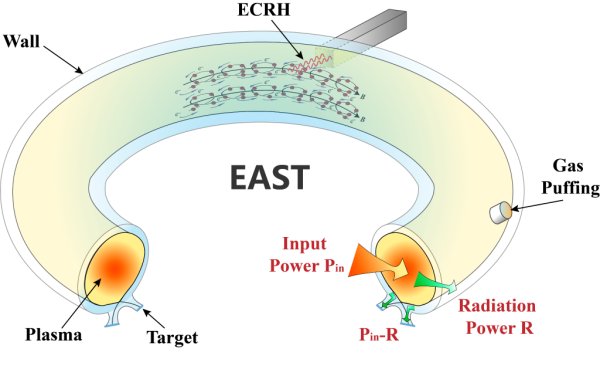
【科技日报】中国“人造太阳”找到突破密度极限方法
Ke Ji Ri Bao· 2026-01-04 01:23
Core Insights - The EAST (Experimental Advanced Superconducting Tokamak) has achieved significant results in nuclear fusion experiments, confirming the existence of a density free zone in tokamaks through boundary plasma and wall interaction self-organization theory [1][2] Group 1: Research Findings - The research team developed a new theoretical model called the Plasma-Wall Self-Organization (PWSO) model, which identifies the key role of boundary impurities in triggering radiation instability at the density limit [2] - The experiments utilized EAST's all-metal wall environment and methods such as electron cyclotron resonance heating to reduce impurity sputtering at the device's boundary, delaying the onset of the density limit and plasma disruption [2] - The successful breakthrough of the density limit and stable entry into the predicted density free zone were achieved by controlling the physical conditions of the target plate to minimize tungsten impurity sputtering, aligning experimental results with PWSO theory predictions [2]
中国“人造太阳”找到突破密度极限方法
Xin Lang Cai Jing· 2026-01-03 23:23
Core Insights - The Chinese "artificial sun," the Experimental Advanced Superconducting Tokamak (EAST), has achieved significant breakthroughs in overcoming the density limit in nuclear fusion experiments [1][2] - The research team has confirmed the existence of a density free zone in tokamak operations, which is crucial for enhancing the economic viability of fusion energy [1] Group 1: Breakthroughs in Fusion Research - The research team developed a new theoretical model called the Plasma-Wall Self-Organization (PWSO) theory, which identifies the critical role of boundary impurities in triggering the density limit [2] - The experiments conducted at EAST utilized a fully metallic wall environment and methods such as electron cyclotron resonance heating to delay the onset of the density limit and plasma disruption [2] Group 2: Experimental Results - The team successfully reduced physical sputtering caused by tungsten impurities on the target plate, allowing the plasma to surpass the density limit and enter the predicted density free zone [2] - The experimental results closely matched the predictions made by the PWSO theory, marking the first confirmation of the existence of a tokamak density free zone [2]
中国“人造太阳”突破密度极限,聚变点火迎来新路径 | Science子刊
量子位· 2026-01-03 04:44
Core Viewpoint - The research led by Professor Zhu Ping from Huazhong University of Science and Technology and Associate Professor Yan Ning from the Hefei Institute of Physical Science has made significant breakthroughs in the study of the Tokamak device, confirming the existence of a "density-free regime" and providing new pathways for fusion ignition [1][4][48]. Summary by Sections Breakthroughs in Tokamak Research - The study validates the boundary plasma-wall interaction self-organization (PWSO) theoretical model, confirming the mechanisms behind the long-standing density limit in Tokamak operations [3][4]. - The research demonstrates that the density limit, traditionally viewed as a hard boundary, can be surpassed, allowing for higher plasma density and improved fusion efficiency [4][41]. Understanding Density Limit - The density limit is a critical challenge in magnetic confinement nuclear fusion, as it directly impacts the conditions necessary for fusion reactions to occur, according to the Lawson Criterion [5][6]. - The Greenwald density limit, an empirical scaling law, has historically constrained Tokamak operations, with most devices operating below 1.0 times this limit [10][14]. PWSO Theory and Its Implications - The PWSO model shifts the perspective from viewing core plasma as an isolated fluid to a coupled self-organizing system with the device walls, highlighting the importance of plasma-wall interactions [16][18]. - The model introduces a new critical density limit that incorporates plasma transport parameters and wall interaction physics, revealing a complex relationship between critical density and various physical factors [22][23]. Experimental Validation - The EAST (Experimental Advanced Superconducting Tokamak) utilized its tungsten wall to conduct experiments that successfully crossed the Greenwald limit, maintaining electron density between 1.3 to 1.65 times the limit without experiencing disruptions [41][42]. - The experiments showed that under specific high-pressure conditions, increasing heating power led to a decrease in plasma temperature, effectively triggering the "switch" to enter the density-free regime [43][46]. Future Implications - The findings suggest that future fusion reactors could achieve high-density steady-state operations without the need for impurity injection, paving the way for breakthroughs in achieving fusion ignition and sustainable energy [47][48].

首次证实!我国“人造太阳”实验获重要成果
Xin Lang Cai Jing· 2026-01-02 09:13
Core Insights - The "artificial sun" known as the Experimental Advanced Superconducting Tokamak (EAST) has achieved significant results in plasma physics experiments, confirming the existence of a density free zone in tokamaks [1][3] Group 1: Research Achievements - The research team developed a new theoretical model called the Plasma-Wall Self-Organization (PWSO) model, which identifies the critical role of boundary impurities in triggering radiation instability at the density limit [3] - The experiments utilized the fully metallic wall environment of the EAST device, employing methods such as electron cyclotron resonance heating and pre-filling to reduce impurity sputtering at the device boundary, thereby delaying the onset of the density limit and plasma disruption [3] - Researchers successfully lowered the physical sputtering caused by tungsten impurities on the target plate, allowing the plasma to surpass the density limit and smoothly enter the predicted density free zone, with experimental results closely aligning with PWSO theoretical predictions [3]
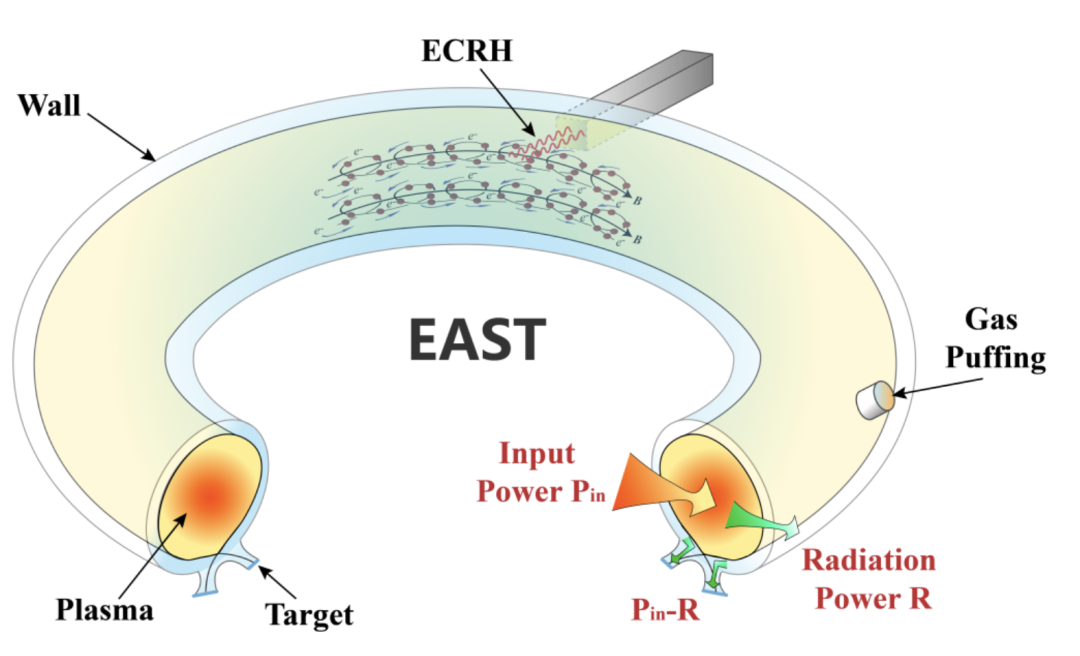
中国“人造太阳”实验,有新突破!
新华网财经· 2026-01-02 05:12
Core Viewpoint - The research team from the Hefei Institutes of Physical Science has confirmed the existence of a density-free zone in the EAST (Experimental Advanced Superconducting Tokamak), providing significant physical evidence for high-density operation in magnetic confinement nuclear fusion devices [1][5]. Group 1: Research Findings - The EAST device utilizes magnetic confinement to achieve controlled nuclear fusion, with plasma density being a critical parameter that directly affects fusion reaction rates [4]. - Previous research indicated a density limit where plasma would rupture and escape magnetic confinement, releasing significant energy and impacting device safety [4]. - The team developed a theory model called Plasma-Wall Self-Organization (PWSO), identifying the role of boundary impurities in triggering radiation instability that leads to the density limit [5]. Group 2: Experimental Methods and Results - By utilizing a fully metallic wall environment in EAST, the researchers employed methods such as electron cyclotron resonance heating and pre-filling gas to reduce boundary impurity sputtering, effectively delaying the onset of the density limit and plasma rupture [5]. - The physical conditions of the target plate were adjusted to reduce tungsten impurity sputtering, allowing plasma to surpass the density limit and enter a new density-free zone [5]. - The experimental results closely matched the predictions of the PWSO theory, marking the first confirmation of the existence of a tokamak density-free zone [5].

中国“人造太阳”实验传新进展
财联社· 2026-01-02 01:29
Core Viewpoint - The research team from the Hefei Institutes of Physical Science has confirmed the existence of a density-free zone in the EAST (Experimental Advanced Superconducting Tokamak), providing significant physical evidence for high-density operation in magnetic confinement nuclear fusion devices [1][5]. Group 1: Research Findings - The tokamak device utilizes magnetic confinement to achieve controlled nuclear fusion, with plasma density being a critical parameter that directly affects fusion reaction rates [2][3]. - Previous research indicated a density limit for plasma, beyond which the plasma would break and escape magnetic confinement, releasing significant energy and impacting the device's safe operation [2][3]. - The team developed a boundary plasma-wall interaction self-organization (PWSO) theoretical model, identifying the key role of radiation instability caused by boundary impurities in triggering the density limit [5]. Group 2: Experimental Methods and Results - By utilizing a fully metallic wall environment in EAST, researchers employed methods such as electron cyclotron resonance heating and pre-filling gas to reduce boundary impurity sputtering, effectively delaying the onset of the density limit and plasma disruption [5]. - The physical conditions of the target plate were adjusted to reduce tungsten impurity-induced sputtering, allowing the plasma to surpass the density limit and enter a new density-free zone [5]. - The experimental results were found to be highly consistent with the PWSO theoretical predictions, marking the first confirmation of the existence of a tokamak density-free zone [5].

中国“人造太阳”实验找到突破密度极限的方法
Xin Hua She· 2026-01-02 00:09
Core Insights - The research team from the Hefei Institute of Physical Science, Chinese Academy of Sciences, confirmed the existence of a density-free zone in the EAST (Experimental Advanced Superconducting Tokamak) nuclear fusion device, providing significant physical evidence for high-density operation in magnetic confinement fusion devices [1][6] Group 1: Tokamak Device and Density Limit - The Tokamak device utilizes magnetic confinement to achieve controlled nuclear fusion, with plasma density being a critical parameter that directly affects fusion reaction rates [3] - Previous research indicated a density limit where plasma would break and escape magnetic confinement, releasing significant energy and impacting device safety [3] Group 2: Research Findings and Theoretical Models - The research team developed a boundary plasma-wall interaction self-organization (PWSO) theoretical model, identifying the key role of radiation instability caused by boundary impurities in triggering the density limit [5][6] - By utilizing a fully metallic wall environment in EAST, researchers employed methods such as electron cyclotron resonance heating and pre-filling to reduce boundary impurity sputtering, actively delaying the onset of the density limit and plasma disruption [6] Group 3: Experimental Validation and Collaboration - The experimental results aligned closely with PWSO theoretical predictions, marking the first confirmation of the existence of a Tokamak density-free zone [6] - This innovative work was a collaborative effort involving the Hefei Institute of Physical Science, Huazhong University of Science and Technology, and Aix-Marseille University, supported by the National Magnetic Confinement Fusion Program [6]