
医疗成本

Search documents
Retirement Planning Mistakes That Only Show Up After You Stop Working
Yahoo Finance· 2026-02-19 14:30
Core Insights - The sequence of returns risk is a critical factor in retirement planning, where the timing of investment returns can significantly impact the longevity of a retirement portfolio [1][3] - Many retirees face regret regarding their savings strategies, with a significant percentage feeling unprepared for actual expenses [4] - Psychological factors play a substantial role in retirement spending, with retirees often struggling to adjust from earning to spending [10][12] Investment Risks - A portfolio that experiences a 15% drop in the first year of retirement, combined with a withdrawal rate of at least 3.3%, increases the likelihood of depleting the portfolio within 30 years by six times compared to those with positive returns in the first year [2] - Early losses in retirement can lead to a rapid depletion of funds, especially if retirees are forced to sell assets at depressed prices [3][19] Planning Mistakes - Common planning mistakes include underestimating healthcare costs, with estimates suggesting a 65-year-old will need approximately $172,500 saved for healthcare in retirement, excluding long-term care [14] - Many retirees do not optimize their Medicare plans, potentially missing out on significant savings [15] - Lifestyle inflation is often underestimated, with retirees spending more in the early years due to newfound freedom, which can lead to financial strain if not properly planned [17][18] Withdrawal Strategies - The 4% withdrawal rule may not hold up in practice, as many retirees find themselves needing to adjust their spending based on real-world conditions [7][8] - Retirees often do not adhere to consistent withdrawal rates, leading to either overspending or underspending, both of which can negatively impact their financial health [8][9] Psychological Factors - The transition from earning a paycheck to relying on savings can create anxiety, leading to either overspending or underspending [10][11] - More than 60% of clients reportedly struggle with the emotional aspects of retirement spending, indicating a need for better psychological preparation [12][13]
CVS earnings show a turnaround in action as the stock rebounds
Yahoo Finance· 2026-02-10 14:47
Core Viewpoint - CVS stock has risen 40% over the last 12 months, significantly outperforming major indexes and achieving returns comparable to Nvidia in percentage terms, despite being a pharmacy chain [1] Group 1: Stock Performance and Market Perception - CVS was previously viewed as a problem stock, with concerns about rising medical costs, structural issues, and the effectiveness of its healthcare model [1][2] - At its lowest point, CVS stock traded at a steep discount, reflecting market skepticism about the company's future [2] Group 2: Financial Results - For Q4, CVS reported revenue of $105.7 billion, an increase of 8.2% year over year, while full-year 2025 revenue surpassed $400 billion, marking a new record [3] - Adjusted earnings per share rose to $6.75 for the year, up from $5.42 in 2024, and operating cash flow exceeded $10 billion [3] Group 3: Segment Performance - Growth was observed across all major segments: insurance, pharmacy services, and retail pharmacy [3] - Aetna's results were mixed, with some trends improving while others remained problematic, reflecting the complexities of the healthcare landscape [4][5] - CVS's pharmacy middleman and health services arm showed steady performance, while retail pharmacy volumes surged nearly 20% in the quarter, indicating the company's scale may be advantageous [6] Group 4: Strategic Goals and Industry Context - Management aims to position CVS as "America's most trusted health care company," though the claim may be viewed skeptically given the adversarial nature of the U.S. healthcare system [7] - The company's turnaround suggests it is navigating the complexities of the healthcare environment more effectively, though the effectiveness of scale and vertical integration remains uncertain [8]
Here’s How Much You Need To Retire With a Modest $50K Lifestyle
Yahoo Finance· 2026-02-02 12:07
Core Insights - The article discusses the financial requirements for retirement, emphasizing the need to save over $1 million to maintain a comfortable lifestyle, specifically a $50,000 annual budget [1][4]. Group 1: Retirement Lifestyle - A $50,000 retirement lifestyle represents annual spending rather than a salary, influenced by factors such as cost of living and mortgage status [2]. - Living in affordable areas and being mortgage-free can enhance the $50,000 budget, allowing for more leisure activities like travel [3]. Group 2: Financial Planning - The 4% rule suggests that to sustain a $50,000 lifestyle, retirees should aim for at least $1.25 million in savings, assuming a retirement duration of 25 to 30 years [4][5]. - For a more conservative approach, a 3.5% withdrawal rate would necessitate up to $1.5 million in retirement savings [5]. Group 3: Social Security Considerations - Social Security can significantly impact retirement savings needs; for instance, if retirees expect $20,000 annually from Social Security, they would only need to cover $30,000 from savings, reducing the required portfolio from $1.25 million to $750,000 [6].
3 Financial Challenges Every Retiree Needs to Plan For
The Motley Fool· 2026-01-04 08:36
Financial Challenges in Retirement - Social Security may not provide sufficient income, covering only about 40% of pre-retirement wages for average earners, with potential benefit cuts looming in about a decade [4][5] - Most seniors require approximately double that amount to meet expenses and maintain a comfortable lifestyle [5] - Rising healthcare costs are a significant concern, with Medicare expenses increasing and healthcare costs outpacing inflation, necessitating dedicated savings for medical expenses [7][8] - Stock market volatility poses risks for retirees who may need to withdraw from their portfolios, making it crucial to have a cash reserve for at least two years' worth of living expenses [9][10] - A balanced investment strategy, including a mix of stocks and stable assets, is recommended to mitigate risks associated with market fluctuations [11][12]
3成美国人看不起病“弃疗”,美机构:悲观情绪正攀升至历史高点
Xin Lang Cai Jing· 2026-01-01 07:28
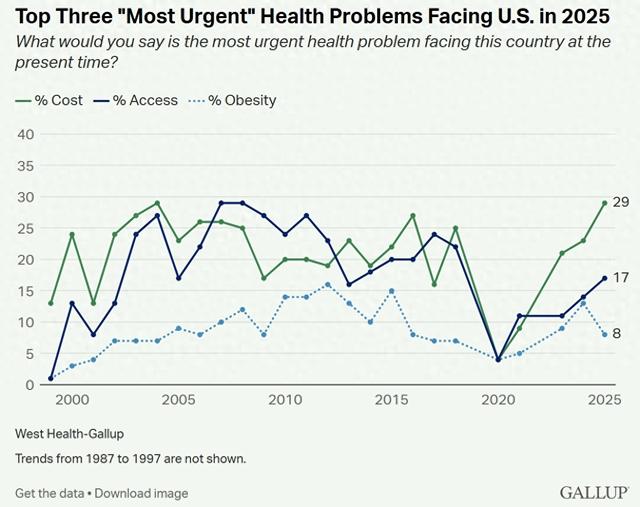
Core Insights - The term "killing line" highlights the harsh reality in American society where a single job loss or serious illness can lead to bankruptcy and homelessness, reflecting a growing pessimism about the healthcare system [1][4] Group 1: Public Sentiment on Healthcare Costs - 29% of respondents identified "healthcare costs" as the most urgent healthcare issue in the U.S., marking the highest level since the survey began in 1987 [1][4] - Only 16% of respondents expressed satisfaction with healthcare costs, the lowest recorded since the survey's inception [1][4] - 24% of Americans rated the national healthcare system positively, also a record low in two decades [4] Group 2: Perception of Healthcare Crisis - 23% of respondents believe the U.S. healthcare system is in crisis, the highest percentage since 1994 [7] - 47% of adults are concerned about their ability to afford necessary healthcare services in the coming year, the highest level since this statistic began in 2021 [8] Group 3: Impact of Rising Healthcare Costs - Rising healthcare costs are forcing many Americans to forgo necessary treatments, with 20% of adults reporting that someone in their household has skipped prescription medications due to cost [7] - 30% of respondents indicated that family members have avoided medical care due to high costs [7] - In Mississippi, nearly 46% of respondents reported that someone in their household has avoided treatment due to expenses [7] Group 4: Policy Implications - Timothy Lash, president of West Health, emphasized that the rising costs of healthcare directly impact Americans' finances and health, urging policymakers to address the issue [7] - The article also notes that significant cuts to federal healthcare funding could lead to millions losing insurance, exacerbating the existing crisis [9]

美财长贝森特豪言2026年经济“光明论” 民调却显示低收入群体信心不足
Zhi Tong Cai Jing· 2025-11-24 02:00
Group 1 - The U.S. Treasury Secretary Scott Bessenet stated that there is no risk of recession in 2026 and expressed optimism about the economic benefits of the Trump administration's trade and tax policies [1] - The "Great Beautiful Act," a large spending plan by the Republican Party, is still being implemented, and its economic effects have not fully materialized [1] - The new law makes the tax cuts from Trump's 2017 policy permanent and provides subsidies for seniors to offset Social Security taxes, while also increasing the deductibility of state and local taxes [1] Group 2 - Healthcare costs are expected to become more affordable, with further announcements from the Trump administration anticipated on this topic [1] - There are signs of distress in certain sectors of the economy, particularly in housing and interest-sensitive industries, although lower energy prices are expected to help reduce inflation [1] - The Director of the White House National Economic Council, Kevin Hassett, indicated that economic data for the fourth quarter may show weakness due to the government shutdown, which lasted 43 days, marking the longest in U.S. history [1] Group 3 - A poll revealed that about two-thirds of registered voters believe the Trump administration has not met expectations regarding the economy and cost of living [2] - According to a recent cost of living survey by JPMorgan, Americans' perceptions of the economy largely depend on their income levels [2] - High-income respondents had an average confidence index score of 6.2 (out of 10), while low-income consumers averaged only 4.4 [2]
Humana's stock falls as Medicaid, health-benefit costs are still problems
MarketWatch· 2025-11-05 13:20
Core Insights - The outlook for Medicaid membership growth has been significantly reduced due to ongoing issues with medical costs [1] Group 1: Medicaid Membership Growth - The anticipated growth in Medicaid membership has been slashed, indicating a potential slowdown in enrollment [1] - Medical costs continue to pose challenges, impacting the overall financial health of the Medicaid program [1]


UnitedHealth Q3 Earnings Beat on Rising Commercial Membership
ZACKS· 2025-10-28 18:21
Core Insights - UnitedHealth Group Incorporated (UNH) reported third-quarter 2025 adjusted earnings per share (EPS) of $2.92, exceeding the Zacks Consensus Estimate of $2.75, but reflecting a 59.2% decline year over year [1][9] - Revenues increased by 12% year over year to $113.2 billion, although this figure missed the consensus mark by 0.2% [1][9] - The earnings were supported by growth in domestic commercial membership and strong performance in Optum Rx, but were partially offset by elevated medical costs [1] Business Performance - UNH's third-quarter premium reached $89 billion, up from $77.4 billion a year ago, but also missed the consensus estimate by 0.2% [2] - The medical care ratio (MCR) was reported at 89.9%, deteriorating by 470 basis points from the previous year and falling short of the Zacks Consensus Estimate of 90.9% [3] Operating Costs and Earnings - Total operating costs for the third quarter were $108.8 billion, an increase of 18.2% year over year, driven by higher medical costs and operating expenses [4] - Operating earnings declined by 50% year over year to $4.3 billion, with the net margin decreasing by 390 basis points to 2.1% [4] Performance of Business Platforms - Revenues from UnitedHealthcare, the health benefits segment, rose 16% year over year to $87.1 billion, driven by domestic commercial membership growth, surpassing the Zacks Consensus Estimate [5] - Optum's revenues were $69.2 billion, an 8% increase year over year, attributed to strong contributions from Optum Rx, exceeding the consensus mark [6] Membership and Financial Position - UnitedHealthcare served 50.1 million people as of September 30, 2025, reflecting a 1.6% year-over-year growth, although it fell short of the consensus estimate [7] - As of September 30, 2025, UnitedHealth had cash and short-term investments of $30.6 billion, total assets of $315.3 billion, and total equity of $101.6 billion, all showing increases from the previous year [10] Outlook - Management projects adjusted net EPS for 2025 to be at least $16.25, up from a previous estimate of $16, with net earnings expected to be at least $14.9 billion [12]


UnitedHealth's stock surges as medical costs rise, but less than investors feared
MarketWatch· 2025-10-28 11:11
Core Viewpoint - UnitedHealth's stock is expected to rise due to lower-than-expected medical costs and an improved profit outlook [1] Summary by Relevant Categories Financial Performance - Medical costs increased less than anticipated, contributing to a positive adjustment in profit forecasts [1] Market Reaction - The stock market is reacting favorably to the news, indicating investor confidence in UnitedHealth's financial health [1]

美国政府停摆进入倒计时,今夜白宫会议两党料互筑“政治高墙”
智通财经网· 2025-09-29 12:18
Core Points - The upcoming White House meeting between President Trump and congressional leaders is expected to exacerbate the political deadlock, potentially leading to the first government shutdown in nearly seven years due to strong political considerations [1] - Democrats are eager to frame the government shutdown debate around rising living costs, particularly healthcare, while Republicans aim to blame Democrats for mismanagement ahead of the 2026 midterm elections [1] - Progressive Democrats are pressuring party leaders to show resolve against the Trump administration, while Democratic leaders are confident in uniting their party around healthcare issues to prevent defections [1] Summary by Sections Political Dynamics - The meeting is characterized by a significant political standoff, with both parties leveraging the situation for electoral gain [1] - Trump has linked Democratic demands to immigration issues, claiming they aim to allocate $1 trillion of taxpayer money for illegal immigrants, although this claim is exaggerated [2] - The Congressional Budget Office estimates that current restrictions on illegal immigrants accessing Medicaid could save $28 billion over ten years [2] Democratic Proposals - Democrats have three main demands: 1. Invest $350 billion to permanently extend tax credits for middle-class families under the Affordable Care Act to prevent premium spikes [1] 2. Repeal cuts to Medicaid from Trump's tax reform, including new work requirements [1] 3. Restore funding cuts to medical research and prevent the White House from rescinding previously approved allocations [1] Republican Stance - Republican leaders suggest that negotiations can occur after passing a short-term funding bill, but Democrats express distrust in Trump's commitment to negotiations [1][2] - The Trump administration threatens large-scale layoffs of federal employees if a shutdown occurs, which could be part of a broader plan to blame Democrats for economic impacts [3] - There are internal divisions within the Republican Party regarding the Affordable Care Act, with some members supporting extensions of subsidies while others advocate for stricter limitations [4]