
医疗AI应用

Search documents
浩希健康科技发布最新财报,净利润388万美元
Jing Ji Guan Cha Wang· 2026-02-11 22:44
Financial Performance - The company reported a revenue of 32.80 million USD, a net profit of 3.88 million USD, earnings per share of 1.66 USD, and a price-to-earnings ratio of 0.81 [1][2]. Industry Policy and Environment - The company's business heavily relies on the online advertising marketing industry, particularly in the digital advertising trend within the healthcare sector. Recent fluctuations in the industry, such as a decline in the advertising marketing segment, may impact the company's stock price. Additionally, advancements in medical AI applications could indirectly affect the company's operations [3].

健麾信息拟7371万元收购AI应用公司博科国信38%股权
Xin Lang Cai Jing· 2026-02-05 12:03
Group 1 - The company, Jianhui Information Technology Co., Ltd., plans to acquire 70% of the equity in Boke Guoxin (Wuhan) Technology Co., Ltd. through a series of transactions totaling approximately RMB 10,371.02 million [1][3] - The acquisition involves purchasing shares from four entities: Zhou Xiaoping (16.75%), Zepo Investment (13.25%), Boke Yixin (4.00%), and Boke Guoxin (4.00%) [3][4] - The target company is a member of the China Healthcare Information Interconnection Technology Alliance and has passed 13 system tests in the FHIR Connectathon, marking it as a leading healthcare IT enterprise in Central China [1][3] Group 2 - The acquisition is expected to enhance the company's core business by injecting innovative capabilities in medical AI applications, such as the B-Klinik intelligent agent, and will help expand opportunities in smart hospitals and community healthcare [1][3] - The transaction has been approved by the company's board of directors and does not require shareholder meeting approval as it does not constitute a related party transaction or a major asset restructuring [4][5]


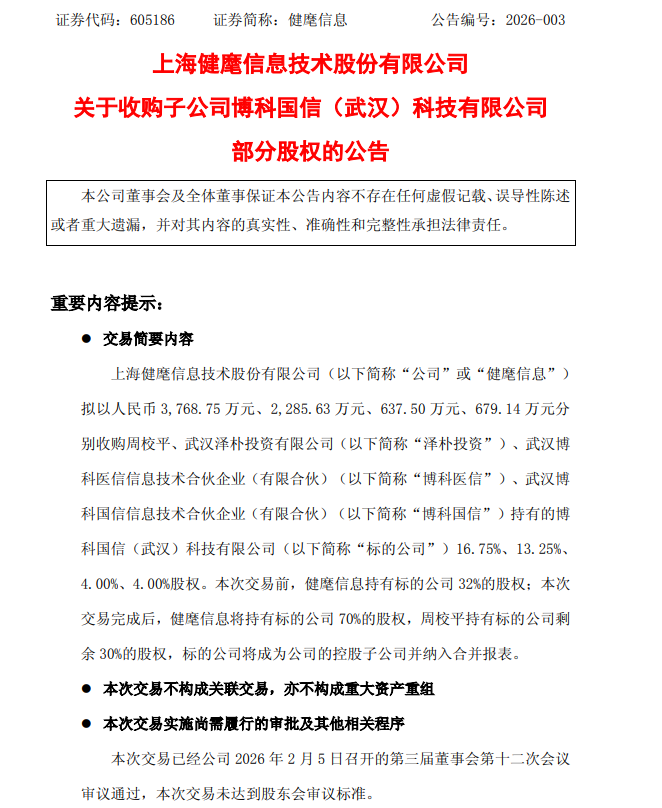
健麾信息最新公告:拟7371万元收购AI应用公司博科国信38%股权
Sou Hu Cai Jing· 2026-02-05 10:40
Group 1 - The company plans to acquire equity stakes in Boke Guoxin (Wuhan) Technology Co., Ltd. for a total of 10,371.02 million yuan, which includes 3,768.75 million yuan from Zhou Xiaoping, 2,285.63 million yuan from Ze Pu Investment, 637.50 million yuan from Boke Yixin, and 679.14 million yuan from Boke Guoxin [1] - After the completion of the transaction, the company will hold 70% of the equity in the target company [1] - The target company is a member of the China Medical Health Information Interconnection Technology Alliance and HL7 China, and is the first medical information technology enterprise in Central China to pass 13 system tests of FHIR Connectathon [1] Group 2 - The target company's research and development in medical AI applications, such as the B-Klinik intelligent agent, will inject innovative momentum into the company's core business [1] - This acquisition is expected to help the company explore business opportunities in smart hospitals, county-level medical communities, and digital health management [1]
健麾信息:拟7371万元收购AI应用公司博科国信38%股权
Mei Ri Jing Ji Xin Wen· 2026-02-05 10:08
Core Viewpoint - The company Jianhui Information (605186) plans to acquire a total of 70% equity in Boke Guoxin (Wuhan) Technology Co., Ltd. through multiple transactions totaling approximately 10.4 million yuan, which will enhance its capabilities in the healthcare information technology sector [1] Group 1: Acquisition Details - Jianhui Information intends to purchase 16.75% equity from Zhou Xiaoping for 37.6875 million yuan, 13.25% from Ze Pu Investment for 22.8563 million yuan, 4.00% from Boke Yixin for 6.375 million yuan, and another 4.00% from Boke Guoxin for 6.7914 million yuan [1] - Upon completion of these transactions, Jianhui Information will hold 70% of the equity in the target company [1] Group 2: Target Company Profile - Boke Guoxin is a member of the China Healthcare Information Interconnection Technology Alliance and HL7 China [1] - The target company is the first healthcare information enterprise in Central China to pass 13 system tests in the FHIR Connectathon [1] Group 3: Strategic Implications - The acquisition is expected to inject innovative intelligence into Jianhui Information's core business, particularly in the development of medical AI applications such as the B-Klinik intelligent agent [1] - This move will help the company explore business opportunities in smart hospitals, county-level medical communities, and digital health management [1]
不接医保、不搞营销、复购超八成,这家健康消费新势力靠什么“破局”和“出圈”?
Ge Long Hui· 2025-12-03 07:57
Core Viewpoint - The healthcare service industry, traditionally considered "counter-cyclical," is facing pressure due to fluctuating consumer confidence and stringent cost-control policies, leading to profit compression for many medical institutions. However, Zhuozheng Medical, a leading private healthcare brand, shows a contrasting growth trajectory with significant revenue and profit increases projected from 2022 to 2024 [1]. Group 1: Financial Performance - Zhuozheng Medical's revenue is projected to grow from 470 million yuan in 2022 to 960 million yuan in 2024, representing a compound annual growth rate (CAGR) of 42.2% [1]. - The company's gross profit is expected to rise from 43.98 million yuan in 2022 to 230 million yuan in 2024, with a CAGR of 126.7% [1]. - The net profit is forecasted to turn positive in 2024, with figures of -220 million yuan, -350 million yuan, and 80.23 million yuan for the years 2022, 2023, and 2024 respectively, leading to a net profit margin of 8.4% in 2024 [1]. Group 2: Business Model - Zhuozheng Medical does not rely on medical insurance, with only 0.2% of its revenue coming from national medical insurance in 2022 and 2023, and 1.2% in 2024, primarily from a newly acquired hospital [2]. - The company generates over 85% of its revenue from cash payments, allowing for self-pricing and avoiding over-treatment revenue models [3]. - The focus on cash-paying customers has enabled Zhuozheng Medical to maintain positive operating cash flow, exceeding 1 billion yuan in the first eight months of 2025 [3]. Group 3: Customer Acquisition Strategy - Zhuozheng Medical adopts a "slow and steady" approach, relying on word-of-mouth and customer referrals rather than aggressive marketing, with marketing expenses constituting only 2.7%, 1.2%, and 1.7% of revenue from 2022 to 2024 [5]. - The company has a high customer retention rate, with membership renewal rates increasing from 42% in 2022 to 67% in 2025, and patient return rates rising from 75.7% to 82.7% over the same period [6][8]. Group 4: Service Model - Zhuozheng Medical employs a "family multi-specialty" model, addressing common health issues and extending care across various specialties, which increases customer retention and frequency of visits [12]. - In 2024, the average customer visited Zhuozheng Medical nearly four times, significantly higher than typical single-specialty institutions [13]. Group 5: Technology Integration - The company has integrated AI into its operations since 2020, focusing on practical applications rather than following industry trends, which has led to a reduction in labor costs from 80% to 54% of revenue by 2025 [14]. - AI applications have improved operational efficiency, such as automating patient appointment assessments and enhancing diagnostic processes [14]. Group 6: Market Outlook - The private mid-to-high-end healthcare service market in China is projected to grow from 426.4 billion yuan in 2024 to 831.4 billion yuan by 2029, with a CAGR of 14.3%, indicating strong potential for companies like Zhuozheng Medical [16].

冯诺依曼研究院成立深港科技合作再添AI范式
2 1 Shi Ji Jing Ji Bao Dao· 2025-05-09 09:45
Core Insights - Hong Kong has established the Von Neumann Institute to integrate embodied intelligence, generative AI, and advanced supercomputing technologies, aiming to promote interdisciplinary collaboration and commercialize research outcomes [1][2] - The institute focuses on five key AI areas: multimodal AI systems, enhancing AI reasoning capabilities, robotics intelligence, AI-driven 3D understanding, and healthcare service reform through large models [2][3] - The institute aims to build a talent pipeline in AI through educational initiatives, targeting over 100 PhD students and engaging with local schools to foster innovation [3] Group 1 - The Von Neumann Institute is the first "full-chain practical" AI research institute in the Greater Bay Area, bridging basic research and industrial application [2] - The institute's approach includes establishing specialized laboratories and joint industry-university collaborations to accelerate the transition from theoretical research to product development [2][3] - The leadership of Jia Jiaya, who has experience as a scientist, entrepreneur, and educator, positions the institute to become a model of "top-tier research and grounded industry" [3] Group 2 - Jia Jiaya emphasizes Hong Kong's role as an "innovation brain" due to its international capital flow, top-tier research resources, and global talent hub, while Shenzhen acts as the "industrial driver" [4] - The integration of large models and visual sensor hardware by Simo Technology showcases a demand-driven approach to innovation, with applications in major factories like Tesla and BYD [4][5] - The collaboration between Hong Kong and Shenzhen has created a rapid coordination mechanism, allowing for quick transitions from research to production [5]