
医药企业转型

Search documents
战略聚焦谋转型 聚力攻坚启新程——海王生物以雷霆之势推动高质量发展跃迁
Sou Hu Wang· 2026-01-06 08:45
Core Insights - The pharmaceutical industry is undergoing a transformation driven by policy collaboration, technological breakthroughs, and industrial restructuring, with a clear shift from price competition to value creation [1] - Shenzhen Haiwang Bioengineering Co., Ltd. is leveraging the new management team's arrival to implement asset optimization, focus on core businesses, and enhance innovation and research, marking a transition from scale expansion to quality and efficiency improvement [1] Industry Policy - The new national medical insurance drug list and the first commercial insurance innovative drug list took effect on January 1, 2026, creating a multi-tiered insurance system that opens diverse payment channels for innovative drugs [1] - The national centralized procurement has entered a new phase aimed at stabilizing clinical practices, ensuring quality, preventing collusion, and countering internal competition, guiding companies towards R&D innovation and quality enhancement [1] Management and Asset Optimization - The new management team established a strategic agenda focused on increasing sales gross margin, ensuring asset safety, improving financing channels, and optimizing capital returns, injecting strong momentum into the transformation [2] - The company is actively divesting non-core assets to enhance the operational quality and profitability of subsidiaries while reallocating limited funds to high-value areas to improve overall profitability [2] Business Focus and Innovation - Haiwang Bio is concentrating on three core sectors: pharmaceutical distribution, pharmaceutical manufacturing, and pharmaceutical R&D, driving business collaboration upgrades [3] - The pharmaceutical distribution sector showed strong performance, with medical device agency revenue reaching 4.986 billion yuan in the first half of 2025, establishing solid partnerships with industry leaders [3] - The pharmaceutical manufacturing sector has a gross margin of 36.14%, with strategies to promote production and sales collaboration [3] - R&D investment reached 31.68 million yuan in the first three quarters of 2025, with ongoing clinical trials for innovative drugs and expansion into traditional Chinese medicine and specialized food sectors [3] Governance Upgrade - The company has revised internal management systems to enhance governance transparency and decision-making efficiency, strengthening internal controls and shareholder return systems [3] - The management team has committed to focusing on high-efficiency business development over the next three years, particularly in the medical device and pharmaceutical manufacturing sectors [3] Industry Outlook - Industry experts note that Haiwang Bio's deep transformation aligns with the demands for high-quality development, showcasing determination and strength through asset optimization, business focus, innovation, and governance upgrades [4] - With the dual drivers of policy benefits and strategic focus, Haiwang Bio is expected to transition from a traditional pharmaceutical company to a technology-driven healthcare service provider, reconstructing its competitive edge [4]

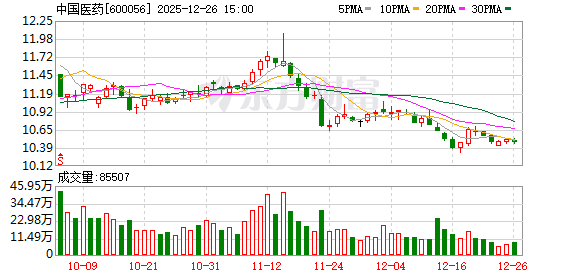
中国医药原董事长高渝文被查 公司前三季度净利润已“倒退”至10年前水平
Mei Ri Jing Ji Xin Wen· 2025-12-27 16:00
Core Viewpoint - The investigation of Gao Yuwen, former chairman of China National Pharmaceutical Group Co., Ltd. (China Pharmaceutical), highlights ongoing corruption issues within the company, which has seen a significant decline in performance over recent years despite leadership changes. Group 1: Leadership and Governance - Gao Yuwen served as chairman for approximately three years and was the highest-ranking official investigated among over ten executives scrutinized in recent anti-corruption efforts [2][3] - Since 2016, China Pharmaceutical has experienced five chairmen, indicating instability in leadership without corresponding improvements in company performance [8][9] Group 2: Financial Performance - In the first three quarters of this year, China Pharmaceutical reported a net profit of approximately 455 million yuan, marking a decline of 4.64% year-on-year and the lowest level in nearly a decade [11][12] - The company's total revenue for the same period was 25.894 billion yuan, down 3.42% year-on-year, continuing a trend of revenue decline for two consecutive years [11][12] Group 3: Market Challenges - The company faces ongoing challenges from policies such as volume-based procurement and medical insurance cost control, which have pressured profit margins [11] - International trade revenue decreased by nearly 20% year-on-year, attributed to the impact of domestic substitution policies [11] Group 4: Strategic Initiatives - To address performance issues, the company is focusing on transformation and innovation, with planned R&D investments of 276 million yuan and 346 million yuan for 2023 and 2024, respectively [11] - The company has significantly reduced sales expenses from 2.485 billion yuan in 2020 to 1.099 billion yuan in 2024 as part of its compliance efforts [11] Group 5: Goodwill and Acquisitions - Previous acquisitions aimed at expanding the pharmaceutical commercial sector have resulted in goodwill risks, with a goodwill impairment loss of approximately 128 million yuan anticipated for 2024 [12] - As of the first three quarters of this year, the company's goodwill balance stood at 996 million yuan, compared to a net profit of 535 million yuan last year [12]


北大医药继续“去北大化” 子公司痛失第一大客户,进一步向医药制造转型
Mei Ri Jing Ji Xin Wen· 2025-08-12 08:38
Core Viewpoint - The termination of the business cooperation between Beijing Beida Pharmaceutical's subsidiary and Peking University International Hospital poses significant risks to the company's main operations, potentially leading to a substantial loss in revenue and profit due to its heavy reliance on this partnership [1][2][3]. Group 1: Business Impact - The termination of cooperation with the International Hospital has resulted in a projected revenue decrease of approximately 6 billion yuan for the current year, which accounts for about 29.13% of the company's most recent audited revenue [2]. - The company anticipates a net profit reduction of around 40 million yuan, representing about 28.99% of the latest audited net profit attributable to shareholders [2]. - Starting in 2026, the company may face even greater losses, with projected revenue declines of 10.27 billion yuan and net profit reductions of approximately 68.69 million yuan, which could account for nearly 50% of the company's recent audited revenue and net profit [2]. Group 2: Business Transition - In response to the loss of its primary client, the company is shifting its focus towards pharmaceutical manufacturing, establishing a new subsidiary based on its production center to enhance its capabilities in generic drug production [1][3]. - The pharmaceutical distribution business, which heavily relied on the International Hospital, generated 14.37 billion yuan in revenue in 2024, making up 69.75% of the company's total revenue [3]. - The company has announced plans to concentrate resources on the manufacturing segment to improve efficiency and leverage its strengths in generic drug production [3][4]. Group 3: Financial Performance - In 2024, the company's pharmaceutical manufacturing revenue was 6.23 billion yuan, accounting for approximately 30% of total revenue, with a gross margin of 57.47%, significantly higher than the 13.48% gross margin from the pharmaceutical distribution business [4]. - The company's generic drug products have been affected by centralized procurement policies, which have led to a decline in gross margin by 11.23 percentage points compared to the previous year [5].

大手笔收购关联方股权,中国医药引监管关注
Bei Ke Cai Jing· 2025-05-15 10:29
Core Viewpoint - China National Pharmaceutical Group Corporation (China Pharmaceutical) plans to acquire 100% equity of Jinsui Technology from Xinxing Group for 302 million yuan, despite facing declining revenue and net profit in 2024, raising questions about the effectiveness of this acquisition in alleviating performance pressure [1][3]. Group 1: Acquisition Details - The acquisition involves a related party transaction as Xinxing Group is a wholly-owned subsidiary of China Pharmaceutical's controlling shareholder, General Technology Group [1]. - Jinsui Technology, established in 1993, has shifted to e-commerce services since 2011, focusing on health consumer products and collaborating with brands like Philips and Omron [2]. - The valuation of Jinsui Technology in this acquisition shows a total equity value of 302 million yuan, with an increase of 116 million yuan in net asset value, representing a 62.72% appreciation [1][2]. Group 2: Financial Performance - In 2024, China Pharmaceutical reported a revenue of 34.148 billion yuan, a decrease of 12.04% year-on-year, and a net profit of 535 million yuan, down 48.91% [3][4]. - The decline in revenue is attributed to a reduction in temporary medical supplies business, which had previously surged during the pandemic [3]. - The pharmaceutical industrial segment, a core business for China Pharmaceutical, saw a revenue drop of 10.10% in 2024, despite a 30% increase in new product sales [4]. Group 3: Debt and Financial Concerns - Jinsui Technology has an outstanding loan principal of 205 million yuan owed to Xinxing Group, raising concerns about the financial implications of the acquisition [2][6]. - China Pharmaceutical has faced issues with previous acquisitions, including significant asset impairment losses and ongoing litigation related to unmet performance commitments from acquired companies [5][6].