医药ETF配置

Search documents
华创医药投资观点&研究专题周周谈 · 第160期:医药行业ETF研究系列二之医药ETF2026年场景化配置框架
Huachuang Securities· 2026-01-25 02:45
Investment Rating - The report does not explicitly state an investment rating for the pharmaceutical industry but emphasizes a positive outlook on various segments within the industry, particularly innovative drugs and medical devices [9][10]. Core Insights - The pharmaceutical industry is transitioning from a quantity-driven logic to a quality-driven logic, focusing on differentiated products and internationalization by 2025 [9]. - There is a notable shift in funding from active to passive medical funds, indicating a low allocation status in the pharmaceutical sector, which is expected to change as passive funds become a significant part of the investment landscape [16][17]. - The report outlines a structured approach to ETF investment in the pharmaceutical sector, emphasizing a dynamic combination of broad-based and targeted strategies to balance returns and risks [27]. Summary by Sections Market Review - The CITIC Pharmaceutical Index decreased by 0.38%, outperforming the CSI 300 Index by 0.24 percentage points, ranking 25th among 30 sectors [6]. - The top-performing stocks included *ST Changyao, Hualan Biological Engineering, and Kangzhong Medical, while the worst performers were Kaiyin Technology and Aidi Pharmaceutical [6]. Innovative Drugs - The report highlights a positive outlook for domestic innovative drugs, suggesting a focus on companies that can deliver profits, such as BeiGene, Innovent Biologics, and others [9]. Medical Devices - The medical device sector is expected to see a recovery in bidding volumes for imaging equipment by 2025, with a focus on companies like Mindray and United Imaging [9]. - The home medical device market is also anticipated to grow due to supportive policies and accelerated international expansion [9]. Innovation Chain (CXO + Life Science Services) - The report indicates a potential recovery in overseas investment and financing, with domestic financing expected to stabilize, marking the beginning of a new wave of innovation [9]. Pharmaceutical Industry - The report suggests that the specialty API sector may see cost improvements, leading to a new growth cycle, with companies like Tonghua Dongbao and Huahai Pharmaceutical highlighted for their potential [9]. Traditional Chinese Medicine - The report discusses the expected growth in the basic drug market and the impact of state-owned enterprise reforms on companies like Kunming Pharmaceutical and Kangyuan Pharmaceutical [11]. Pharmacy Sector - The report expresses optimism about the pharmacy sector due to the acceleration of prescription outflow and the optimization of competitive dynamics, recommending companies like YaoXing and YiFeng Pharmacy [11]. Medical Services - The report notes that anti-corruption measures and centralized procurement are improving the market environment for private medical services, with recommendations for companies like Huashan Medical and Aier Eye Hospital [11]. Blood Products - The report anticipates a favorable long-term growth path for the blood products industry, with companies like TianTan Biological and Boya Biological expected to benefit from increased demand and supply elasticity [11].

华创医药周观点:医药行业ETF研究系列二之医药ETF2026年场景化配置框架 2026/01/25
华创医药组公众平台· 2026-01-24 16:13
Core Viewpoint - The article discusses the investment framework for the pharmaceutical industry ETF in 2026, emphasizing a dual-driven approach of demand and innovation to navigate the market recovery and differentiation after a prolonged bear market since 2021 [29]. Market Review - The CITIC Pharmaceutical Index decreased by 0.38%, outperforming the CSI 300 Index by 0.24 percentage points, ranking 25th among 30 primary industries [9]. - The top ten stocks by increase this week included ST Changyao, Hualan Biological Engineering, and Kangzhong Medical, with gains ranging from 6% to 70.38% [9]. - The bottom ten stocks by decrease included Kain Technology and Aidi Pharmaceutical, with declines of up to 45% [9]. Industry and Stock Events - The article highlights a shift in funding from active to passive management in the pharmaceutical sector, with passive funds becoming a significant part of the long-term funding structure [18]. - The article notes that the innovation drug sector is expected to see a transition from quantity to quality, focusing on differentiated products and internationalization by 2025 [12]. - The medical device sector is experiencing a recovery in bidding volumes, particularly in imaging equipment, and is benefiting from policies promoting home medical devices and accelerated overseas expansion [12]. - The article discusses the favorable conditions for the blood products industry, with relaxed approval for plasma stations and a clear growth path for the industry during the 14th Five-Year Plan period [13]. Investment Strategy - The article proposes a dynamic ETF configuration framework for the pharmaceutical sector, categorized into three layers: a core base of broad-based ETFs, a dual-driven layer focusing on innovative drugs and medical devices, and a defensive layer using traditional Chinese medicine and overseas biotech [22]. - The article emphasizes the importance of a systematic approach to ETF selection, considering liquidity, tracking quality, and cost [24]. - It suggests that the pharmaceutical sector is entering a new growth cycle driven by rigid demand and continuous innovation, necessitating a more structured and rhythmic ETF combination strategy [22].

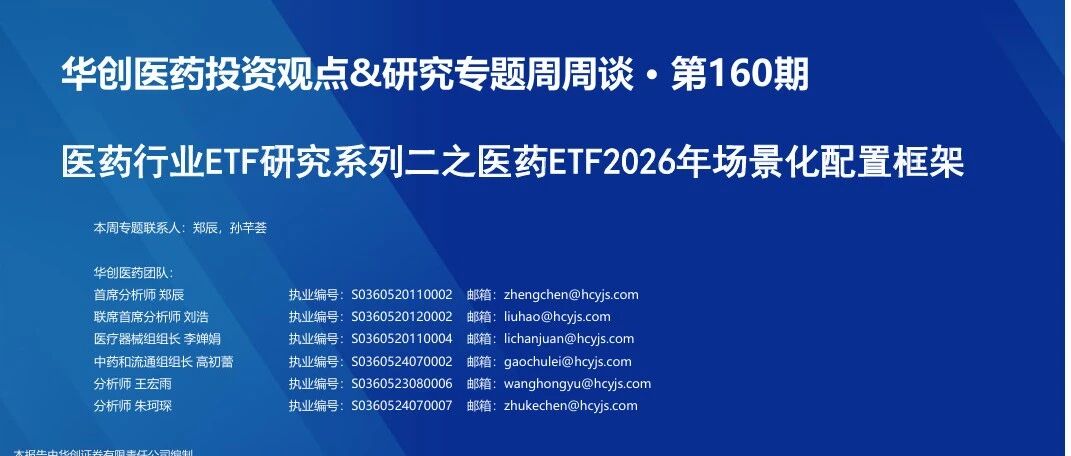
港股医药板块震荡调整,关注恒生创新药ETF(159316)、港股通医药ETF(513200)等配置价值
Mei Ri Jing Ji Xin Wen· 2025-09-15 14:02
Group 1 - The Hang Seng Hong Kong Stock Connect Innovative Drug Index decreased by 0.4%, while the CSI Hong Kong Stock Connect Pharmaceutical and Health Comprehensive Index fell by 0.1% [1] - The CSI Biotechnology Theme Index increased by 0.1%, and the CSI Innovative Drug Industry Index rose by 0.2% [1] - The CSI 300 Pharmaceutical and Health Index saw an increase of 0.4% [1] Group 2 - The Hang Seng Innovative Drug ETF (159316) experienced a net inflow of 580 million yuan last week, bringing its total size to 2.7 billion yuan, marking a historical high [1] - The rolling price-to-earnings ratio for the pharmaceutical and health industry is reported at 33.5 times, with a valuation percentile of 63.4% [4] - The liquid products and other human biotechnology sector have a rolling price-to-earnings ratio of 64.2 times, with a valuation percentile of 85.3% [4]