半导体IP授权

Search documents
芯原微电子(上海)股份有限公司2025年第三季度报告
Shang Hai Zheng Quan Bao· 2025-10-28 00:13
Core Viewpoint - The company reported significant growth in revenue and a reduction in losses for the third quarter of 2025, driven by high order volumes and strong demand in the semiconductor industry [4][9]. Financial Performance - The company achieved a record revenue of 1.281 billion yuan in Q3 2025, marking a 119.26% increase quarter-over-quarter and a 78.38% increase year-over-year [4]. - For the first three quarters of 2025, total revenue reached 2.255 billion yuan, representing a year-over-year growth of 36.64% [10]. Business Segments - Revenue from chip design services in Q3 2025 was 428 million yuan, up 290.82% quarter-over-quarter and 80.23% year-over-year [5]. - The mass production business generated 609 million yuan in Q3 2025, reflecting a quarter-over-quarter increase of 132.77% and a year-over-year increase of 157.84% [5]. - Intellectual property licensing revenue was 212 million yuan in Q3 2025, with a quarter-over-quarter growth of 13.43% [5]. Orders and Backlog - The company signed new orders worth 1.593 billion yuan in Q3 2025, a year-over-year increase of 145.80%, with approximately 65% related to AI computing [6]. - The total backlog of orders reached 3.286 billion yuan by the end of Q3 2025, with 83.52% coming from system manufacturers, large internet companies, cloud service providers, and automotive companies [8]. Profitability - The net loss attributable to the parent company narrowed significantly to 26.8511 million yuan in Q3 2025, a reduction of 84.20% year-over-year and 73.02% quarter-over-quarter [9]. - The company’s gross profit for the first three quarters of 2025 was 788 million yuan, with a gross margin of 34.95% [13]. Research and Development - The company maintained a high level of R&D investment, totaling 999 million yuan in the first three quarters of 2025, with a reasonable decrease in the proportion of R&D expenses relative to revenue [14].

芯原股份三季度收入新高仍亏损,国产AI芯片企业盈利受考验
Di Yi Cai Jing· 2025-10-09 13:01
Core Insights - The domestic AI chip industry is experiencing a performance explosion, but most companies still face profitability challenges, making the conversion of large orders into actual profits a key focus for the capital market [1][5] Company Performance - Chipone Technology (688521.SH) reported a significant increase in revenue, expecting to achieve 1.284 billion yuan in the third quarter, marking a 119.74% increase quarter-on-quarter and a 78.77% increase year-on-year [1] - The company signed new orders worth 3.249 billion yuan in the first three quarters, exceeding the total for the entire year of 2024, with 65% of these orders related to AI computing power [1][2] - Despite the revenue surge, Chipone reported a net loss of 320 million yuan in the first half of the year, which is a 12.3% increase in losses compared to the same period last year [1][3] Business Segmentation - The company's one-stop chip customization business is the core growth driver, with expected revenues of 429 million yuan from chip design and 609 million yuan from chip mass production in the third quarter, representing increases of 291.76% and 133.02% respectively [2] - The one-stop chip customization business is projected to account for over 80% of total revenue in the third quarter, while the traditional semiconductor IP licensing business's revenue is expected to remain flat year-on-year [2][4] Order Conversion Efficiency - As of the end of the third quarter, Chipone's backlog was estimated at 3.286 billion yuan, with 90% coming from the one-stop chip customization business, and 80% expected to convert to revenue within a year [3] - The company has maintained a high backlog for eight consecutive quarters, indicating strong demand for AI chips [3] Profitability Challenges - The company's high R&D expenses are a core issue affecting profitability, with R&D costs reaching 1.247 billion yuan in 2024, accounting for 53.7% of revenue [3] - The gross margin for the one-stop chip customization business is significantly lower at 18.17%, compared to 92.73% for traditional IP licensing, further exacerbating profitability pressures [4] Industry Context - The domestic AI chip industry is facing similar profitability challenges, with companies like Moore Threads and Muxi also reporting significant revenue growth but continuing to incur losses [5] - The competitive landscape indicates that the first companies to achieve large-scale production will have a profitability advantage, as the market remains fragmented without a clear leader [6]

国产替代浪潮中的隐形冠军③ | 解码半导体IP“销冠”芯原股份
Bei Jing Shang Bao· 2025-09-02 14:58
Core Insights - The rise of domestic semiconductor companies like Verisilicon (芯原股份) is a result of the trend towards domestic substitution in the technology sector, focusing on deep specialization in hard technology [1] - The acquisition of RISC-V CPU IP company Chiplet (芯来智融) by Verisilicon is seen as a strategic move to enhance its CPU IP capabilities and strengthen its overall stack [3][11] Group 1: Market Position and Performance - Verisilicon ranks as the eighth largest semiconductor IP provider globally and the first in China, with a market share of 1.6% and an IP licensing revenue of approximately $113 million in 2024 [4][6] - The global semiconductor IP market is dominated by ARM and Synopsys, which together hold about 66% of the market share, highlighting the competitive landscape [6] - Verisilicon's IP offerings cover a wide range of applications, including AI, automotive electronics, and cloud services, with significant adoption among major global companies [9][7] Group 2: Business Model and Ecosystem - Verisilicon's business model, SiPaaS (Silicon Platform as a Service), allows for a distributed and reusable platform service, reducing the barriers for smaller companies to enter the semiconductor market [10] - The company's ecosystem approach enables collaboration and specialization among various players in the semiconductor industry, enhancing overall innovation efficiency [10][12] Group 3: Financial Performance and R&D Investment - In the first half of 2025, Verisilicon's R&D expenses reached 612 million yuan, accounting for 62.85% of its total revenue, indicating a strong commitment to innovation [14] - Despite significant R&D investments, the company faced net losses in 2023 and 2024, with a continued loss of 320 million yuan in the first half of 2025, reflecting the industry's cyclical nature [16][17] - Recent financial improvements were noted, with a 49.9% increase in revenue in Q2 2025, suggesting a recovery in demand for its IP solutions [17]

芯原股份2025年中报简析:增收不增利,公司应收账款体量较大
Zheng Quan Zhi Xing· 2025-08-23 22:58
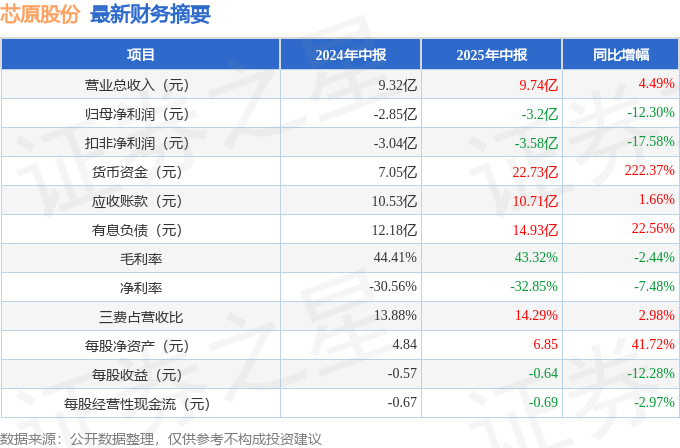
Financial Performance - The company reported a total revenue of 974 million yuan for the first half of 2025, an increase of 4.49% year-on-year [1] - The net profit attributable to shareholders was -320 million yuan, a decrease of 12.3% compared to the previous year [1] - In Q2 2025, total revenue was 584 million yuan, down 4.84% year-on-year, with a net profit of -99.51 million yuan, a decline of 27.86% [1] - The gross margin was 43.32%, down 2.44% year-on-year, while the net margin was -32.85%, a decrease of 7.48% [1] - The total of selling, administrative, and financial expenses was 139 million yuan, accounting for 14.29% of revenue, an increase of 2.98% year-on-year [1] Balance Sheet Highlights - Cash and cash equivalents increased significantly by 222.37% to 2.273 billion yuan due to funds raised from a specific stock issuance [1] - Accounts receivable stood at 1.071 billion yuan, a slight increase of 1.66% [1] - Interest-bearing liabilities rose by 22.56% to 1.493 billion yuan [1] - The net asset value per share increased by 41.72% to 6.85 yuan [1] Cash Flow Analysis - Operating cash flow per share was -0.69 yuan, a decrease of 2.97% year-on-year [1] - The net cash flow from investing activities increased by 352.0%, attributed to the maturity of financial assets [4] - The net cash flow from financing activities surged by 712.12% due to funds raised from stock issuance [5] Business Operations - The company has a significant amount of accounts receivable, which accounted for 46.11% of total revenue [1] - The company is focusing on enhancing its semiconductor IP licensing and chip customization services, which are expected to complement each other effectively [9] Market Position - The company has shown a historical median ROIC of -8.27%, indicating poor investment returns [6] - The company has experienced losses in 7 out of its 10 years since listing, suggesting a challenging financial history [6] - The largest fund holding the company's shares is the Huaxia SSE Sci-Tech Innovation Board 50 ETF, which has seen significant growth in the past year [8]