单一行政理论

Search documents
就在美联储做出暂停降息决定后,特朗普正式发声,不会让现任美联储主席连任,将任命银行高管担任这个职务,这会让美国货币政策大变吗?而从特朗普的决定看,他依然把“忠诚”作为最优先的选择,这会造成怎样的影响?日前,美联储主席鲍威尔宣布,鉴于“美国经济前景有明显改善”,因此决定暂停降息。而业内人...
Sou Hu Cai Jing· 2026-01-31 03:53
Group 1 - The Federal Reserve's decision to pause interest rate cuts is influenced by the improving economic outlook in the U.S. [1] - Trump's nomination of Kevin Walsh as the new Federal Reserve Chair indicates a shift towards a more hawkish monetary policy, prioritizing loyalty over economic theory [1][4] - Walsh's approach opposes quantitative easing and advocates for supply-side reforms, which may lead to increased market volatility if implemented [1] Group 2 - The effectiveness of the Federal Reserve's aggressive interest rate hikes followed by cuts is questioned, as it has not translated into beneficial trade outcomes for the U.S. economy [3] - Walsh's nomination is seen as a result of political loyalty rather than economic expertise, as he surpassed other candidates due to Trump's desire for control over the Federal Reserve [4] - Even with a new chair, the Federal Reserve may still refrain from significant interest rate cuts due to the ongoing economic pressures and geopolitical factors [5]

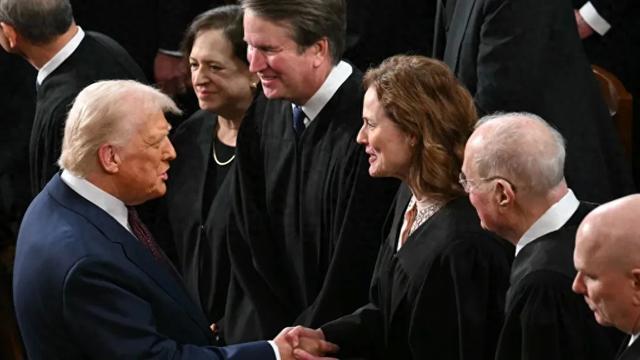
90年先例要被推翻、美联储独立性也悬了?美最高院暗示支持特朗普解雇FTC委员
Hua Er Jie Jian Wen· 2025-12-08 20:27
Core Viewpoint - The U.S. Supreme Court's recent oral arguments signal a potential shift in the federal power structure, raising concerns about the independence of the Federal Reserve amidst challenges to the long-standing precedent protecting independent federal agencies [1][2]. Group 1: Supreme Court's Stance - The conservative majority of the Supreme Court is questioning the constitutionality of independent agencies, suggesting that the President should have control over traditionally independent federal institutions [3][5]. - Justice Neil Gorsuch criticized the Humphrey's Executor precedent as "improperly reasoned," indicating a likelihood to vote for its overturning [3]. - Chief Justice John Roberts described the precedent as a "withered shell," arguing that it no longer holds relevance due to significant changes in the FTC over the past 90 years [3]. Group 2: Concerns from Liberal Justices - Liberal justices expressed strong warnings against overturning the long-standing position protection mechanism, arguing it would grant the President unchecked power [5]. - Justice Elena Kagan highlighted the potential for the President to wield enormous, unaccountable power over independent agencies, undermining the structure of government [5]. - Justice Sonia Sotomayor questioned the court's history of overturning such significant precedents that have greatly influenced government operations [5]. Group 3: Implications for the Federal Reserve - The upcoming case regarding the dismissal of Federal Reserve Governor Lisa Cook may reflect the court's stance on the independence of the Federal Reserve [2][9]. - The court previously indicated a potential distinction for the Federal Reserve, suggesting it may not be affected by the same rulings applicable to other independent agencies [9]. - Legal experts predict that the court is likely to overturn the Humphrey's Executor precedent, which could allow the President to dismiss officials from the FTC and similar agencies [6][9]. Group 4: Trump's Administrative Theory - The Trump administration's legal team advocates for a "unitary executive theory," asserting that the President has exclusive constitutional authority to exercise executive power, including regulatory decisions [7]. - Deputy Attorney General D. John Sauer argued that the current structure creates a power vacuum where significant government authority is exercised without accountability to the President [7]. - The administration's stance has led to the dismissal of several independent agency officials, raising questions about the future of these institutions [7][8]. Group 5: Future Considerations - The ruling on the Slaughter case is expected by June 2024, which will not only determine the fate of FTC Commissioner Slaughter but also provide insights into the future of Federal Reserve Governor Cook [10][11]. - The outcome of these cases could fundamentally reshape the power dynamics within the U.S. federal government [11].
专访|200余起诉讼,特朗普上台100天,美国已进入宪政危机
Xin Lang Cai Jing· 2025-04-30 03:32
Core Points - The article discusses the unprecedented expansion of presidential power under Trump during his first 100 days in office, characterized by a record 210 executive orders and minimal legislative action [2][3][5] - It highlights the legal challenges faced by Trump's administration, including court rulings against his executive actions, indicating a struggle between the executive branch and the judiciary [3][10][32] - The article emphasizes the political dynamics within Congress, noting the lack of checks on presidential power due to Republican control, which has led to a significant erosion of legislative oversight [9][16][18] Group 1: Presidential Power Expansion - Trump's administration has issued 210 executive orders, a historical record, while largely bypassing Congress [2][3] - The use of executive power has been described as radical and unprecedented, with actions that challenge traditional legal boundaries [6][20] - The administration's approach reflects a shift towards a more militarized narrative on immigration and a broader interpretation of executive authority [7][8][20] Group 2: Legal Challenges and Judicial Response - As of April 25, at least 122 court rulings have temporarily halted various Trump initiatives, with 211 cases currently under review [3][10] - The judiciary has increasingly acted as a check on executive power, with federal courts issuing nationwide injunctions against Trump's policies [10][12] - Trump's administration has shown a tendency to ignore court rulings, raising concerns about the respect for judicial authority [10][32] Group 3: Congressional Dynamics - The Republican majority in Congress has largely supported Trump's actions, resulting in minimal legislative pushback against his executive orders [9][16] - There is a notable absence of congressional investigations or oversight, which has historically served as a check on presidential power [16][18] - The political environment has led to a situation where party loyalty overrides legislative accountability, diminishing the effectiveness of checks and balances [17][18]