原料供应保障

Search documents
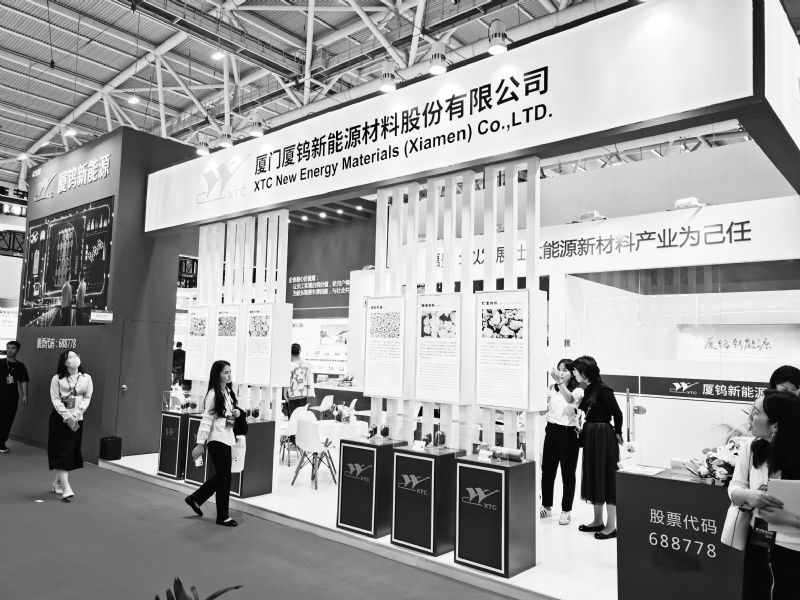
厦钨新能核心产品热销年营收200亿 研发人员占近15%手握288项专利
Chang Jiang Shang Bao· 2026-01-29 01:29
Core Viewpoint - Xiamen Tungsten Co., Ltd. (688778.SH) has reported impressive financial results for 2025, showcasing strong growth in revenue and net profit, indicating robust operational resilience in the lithium battery materials sector [2][4]. Financial Performance - In 2025, the company achieved revenue of 20.034 billion yuan, a year-on-year increase of 47.84%, and a net profit attributable to shareholders of 755 million yuan, up 41.83% [2][4]. - The company experienced a significant revenue growth of 80.55% in 2022, reaching 28.75 billion yuan, and a net profit surge of 93.66% to 1.121 billion yuan [3]. - However, in 2023 and 2024, the company faced a temporary decline in performance due to industry-wide adjustments, with revenues of 17.31 billion yuan and 13.3 billion yuan, respectively [3][4]. Product Performance - The sales volume of lithium cobalt oxide reached 65,300 tons in 2025, reflecting a year-on-year growth of 41.31%, significantly outpacing the industry average [4]. - The sales volume of power battery cathode materials, including ternary materials and lithium iron phosphate, reached 77,400 tons, marking a 47.83% increase [4]. Research and Development - From 2021 to the first three quarters of 2025, the company invested a total of 2.502 billion yuan in R&D, maintaining a high level of investment intensity in the industry [6]. - As of mid-2025, the company held 288 registered patents, including 137 invention patents, and employed 544 R&D personnel, accounting for nearly 15% of its total workforce [6]. Market Strategy and Expansion - The company has established five major production bases for cathode materials and has a significant international presence, including a wholly-owned subsidiary in Germany and a joint venture with France's Orano Group [5]. - Strategic partnerships have been formed, including agreements with Zhongwei Co. and Greeenmei, to secure raw material supplies, with expected annual cooperation volumes of 115,000 tons and 150,000 tons, respectively [7]. Asset Growth - The total assets of the company increased from 6.222 billion yuan in 2020 to 21.931 billion yuan by the end of 2025, representing a growth of 140.76% [7].


欢乐家:印尼公司已完成设立登记手续 拟建设椰子加工项目
Zheng Quan Shi Bao Wang· 2025-08-15 02:43
Core Viewpoint - The company has established a wholly-owned subsidiary in Indonesia and increased its registered capital, which is expected to enhance its supply chain competitiveness and resource security for future development [1] Group 1 - The company announced the completion of registration procedures for its wholly-owned subsidiary in Indonesia [1] - The registered capital of the subsidiary, Joyful Home (Hong Kong) International Holdings Limited, has been increased from 17 million USD to 38 million USD [1] - This investment is aimed at extending the company's reach into the upstream product raw material sector, thereby improving the stability and safety of its raw material supply [1]
C1 生物制造产业化的关键路径是什么?谭天伟等人提出保障原料供应、提升碳转化率等策略,实现可持续发展
合成生物学与绿色生物制造· 2025-06-03 12:36
Core Viewpoint - The article emphasizes the importance of C1 biomanufacturing as a sustainable alternative to traditional chemical production, highlighting its potential to address global challenges related to resource depletion and carbon emissions [1][12]. Group 1: C1 Biomanufacturing Overview - C1 biomanufacturing utilizes one-carbon compounds such as CO₂, CO, CH₄, and CH₃OH as raw materials, converting them into high-value chemicals and fuels through microbial processes [3][5]. - The technology integrates metabolic engineering, synthetic biology, and fermentation techniques, aiming to transition from laboratory to industrial scale while ensuring economic viability and environmental sustainability [3][5]. Group 2: Economic and Technical Challenges - Current carbon conversion efficiencies in C1 biomanufacturing are below 10%, leading to increased capital and operational costs, with fermentation equipment costs exceeding 92% in some cases [7][9]. - The article identifies two sustainable pathways for improving production: a dual-stage bioconversion system using steel mill flue gas and a hybrid process coupling CO₂ electrochemical reduction to methanol with microbial conversion [5][9]. Group 3: Raw Material Supply Issues - C1 biomanufacturing faces challenges related to the supply of raw materials, which are geographically dispersed and subject to significant cost fluctuations, with raw material costs accounting for over 57% of operational expenses [9][10]. - Developing technologies that utilize waste materials as raw inputs is crucial for enhancing economic viability and ensuring stable supply chains [9][10]. Group 4: Policy and Collaborative Efforts - Establishing a collaborative mechanism among industry, academia, and research institutions is essential for securing raw material supply, enhancing conversion efficiency, and creating a transparent profit-sharing model [10][12]. - Successful examples include partnerships like Lanzatech's collaboration with Shougang Group for ethanol production from steel mill emissions, demonstrating the importance of upstream and downstream cooperation [10]. Group 5: Environmental Benefits and Future Directions - C1 biomanufacturing shows significant carbon reduction potential, with the ability to achieve net reductions of 17.20 to 1219.03 tons of CO₂ equivalent per ton of chemical produced [11]. - The article suggests that advancements in technology and ongoing cost optimization will pave the way for the commercialization of C1 biomanufacturing in the near future [8][11].