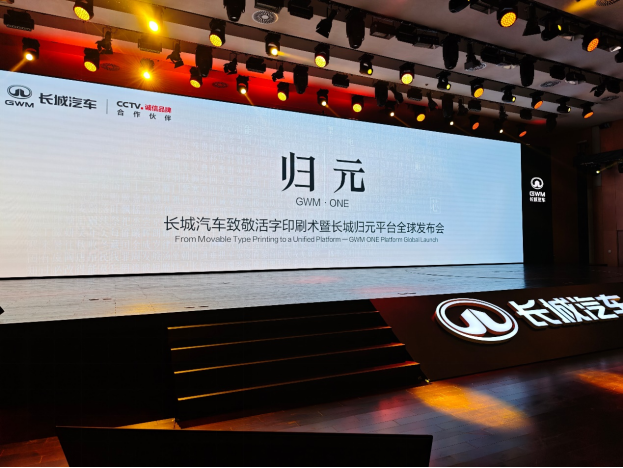
原生AI全动力汽车平台

Search documents
长城汽车(601633):25Q4业绩受战略投入扰动,关注归元平台新车周期
GUOTAI HAITONG SECURITIES· 2026-03-31 03:07
Investment Rating - The report maintains a "Buy" rating for Great Wall Motors [2][5]. Core Views - The company reported a revenue of 69.2 billion yuan in Q4 2025, with a net profit attributable to shareholders of 1.2 billion yuan. The new vehicle cycle has begun, and the global strategy is clearly laid out, justifying the "Buy" rating [2][11]. - The report highlights that the decline in profitability is primarily due to increased investments in new models and technology, as well as the establishment of new direct-to-consumer channels [11]. Financial Summary - Total revenue for 2025 is projected at 222.8 billion yuan, a year-on-year increase of 10.2%. Net profit attributable to shareholders is expected to be 9.87 billion yuan, a decrease of 22.1% [4][11]. - The earnings per share (EPS) for 2026 is estimated at 1.51 yuan, with a price-to-earnings (P/E) ratio of 17x, leading to a target price of 25.60 yuan [11]. - The company achieved a total sales volume of 400,000 vehicles in Q4 2025, a year-on-year increase of 5% and a quarter-on-quarter increase of 13% [11]. Sales and Product Strategy - The report notes that the company launched the world's first native AI all-powertrain vehicle platform, named the "Guiyuan" platform, which aims to enhance product efficiency and competitiveness [11]. - The overseas sales volume reached 172,000 vehicles in Q4 2025, representing a year-on-year increase of 33% [11]. Market Position and Valuation - The total market capitalization of Great Wall Motors is approximately 178.7 billion yuan, with a current share price range of 19.84 to 26.68 yuan over the past 52 weeks [6]. - The company has a net asset return rate of 11.2% for 2025, with a projected increase to 16.5% by 2028 [4][12].

长城汽车2025年营收2228.24亿元,海外销量创新高
Ju Chao Zi Xun· 2026-03-29 07:06
Core Viewpoint - Great Wall Motors Co., Ltd. reported a total revenue of 222.82 billion yuan for 2025, marking a year-on-year growth of 10.2%, while the net profit attributable to shareholders decreased by 22.07% to 9.87 billion yuan [2][3] Financial Performance - Total revenue for 2025 reached 222.82 billion yuan, up from 202.19 billion yuan in 2024, reflecting a growth of 10.2% [3] - Net profit attributable to shareholders was 9.87 billion yuan, down from 12.66 billion yuan in the previous year, a decline of 22.07% [3] - Basic earnings per share were 1.16 yuan, a decrease of 22.15% compared to 1.49 yuan in 2024 [3] - The gross profit margin was 18.04%, down by 1.47 percentage points from the previous year [3][5] - Total assets at the end of 2025 were 2252.88 billion yuan, a 3.48% increase from the beginning of the year [5] - Total liabilities decreased by 0.96% to 1373.96 billion yuan, resulting in an asset-liability ratio of 60.99%, down by 2.73 percentage points [5] Sales and Market Performance - The company sold 1.32 million new vehicles in 2025, representing a year-on-year increase of 7.23% [3] - Overseas sales reached 506,800 units, a growth of 11.60%, with a total of over 2 million cumulative overseas sales [5] - The Haval brand sold 761,500 units, up 7.69%, while the Tank brand sold 234,400 units, maintaining its position as the top-selling off-road SUV in China [4] - The WEY brand achieved a record high of 99,600 units sold, a significant increase of 79.36% [4] Research and Development - The total R&D expenditure for the year was 10.38 billion yuan, with a focus on new technologies such as the Hi4 intelligent four-wheel drive system [4] - The company plans to launch the world's first native AI all-power platform, compatible with various power forms, in early 2026 [4] Dividend Distribution - The company proposed a cash dividend of 0.35 yuan per share, totaling approximately 29.95 billion yuan, which accounts for 30.36% of the net profit attributable to shareholders [2]

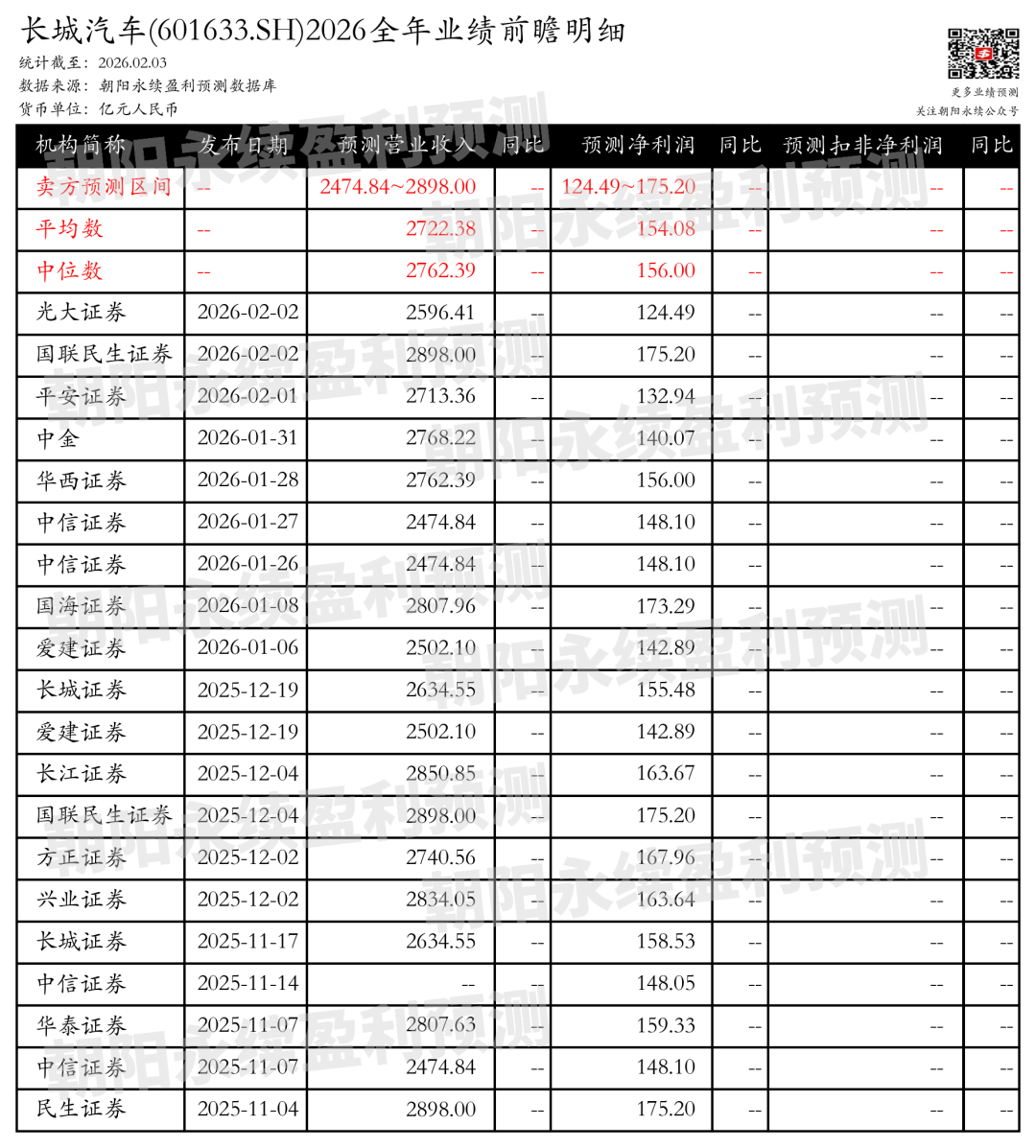
长城汽车:销量新高,高端化升级,预测全年营业收入2474.84~2898.00亿元
Xin Lang Cai Jing· 2026-02-03 12:53
Core Viewpoint - The forecast for Changcheng Automobile's revenue for 2026 is between 247.48 billion to 289.80 billion yuan, with a net profit forecast of 12.45 billion to 17.52 billion yuan, indicating potential for exceeding expectations in future financial disclosures [1][8]. Revenue and Profit Forecast - The predicted revenue range is 2474.84 to 2898.00 million yuan, with an average forecast of 2722.38 million yuan and a median of 2762.39 million yuan [2][9]. - The predicted net profit range is 124.49 to 175.20 million yuan, with an average of 154.08 million yuan and a median of 156.00 million yuan [2][9]. Sales Performance - Changcheng Automobile achieved a total sales volume of 1.324 million units in 2025, marking a year-on-year increase of 7.3%, setting a historical record [3][10]. - WEY brand sales reached 102,000 units, showing a significant year-on-year growth of 86.3% [4][10]. - Haval brand sales totaled 759,000 units, with a year-on-year increase of 7.4% [3][10]. - Tank brand sales were 233,000 units, reflecting a slight year-on-year increase of 0.7% [5][10]. - Overseas sales reached 506,000 units, representing a year-on-year growth of 11.7% [11]. New Product Developments - The company launched the world's first native AI all-power platform, named "Guiyuan," which supports five types of power configurations and aims to introduce over 50 models across seven categories [12]. - The platform features a pure electric range of up to 363 kilometers and a comprehensive WLTC range of 1393 kilometers, with rapid charging capabilities [12].
一套架构,全域兼容 长城汽车发布归元平台
Zhong Guo Zhi Liang Xin Wen Wang· 2026-01-18 13:48
Core Viewpoint - The launch of the "Guiyuan" platform by Great Wall Motors emphasizes a return to the essence of the automotive industry through a technology-driven approach, aiming to simplify complex technologies and enhance user experience [1][15]. Group 1: Platform Overview - The Guiyuan platform is inspired by the Chinese invention of movable type printing, focusing on modular, combinable, and efficient production methods that significantly reduce costs and time [3]. - It features a structure that allows for the decomposition of hardware into 49 core modules and 329 common components, enhancing the platform's scalability and adaptability [5]. - The software architecture is based on SOA, with over 2,000 standardized atomic capability tags, transforming hardware capabilities into a resource pool that can be easily accessed and utilized by AI [5]. Group 2: Powertrain Compatibility - The platform supports five powertrain types: PHEV, HEV, BEV, FCEV, and ICE, showcasing its versatility to meet diverse global market energy structures and user needs [7]. Group 3: Performance Metrics - The Super Hi4-PHEV achieves a pure electric range of 363 kilometers and accelerates from 0 to 100 km/h in 4.4 seconds, with a fuel consumption as low as 6.3L/100km [9]. - The high-capacity HEV features a significant acceleration improvement of 12% and a 14.4% reduction in fuel consumption [9]. - The 900V high-voltage BEV can be charged in just 10.5 minutes, while hydrogen models leverage self-developed fuel cell technology [9]. Group 4: AI Integration - The platform incorporates a native AI system that enhances vehicle intelligence, enabling features such as proactive defense and advanced driving capabilities through a comprehensive sensor network [9]. - The vehicle's AI can understand user preferences, making it a more intuitive travel companion [9]. Group 5: Safety Innovations - The Guiyuan platform adopts the "T-Safety" concept, integrating advanced safety features and materials to create a robust protective structure for vehicles [11]. - It employs a 24-hour warning system through vehicle-cloud connectivity, ensuring comprehensive safety for drivers and passengers [11]. Group 6: Research and Development - The platform is the result of over 30 years of self-research and development by Great Wall Motors, with more than 150 key components being independently controlled [13]. - A team of 23,000 engineers and significant R&D investment have optimized both development costs and timelines, creating a positive feedback loop that benefits users and enhances the automotive industry [13].