
去美元化周期

Search documents
广发策略:26年定价逻辑前瞻,“弹簧”未到极限时
Xin Lang Cai Jing· 2026-01-04 08:53
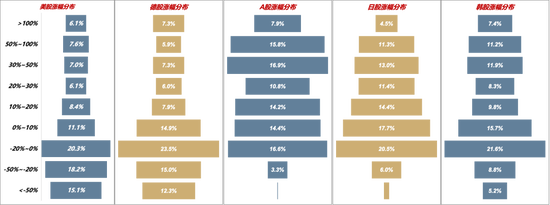
Group 1 - The global bull market structure for 2025 is characterized by a "two-eight differentiation," where the percentage of declining stocks in major markets like the US, Germany, Japan, and South Korea is significantly higher compared to A-shares, which only have an 18% decline rate [1][38]. - The leading sectors for growth are technology and resources, driven by macro narratives such as the acceleration of the AI industry cycle and the de-dollarization cycle, with strong profit support for these sectors [4][41]. - The concentration of market capitalization is reaching new highs, with major global equity markets showing a concentration ratio of 30%-50% for the top 10 companies, while China's market capitalization concentration is only 18% [5]. Group 2 - The scarcity of high-growth assets is increasing, with only 36% of A-share companies expected to grow at over 20%, down from a historical average of around 45% [3]. - The overseas revenue share of A-share companies has been steadily increasing over the past 20 years but remains low compared to developed countries, with an average of 15% for China compared to 60% for Europe and 30% for the US and Japan [6]. - The effectiveness of pricing based on economic conditions is expected to be more pronounced in 2025, with a focus on profitability indicators such as ROE and net profit growth [10].

2026年定价逻辑前瞻:“弹簧”未到极限时
GF SECURITIES· 2026-01-04 07:04
Group 1: Global Bull Market Structure - The global equity market shows a significant structural characteristic of "80/20 differentiation," where the percentage of declining stocks in major markets like the US, Germany, Japan, and South Korea reached 56%, 51%, 29%, and 35% respectively, while the A-share market had a decline rate of only 18% [12][10] - Leading sectors include technology and resources, driven by macro narratives such as the acceleration of the AI industry cycle and the revaluation of resources in the de-dollarization cycle. These sectors generally have strong profit support [16][10] - Market capitalization concentration is reaching new highs, with the top 10 companies in most global equity markets accounting for 30%-50% of total market capitalization. In contrast, the concentration in Chinese markets is significantly lower at 18% [25][22] Group 2: Scarcity of High-Growth Assets - The economic cycle has flattened, leading to a scarcity of high-growth assets. In the A-share market, companies with a net profit growth rate exceeding 20% account for 36%, down from historical averages of around 42%-45% [31][30] - In the US, the proportion of companies with net profit growth exceeding 30% is currently 32%, below the historical average of 35%, while the percentage of companies with negative growth is 45%, higher than the historical average of 38% [37][36] - Globalization remains a source of sustained growth, with high growth concentrated in non-US countries post-2020, while the overseas revenue share of major developed countries' companies is significantly higher than that of Chinese companies [48][47] Group 3: Pricing Logic and Market Dynamics - In 2025, the pricing logic in the A-share market is expected to become more extreme, with the effectiveness of growth factors significantly surpassing other financial indicators [54][53] - The current market pricing structure resembles the latter part of the "golden girl" phase, characterized by a significant index rise alongside a high percentage of declining stocks, indicating potential market extremes [54][10] - Signals for market exit may not be effectively indicated by traditional metrics such as industry performance dispersion or valuation dispersion, suggesting a need for a more nuanced understanding of market dynamics [54][10]