反向格林斯潘谜题

Search documents
多重反者道之动的交点——为什么是凯文·沃什(Kevin Warsh):【资产配置海外双周报】2026年第1期-20260202
Huachuang Securities· 2026-02-02 07:11
Group 1: Kevin Warsh's Nomination and Market Impact - The nomination of Kevin Warsh as the next Federal Reserve Chair is not following the linear logic previously expected by investors, indicating a shift in market dynamics[3] - Warsh is seen as a "hawk" on inflation, advocating for interest rate cuts while attempting to restore market and fiscal discipline through quantitative tightening[3] - His approach aims to redirect excess liquidity from financial markets into the real economy and the U.S. Treasury market[3] Group 2: Candidate Comparison and Selection Rationale - Among the four candidates considered, Warsh had the lowest compliance probability (30%-40%), contrasting with Kevin Hassett's 90%-95%[7] - The choice of Warsh was influenced by the need to appease traditional Republican establishment figures and address rising pressures in the U.S. Treasury market[10] - Warsh's nomination is seen as a strategic move to avoid potential market turmoil that could arise from selecting a more compliant candidate like Hassett[10] Group 3: Warsh's Monetary Policy Philosophy - Warsh criticizes the combination of strong regulation and quantitative easing, viewing it as financial repression that distorts long-term Treasury yields[11] - He advocates for restoring market discipline, which includes allowing long-term Treasury yields to reflect inflation expectations and debt risks[11] - His policy aims to lower financing costs for small and medium enterprises, aligning with Trump's economic growth narrative[14] Group 4: Implications for Fiscal Policy - Warsh's monetary policy approach necessitates a reduction in the duration of outstanding U.S. Treasury debt to manage interest expenses effectively[15] - The potential for a significant decrease in interest expenses as a percentage of GDP is highlighted, drawing parallels to historical fiscal strategies post-World War II[17] - Warsh's policies are designed to balance the need for fiscal discipline while supporting economic growth through lower financing costs[20]
Riders on the Charts: 每周大类资产配置图表精粹 第285期
Sou Hu Cai Jing· 2025-11-04 12:25
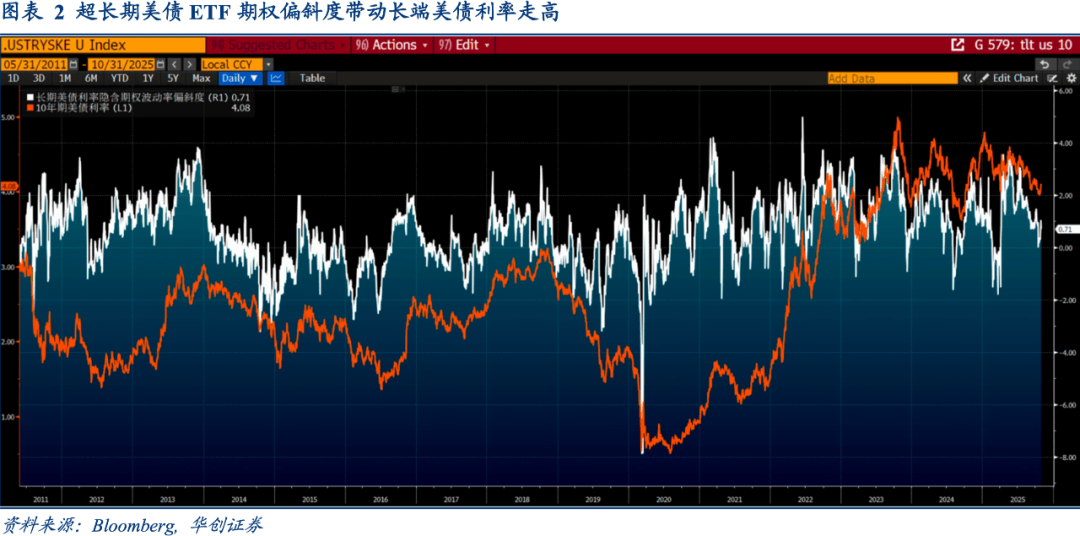
Group 1 - The ratio of total returns between gold and U.S. Treasuries suggests that high inflation risks may have been adequately priced in, with the ratio reaching 0.38 as of October 2023, comparable to levels seen in August 1975 and June 1978 when U.S. CPI was significantly higher [2][4] - The skewness of options for the iShares 20+ Year Treasury Bond ETF (TLT) has rebounded, indicating increased investor concern over inflation risks, leading to a rise in the 10-year Treasury yield to 4.1% despite the Federal Reserve's rate cuts [2][4] - The U.S. Treasury's increased debt issuance has resulted in a surge in the usage of the Standing Repo Facility (SRF), with Treasury cash reserves rising from $330 billion to $1 trillion between June and October 2023, while commercial bank reserves fell significantly [8][10] Group 2 - The equity risk premium (ERP) for the CSI 300 Index was reported at 4.4% as of October 31, 2023, indicating a potential for valuation uplift as it is below the historical average [14] - The forward arbitrage return for China's 10-year government bonds was noted at 27 basis points, which is significantly higher than levels recorded in December 2016, suggesting improved arbitrage opportunities [16] - The total return ratio between domestic stocks and bonds stood at 28.6 as of October 31, 2023, indicating that the relative attractiveness of equity assets compared to fixed income has increased [26]