反摩尔定律

Search documents
豪赌AI医疗,全球第一药企与全球第一科技巨头达成合作
Tai Mei Ti A P P· 2026-01-13 11:20
Core Viewpoint - The strategic partnership between Eli Lilly, a leading pharmaceutical company, and Nvidia, a top technology giant, marks a significant shift in the pharmaceutical industry, focusing on AI-driven drug development and manufacturing processes [1][14]. Group 1: Partnership Details - Eli Lilly and Nvidia will invest $1 billion over five years to establish a joint innovation lab in the San Francisco Bay Area [1]. - The lab will not only serve as a computing center but will also aim to completely restructure the drug development process using AI [2]. - The partnership will utilize Nvidia's latest AI chip architecture, Vera Rubin, which is designed for high-precision scientific calculations essential for drug development [2][3]. Group 2: Technological Integration - The collaboration will integrate hardware and software, with Nvidia's BioNeMo platform and Eli Lilly's TuneLab platform combining to enhance drug discovery [3][4]. - BioNeMo will function as a generative AI platform for biology, capable of generating new protein structures, while Eli Lilly will contribute its extensive historical experimental data [3][4]. - The partnership aims to address the data and model gap in AI healthcare, leveraging federated learning technology [4]. Group 3: Manufacturing Innovations - The collaboration extends to manufacturing, with plans to create a "digital twin" of Eli Lilly's production line using Nvidia's Omniverse platform [5]. - This digital twin will simulate production processes to optimize supply chain efficiency, potentially leading to significant revenue increases for high-demand products [5]. Group 4: Industry Context and Implications - Eli Lilly's decision to partner with Nvidia reflects a strategic move to overcome the challenges of traditional drug development, which is often time-consuming and costly [6][7]. - The partnership signifies a shift from a "Discovery" to a "Design" paradigm in drug development, allowing for targeted molecular design rather than random screening [7][8]. - The collaboration is expected to accelerate industry changes, prompting other major pharmaceutical companies to seek similar technological partnerships [16][18]. Group 5: Future Outlook - The partnership is seen as a potential turning point in AI-driven pharmaceutical development, creating a new model of collaboration between top pharmaceutical and technology companies [15][16]. - The competition in the pharmaceutical industry is likely to intensify as companies race to secure technological alliances, with AI becoming a critical component of drug development [19][20].


MNC早研已死,投行永生:中国创新药大时代
Xin Lang Cai Jing· 2026-01-06 01:17
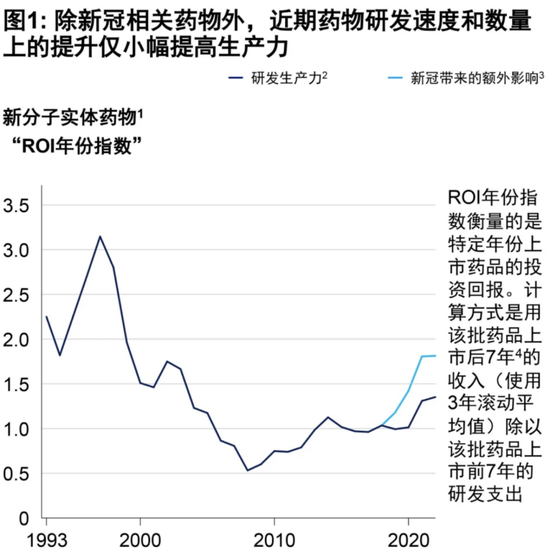
Core Insights - The current recovery cycle of China's innovative pharmaceuticals is driven by significant industry trends, particularly the shift in multinational corporations (MNCs) from a comprehensive full-chain model to a more focused approach [1][17]. Group 1: Industry Changes - The "anti-Moore's Law" indicates that the number of new drugs produced per $1 billion in R&D investment is halving every nine years, highlighting a decline in productivity within the pharmaceutical industry [2][18]. - The R&D return on investment for leading pharmaceutical companies has plummeted from 10.1% in 2010 to just 1.2% in 2022, attributed to bureaucratic inefficiencies and risk aversion towards early-stage R&D [2][19]. - MNCs are increasingly relying on external solutions for drug development, as the failure rate for drug discovery is over 90%, making the acquisition of late-stage projects a more attractive option [3][20]. Group 2: Strategic Shifts - MNCs are consciously reducing internal early-stage R&D and expanding their mid-to-late stage pipelines through external collaborations and acquisitions, reflecting a trend towards a more investment banking-like approach [4][21]. - The essential capabilities for MNCs now include pipeline valuation and mergers & acquisitions, as well as large-scale clinical trial management and commercialization [5][22]. Group 3: Opportunities for Chinese Innovative Pharmaceuticals - The structural changes in the global pharmaceutical industry present a significant strategic opportunity for China's innovative drug sector, which can fill the gap in early-stage assets due to its unique advantages [6][23]. - The number and quality of external business development (BD) transactions for Chinese innovative drugs have surged, with total licensing deals reaching $135.655 billion in 2025, more than doubling from 2024 [7][24]. - Chinese innovative drug companies are becoming highly sought-after assets, as evidenced by the rapid growth of the Hong Kong Stock Connect innovative drug ETF, which increased from over 400 million yuan to over 2.1 billion yuan in 2025 [9][26]. Group 4: Future Prospects - Collaborating with MNCs allows Chinese innovative drug companies to gain essential cash flow and efficient growth methods, while also learning about global regulatory standards and complex clinical operations [11][28]. - The long-term outlook for China's innovative drug sector is promising, with expectations of developing its own global pharmaceutical giants in the future [14][28]. - The recent performance of innovative drug assets in the stock market, including a significant rise in the Hong Kong Stock Connect innovative drug ETF, indicates strong market confidence in this sector [16][28].
创新药的“效率魔咒”,百奥赛图要来破一破?
Xin Lang Zheng Quan· 2025-09-23 09:41
Group 1 - The core issue in the pharmaceutical industry is the increasing cost of innovative drugs while the success rate of new drug development is declining, referred to as the "anti-Moore's Law" [1] - Chinese biotech companies have significantly increased their presence in global innovative drug business development (BD), accounting for over 40% of major deals in the first half of 2025, up from less than 5% four years ago [2] - The urgency for multinational pharmaceutical companies to collaborate with Chinese firms is driven by an impending patent expiration wave, necessitating new molecules to fill their pipelines [2] Group 2 - Baiyoutai has distinguished itself by building a platform rather than relying on a few blockbuster drugs, enhancing preclinical research efficiency from five to six years to just 12-18 months [3] - The company has signed over 280 collaboration agreements in a few years, capitalizing on its antibody library and addressing the challenges of international expansion [3] - The next two decades are expected to be the era of "antibody+" innovations, with Baiyoutai exploring new combinations such as antibody with nucleic acid delivery systems [4] Group 3 - Baiyoutai is likened to the "TSMC of the innovative drug industry," focusing on foundational technologies that empower others to create significant therapeutic breakthroughs [5] - The company is also described as an "antibody supermarket," providing a diverse range of molecules to meet client needs [5] - The efficiency challenges in innovative drug development may find solutions through Baiyoutai's unique offerings, such as its humanized mouse models and comprehensive human antibody libraries [6]
全球大变局下,中国创新药的集体拐点与百奥赛图的征途
Xin Lang Zheng Quan· 2025-09-23 02:13
Group 1 - By May 2025, Chinese biopharmaceutical companies accounted for over 40% of BD transactions with upfront payments exceeding $50 million, a significant increase from less than 5% four years ago, indicating a shift in the global pharmaceutical landscape [1] - Despite recent political tensions, the trend of BD cooperation remains strong as multinational pharmaceutical companies face a "patent cliff" with over $100 billion in sales from blockbuster drugs losing protection in the next five years [1] - Reports from Deloitte and McKinsey highlight declining global R&D efficiency and increasing costs, prompting multinational companies to focus more on the Chinese market for new molecular solutions [1] Group 2 - Chinese pharmaceutical companies, including leading firms and biotech companies, have increasingly turned to licensing innovative drugs as a stable source of income, with significant growth in overseas transaction frequency and amounts [2] - Baiyoutai has signed over 280 drug cooperation/authorization/transfer agreements from 2024 to the first half of 2025, with a 50% year-on-year revenue growth and net profit exceeding the previous year's total [2] Group 3 - Baiyoutai has successfully navigated the "efficiency dilemma" in preclinical research, addressing the "anti-Moore's Law" challenge where R&D investment rises but output efficiency declines [3] - The company has developed over 4,390 gene-edited animal models, including over 1,000 humanized mice, enhancing the accuracy of preclinical drug validation [3] - Baiyoutai's "thousand mice, ten thousand antibodies" platform has reduced early drug discovery cycles from over five years to approximately 12-18 months, significantly improving R&D efficiency and success rates [3] Group 4 - The industry is transitioning into the "antibody+" era, where antibody therapies are combined with various technologies, creating new growth opportunities [4] - Baiyoutai has proactively engaged in this trend, collaborating with Merck to explore nucleic acid delivery systems, indicating a shift beyond traditional antibody applications [4] Group 5 - Baiyoutai's platform value is being further realized through the continuous expansion of its antibody library, covering multiple disease areas, and integrating AI and automated R&D systems to enhance industry efficiency [5] Group 6 - Over the past decade, Chinese innovative drugs have evolved from a catch-up phase to becoming a crucial part of global BD transactions, with companies like Baiyoutai redefining the future of the pharmaceutical industry through "technology platform + global cooperation" models [6] - This trend signifies that China is no longer just a follower but is actively participating in shaping the rules of the future pharmaceutical industry [6]
全球大变局,中国创新引擎的拐点与征途
Xin Lang Zheng Quan· 2025-09-22 05:56
Core Insights - The Chinese innovative drug sector is rapidly rising, with over 40% of BD transactions from multinational pharmaceutical companies involving Chinese biotech firms as of May 2023, compared to less than 5% four years ago [1] - Despite political tensions, the demand for innovative drugs continues to grow, driven by multinational companies facing patent cliffs and declining R&D efficiency [3][4] - Companies like Baiaosaitou are redefining the globalization path of Chinese innovative drugs, positioning themselves as essential infrastructure for global drug development [1][12] Industry Trends - The current wave of BD collaborations is supported by two main factors: the impending loss of patent protection for over $1 trillion in blockbuster drugs and the need for improved innovation returns [3][4] - Major pharmaceutical companies are increasingly focusing on efficiency and are actively seeking partnerships in China, recognizing the speed and quality of Chinese innovative drugs [7] - The trend of Chinese companies transitioning from "license in" to "license out" signifies a shift towards a new model of drug development, emphasizing platform-based approaches [18] Company Performance - Baiaosaitou achieved profitability in 2024, with further improvements in profit quality in the first half of 2025, demonstrating the sustainability of its innovation capabilities [2] - The company has established over 280 drug collaboration agreements, with a significant increase in new orders, leading to a revenue of 621 million yuan in the first half of 2025, a 51.5% year-on-year increase [8] - Baiaosaitou's unique technology platforms, including gene editing and humanized mouse models, enable it to efficiently support drug discovery and development, significantly shortening the drug development cycle [11][12] Technological Advancements - Baiaosaitou's innovative platforms, such as the RenMab and RenLite, allow for the rapid discovery and development of human antibodies, addressing critical challenges in drug development [11][17] - The integration of AI and automation with its extensive antibody library enhances the efficiency of drug discovery processes, positioning Baiaosaitou as a key player in the global antibody drug development landscape [17] - The company is expanding its capabilities to include diverse therapeutic formats, such as bispecific antibodies and antibody-drug conjugates, to meet evolving market demands [15][17] Future Outlook - The emergence of the "antibody+" era indicates a shift towards more complex therapeutic modalities, providing opportunities for companies like Baiaosaitou to leverage their technological advancements [13][14] - As global collaborations deepen, Baiaosaitou is poised to become an indispensable partner in the antibody drug development process, driving innovation and growth in the industry [12][18] - The ongoing transformation in the Chinese pharmaceutical landscape reflects a broader trend of redefining value chains through technological platforms and global market engagement [18]