
创新药全球化

Search documents
百济神州穿越“死亡谷”:首次实现全年盈利,下一波增长点在哪?
2 1 Shi Ji Jing Ji Bao Dao· 2026-02-27 02:30
Core Insights - BeiGene reported a total revenue of 38.205 billion RMB for the fiscal year 2025, marking a 40.4% year-on-year increase, driven by product revenue growth and improved operational efficiency [1] - The net profit attributable to the parent company reached 1.422 billion RMB, indicating a significant turnaround from previous losses [1] - The company's flagship product, Brukinsa (Zebutinib), achieved global sales of 28.067 billion RMB, a 48.8% increase, solidifying its position as a global leader in the BTK inhibitor market [1][2] Revenue Breakdown - Product revenue for BeiGene reached 37.770 billion RMB, up 39.9%, primarily due to the sales growth of Brukinsa, Amgen-licensed products, and Tislelizumab [1][2] - In the U.S. market, Brukinsa's annual sales were 20.206 billion RMB, a 45.5% increase; in Europe, sales reached 4.265 billion RMB, up 66.4%; and in China, sales were 2.472 billion RMB, a 33.1% increase [1] Product Approvals and Pipeline - Brukinsa is the most widely approved BTK inhibitor globally, with approvals in over 75 markets [2] - The company plans to conduct a mid-term analysis of the MANGROVE trial in the first half of 2026, comparing Brukinsa combined with Rituximab against Bendamustine plus Rituximab for adult patients with mantle cell lymphoma [2] - Tislelizumab's global sales reached 5.297 billion RMB, an 18.6% increase, with ongoing efforts to submit new indications for regulatory approval in the U.S. and China [2] Market Position and Future Outlook - Analysts noted that BeiGene's transition from a "cash-burning machine" to a "cash-generating machine" reflects a significant shift in the global strategy for Chinese innovative drugs [3] - The company is expected to generate revenue between 43.6 billion and 45 billion RMB in 2026, with a gross margin projected to remain high at around 80% [4] - Concerns remain regarding the pipeline for new products following Brukinsa and Tislelizumab, with several late-stage candidates nearing commercialization [4][5] Strategic Initiatives - BeiGene is exploring the introduction of BTK inhibitors and IRAK4 degraders into autoimmune diseases, which could expand its market reach beyond oncology [5] - The company has received priority review status from the FDA for its BCL2 inhibitor, which is aimed at treating adult patients with relapsed/refractory mantle cell lymphoma [4][5] - The market is keenly awaiting the potential of new innovative candidates to emerge from BeiGene's pipeline, which could further enhance its valuation in the long term [5]
首次年度盈利!百济神州2025年营收增超四成 百悦泽全球大卖逾280亿元
Mei Ri Jing Ji Xin Wen· 2026-02-26 15:55
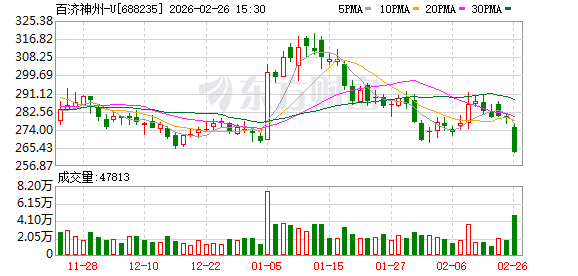
Core Viewpoint - BeiGene achieved a significant milestone by reporting its first annual profit in 2025, with total revenue reaching 38.205 billion yuan, a year-on-year increase of 40.4%, and a net profit of 1.422 billion yuan, recovering from a net loss of 4.978 billion yuan in the previous year [1][5]. Financial Performance - Total revenue for 2025 was 38.205 billion yuan, up from 27.214 billion yuan in the previous year, marking a 40.4% increase [3]. - Product revenue contributed 37.770 billion yuan, reflecting a 39.9% increase from 26.994 billion yuan [3]. - Operating profit was 2.562 billion yuan, a turnaround from an operating loss of 4.162 billion yuan [3]. - Total profit amounted to 2.558 billion yuan, compared to a loss of 4.163 billion yuan in the prior year [3]. - Net profit attributable to the parent company was 1.422 billion yuan, recovering from a loss of 4.978 billion yuan [3]. Product Performance - The growth in product revenue was primarily driven by the sales of the BTK inhibitor Brukinsa (Zebutinib) and the PD-1 inhibitor Tislelizumab [5]. - Brukinsa achieved global sales of 28.067 billion yuan in 2025, a 48.8% increase year-on-year, making it the first "blockbuster" drug in China's pharmaceutical sector [5][6]. - Sales in the U.S. market for Brukinsa reached 20.206 billion yuan, up 45.5%, while sales in Europe and China were 4.265 billion yuan (66.4% increase) and 2.472 billion yuan (33.1% increase), respectively [6]. Regulatory Approvals and Pipeline - Brukinsa has been approved in over 75 markets globally, with recent updates in the U.S., EU, and UK based on positive results from the Phase 3 ALPINE trial [6][7]. - Tislelizumab has been approved in over 50 markets, with plans to submit new indications for gastric cancer treatment in the U.S. and China in 2026 [7]. R&D and Future Outlook - The company is focusing on diversifying its product pipeline to reduce reliance on Brukinsa, with several candidates in late-stage clinical trials [8]. - BeiGene's product BeiGene (Sotigalimab) has received approval for the first global marketing application in China for certain types of lymphoma [9]. - The company anticipates launching multiple candidates for solid tumors and has received fast-track designation for BGB-B2033 for liver cancer treatment [9][10]. - For 2026, BeiGene projects revenue between 43.6 billion and 45 billion yuan, representing a growth rate of 14.12% to 17.79% compared to 2025 [11].

创新药向上还是向下:BD 交易爆发、大摩持续唱多,板块仍处调整期
Mei Ri Jing Ji Xin Wen· 2026-02-24 14:23
Core Insights - China's innovative drug sector continues to thrive, with significant business development (BD) transactions occurring in early 2026, indicating strong global recognition of Chinese innovation [1][2] - Morgan Stanley's report highlights the long-term potential of China's pharmaceutical industry, emphasizing the importance of globalization and industry differentiation [1][2] Group 1: Business Development Transactions - As of February 15, 2026, there have been 39 license-out transactions in China's innovative drug sector, with upfront payments totaling approximately $2.953 billion and total transaction values exceeding $49 billion [1] - In 2025, the total BD transaction amount for Chinese innovative drugs reached $135.7 billion, surpassing that of the United States for the first time [2] - The first 49 days of 2026 have already seen transaction volumes exceed any single quarter in 2025, reflecting a robust growth trend [2] Group 2: Key Companies and Developments - Morgan Stanley identifies Heng Rui Medicine as a top pick, expecting accelerated sales growth and positive momentum in new cooperative transactions for 2026 [2] - The approval of the innovative drug, phosphor-lucotidine cream, by Kangzhe Pharmaceutical marks a significant milestone, being the first targeted drug for vitiligo in China [2] - Kangzhe Pharmaceutical's planned spin-off of its subsidiary, Demai Pharmaceutical, for a Hong Kong listing is seen as a strategic move to focus on core therapeutic areas while potentially enhancing short-term profitability [3] Group 3: Market Trends and Future Outlook - The innovative drug sector is experiencing a clear division, with companies reliant on generic drugs facing performance pressures, while those with sustainable innovation capabilities are positioned for high-quality growth [3][4] - The current BD trend is shifting towards early-stage research projects, with over 50% of recent transactions involving preclinical projects [5] - Companies like Kangfang Biotech are committed to expanding their global footprint and enhancing the international visibility of Chinese innovations in drug development [5]

全线飘红!创新药迎强势反弹,双标的封死涨停,多龙头联动走高,景气度拉满!
Jin Rong Jie· 2026-02-10 02:56
Group 1 - The A-share innovative drug sector is experiencing significant fluctuations and has become a core highlight in the pharmaceutical industry, with companies like Wanbangde and Haixiang Pharmaceutical hitting the daily limit up [1] - Multiple stocks, including Xinlitai and Hansen Pharmaceutical, are rising in tandem, indicating a dual-leader effect and a broader market rally within the sector [1] - Increased market attention and net capital inflow are evident, showcasing a clear upward trend and structural opportunities within the sector [1] Group 2 - A major strategic partnership has been established between Innovent Biologics and Eli Lilly, enhancing confidence in the sector and promoting the globalization of domestic innovative drugs [2] - The industry is projected to experience strong growth, with a significant increase in the number of approved domestic innovative drugs and market size by 2025, alongside record-high overseas licensing transactions [2] - Continuous policy support is evident, with the 2025 version of the medical insurance catalog adding several innovative drugs, addressing implementation challenges and providing a supportive framework for industry development [2] Group 3 - The innovative drug research and development sector is a core beneficiary of policy, technology, and globalization benefits, with companies like Wanbangde and Xinlitai directly benefiting from the industry's growth [3] - The pharmaceutical raw materials and CDMO sectors, represented by Haixiang Pharmaceutical, are also benefiting from the commercialization of innovative drugs, leading to increased demand [3] - The traditional Chinese medicine innovative drug sector is experiencing growth due to industry innovation and policy support, with companies like Hansen Pharmaceutical and Qianjin Pharmaceutical participating in the sector's upward trend [3]


未知机构:海通国际信达生物与礼来制药达成全球战略合作推进肿瘤及免疫领域的新药开发D-20260210
未知机构· 2026-02-10 02:25
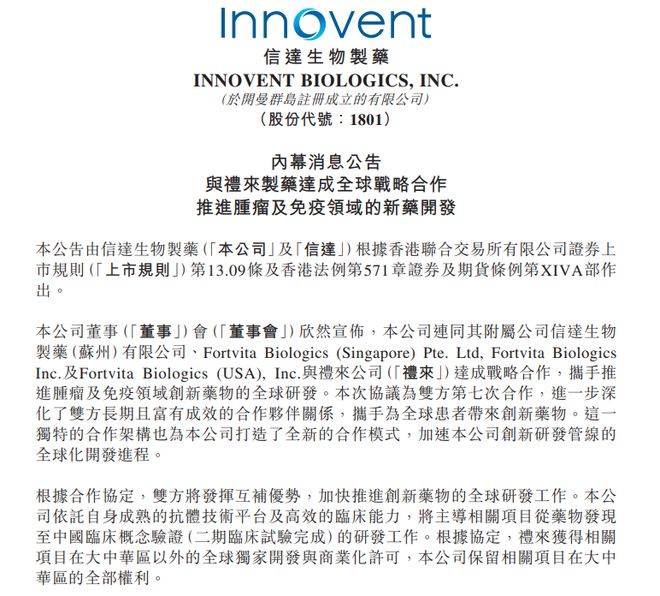
Summary of the Conference Call Company and Industry Involved - **Company**: Innovent Biologics (信达生物) - **Partner**: Eli Lilly (礼来制药) - **Industry**: Biopharmaceuticals, specifically focusing on oncology and immunology Core Points and Arguments - **Strategic Collaboration**: Innovent Biologics announced a strategic partnership with Eli Lilly to advance the global development of innovative drugs in oncology and immunology [1] - **Development Responsibilities**: Innovent will lead the projects from drug discovery to clinical proof of concept in China, specifically completing Phase II clinical trials [1] - **Global Rights**: Eli Lilly will obtain exclusive global development and commercialization rights outside Greater China, while Innovent retains all rights within Greater China [1] - **Financial Terms**: Innovent will receive an upfront payment of $350 million, with potential milestone payments totaling up to approximately $8.5 billion based on specific future achievements [1] - **Sales Revenue Sharing**: Innovent is entitled to a tiered sales revenue share from net sales outside Greater China for each product [2] Additional Important Insights - **Seventh Collaboration**: This marks the seventh collaboration between Innovent and Eli Lilly, indicating a strong ongoing relationship [3] - **Risk Mitigation**: The "China PoC + global development" model reduces Innovent's overseas development risks while leveraging Eli Lilly's global network to enhance efficiency [4] - **Strategic Significance**: The collaboration's financial components will strengthen Innovent's financial security, and the sales revenue sharing will provide long-term benefits from global market growth [5] - **Synergy with Existing Pipeline**: The focus on oncology and immunology aligns with Innovent's existing core pipeline, including products like IBI363 (PD1/IL2) and IBI343 (CLDN18.2 ADC), enhancing overall competitiveness [5] - **Potential Early-Stage Products**: Other early-stage clinical products with significant market potential include IBI324 (VEGF-A/Ang-2), IBI3001 (EGFR/B7H3 ADC), and IBI3002 (IL-4Rα/TSLP) [5]

股价涨6.92%!信达生物与礼来88.5亿美元战略合作落地,加速中国创新药全球化
Jin Rong Jie· 2026-02-09 08:11
Core Insights - Chinese innovative biopharmaceutical company Innovent Biologics (01801.HK) has announced a global strategic collaboration with Eli Lilly to advance the global development of innovative drugs in oncology and immunology, marking their seventh collaboration since 2015 [1][3] Group 1: Collaboration Details - The partnership aims to leverage complementary strengths to accelerate the global development of innovative drugs, with Innovent leading the research from drug discovery to clinical concept verification in China, while Eli Lilly will have exclusive global development and commercialization rights outside Greater China [3] - Innovent will receive an upfront payment of $350 million, with potential milestone payments totaling up to $8.5 billion if all development, regulatory, and commercialization milestones are achieved [3] Group 2: Financial Performance and Market Position - Innovent has established a high-quality technology platform covering the entire cycle of biopharmaceutical development, with 18 products approved for market, 4 new drug molecules in Phase III or pivotal clinical studies, and 15 new drug candidates in clinical research [4] - Recent revenue forecasts indicate that Innovent expects approximately 11.9 billion yuan in product revenue for 2025, representing a 45% year-on-year increase, with Q4 revenue projected at around 3.3 billion yuan, showing over 60% growth year-on-year [4] - The collaboration with Eli Lilly further solidifies Innovent's position in the global innovative drug sector, following a previous $11.2 billion partnership with Takeda in October 2025 [4]
JPM 2026收官,中国创新药加速全球化进程
2026-01-26 02:50
Summary of Conference Call Industry Overview - The conference focused on updates and developments in the Chinese biopharmaceutical industry, particularly highlighting companies such as BeiGene, 3SBio, and Kelun-Biotech [1][10]. Key Company Insights BeiGene - BeiGene's BCL-2 inhibitor has been approved for sale in China and is expected to receive accelerated approval in the U.S. within the year [1]. - BCL-2 is viewed as a second growth driver for BeiGene, complementing its existing BTK inhibitors, which have shown rapid sales growth in the U.S. market [2]. - The company has a robust pipeline for solid tumors, with several candidates entering late-stage development, including treatments for breast cancer and other indications [3]. - BeiGene is anticipated to report its first annual profit, with expectations that its annual report may exceed forecasts [3]. 3SBio - Pfizer has outlined a global development plan for its drug 707, with five global Phase III trials expected to start by 2026, targeting various cancers [4]. - The trials include first-line treatments for colorectal cancer and non-small cell lung cancer [4]. Kelun-Biotech - Kelun-Biotech is expected to have a significant year with five products anticipated to be commercialized, three of which have already been included in the national medical insurance [5]. - The company has successfully commercialized its top two ADC products and is expected to see explosive growth following their inclusion in insurance [5]. Innovent Biologics - Innovent's Ivosidenib is expected to receive final approval from the FDA in Q4 of this year, with ongoing clinical trials for various cancers [6][7]. - The company is also preparing for the commercialization of its CAR-T product, which has already been approved domestically [8]. Rongchang - Rongchang has announced plans for three Phase III trials, including one for non-small cell lung cancer, which has received FDA approval [7][8]. Other Notable Mentions - Merck has initiated 16 global Phase III trials for its drug targeting various major indications, with data expected in the second half of the year [5]. - The conference highlighted the importance of clinical trial data releases for several companies, which are crucial for their long-term valuations [3][10]. Market Dynamics - The overall market for innovative drugs is currently experiencing a downturn, primarily due to internal funding shifts within the pharmaceutical sector [10]. - The high percentage of holdings in innovative and traditional pharmaceuticals (around 75%) has led to a reallocation of funds towards other sectors like AI healthcare and CROs [11]. - Despite the market's performance, the fundamental aspects of many companies remain strong, with ongoing clinical advancements and positive earnings expectations [11]. - The total amount of business development (BD) transactions in recent weeks has already reached 25% of last year's total, indicating a robust pace of international expansion [11]. Conclusion - The conference provided a comprehensive overview of the current state of the biopharmaceutical industry in China, highlighting significant advancements and the potential for growth among key players. The market dynamics suggest a temporary disconnect between stock performance and fundamental company health, indicating potential investment opportunities.


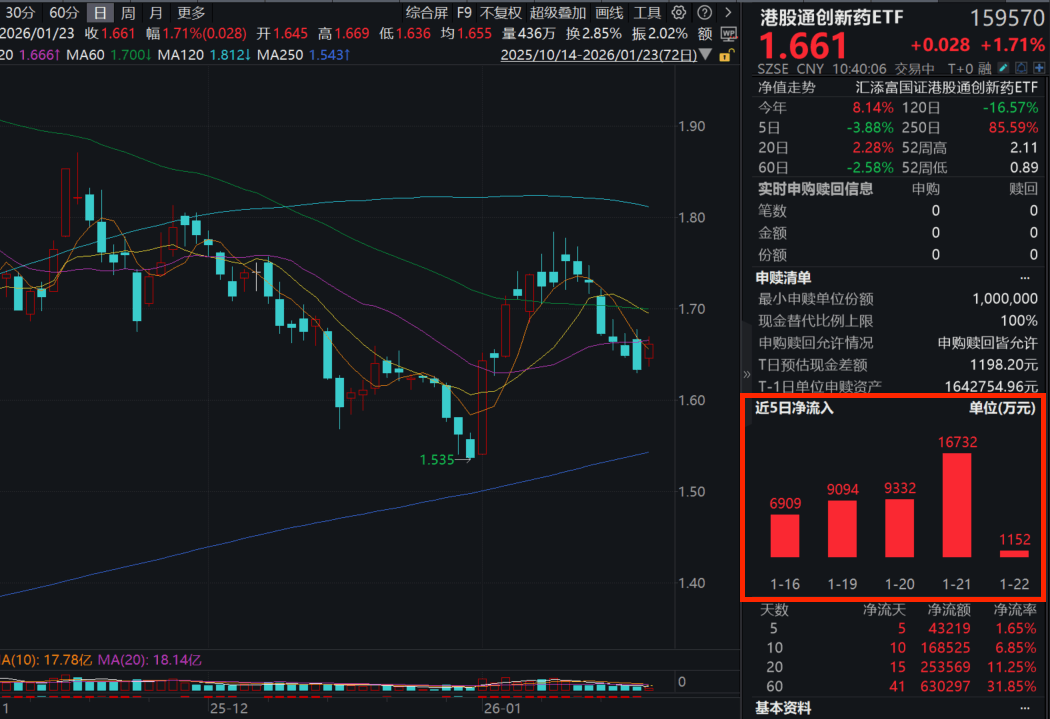
康方生物涨超4%,自研古莫奇单抗第二项适应症获NDA受理!港股通创新药ETF(159570)涨近2%,近5日净流入超4.3亿元!
Xin Lang Cai Jing· 2026-01-23 03:05
Group 1 - The Hong Kong pharmaceutical sector is experiencing a strong rebound, with the Hong Kong Stock Connect Innovation Drug ETF (159570) rising nearly 2% and achieving a transaction volume exceeding 700 million yuan in a short period [1] - The ETF has seen a cumulative net inflow of over 430 million yuan in the past five days, with its latest scale surpassing 25.1 billion yuan, leading in its category [1] - The majority of the weighted stocks in the ETF's index have shown positive performance, including Kangfang Biopharma and Kelun-Botai, which both rose over 4% [3][4] Group 2 - Kangfang Biopharma announced that its new humanized anti-IL-17A monoclonal antibody, AK111, has received acceptance for a new drug application for treating active ankylosing spondylitis (AS) by the National Medical Products Administration (NMPA) [3] - This new drug is expected to provide a new treatment option for nearly 4 million AS patients in China [3] - The JPMorgan Healthcare Conference highlighted the achievements of Chinese innovative drug companies, with expectations for significant revenue growth and multiple drug approvals in the coming years [5][6] Group 3 - The domestic pharmaceutical industry is witnessing rapid technological advancements and an acceleration in globalization, with significant transactions exceeding 10 billion USD occurring [6][7] - The industry is entering a critical period of validation for innovative drug performance, with many companies expected to launch global registration studies and new product applications [6][7] - A domestic innovative drug company projected a revenue increase of 15.84% for 2025, with a substantial net profit growth of 102.65% [7]
在美国“医药春晚”,中国药企从“可选消费”变成“必选消费”
Hua Er Jie Jian Wen· 2026-01-14 06:45
Core Insights - The recent J.P. Morgan Global Healthcare Conference highlighted an increased focus on mergers and external licensing among multinational pharmaceutical companies, particularly regarding innovative drug assets from China [1][2] - J.P. Morgan's analysis indicates that Chinese innovative drugs have evolved from being optional assets to a category that multinational companies must systematically evaluate during asset selection, although this change is highly dependent on clinical data and global development capabilities [1][2][5] Group 1: Mergers and Acquisitions - Mergers and acquisitions are becoming essential survival tools for pharmaceutical companies due to expiring core patents, declining internal R&D returns, and intensified competition in key therapeutic areas [2] - The criteria for selecting external assets have shifted from merely technical concepts to the ability to enter late-stage clinical or registration phases within a controllable timeframe [2][5] Group 2: Clinical Progress and Cost Considerations - The attention on Chinese innovative drugs is primarily driven by clinical progress rather than cost advantages, with R&D costs being a secondary factor compared to time and certainty [3] - Some Chinese pharmaceutical projects have advanced to compete globally in certain indications, not due to innovative mechanisms but due to clinical execution efficiency and patient enrollment speed [3][5] Group 3: External Licensing as a Risk Management Tool - External licensing is increasingly viewed as a risk management strategy rather than a passive monetization approach, helping Chinese companies reduce uncertainty in global development [4] - For external licensing to enhance long-term value, the assets must have clear clinical positioning and scalability; otherwise, such transactions may only serve as one-time financial arrangements [4] Group 4: Industry Dynamics and Investment Focus - The current changes reflect an upgrade in the asset selection mechanism rather than an overall revaluation of the industry, with some Chinese innovative projects entering the evaluative scope due to their progress and data quality [5][6] - The differentiation within the Chinese pharmaceutical sector is expected to intensify, with projects that can meet global evaluation criteria likely to attract more capital attention [6] Group 5: Ongoing Risks - Despite the positive trends, inherent risks in the pharmaceutical industry remain, including clinical failures, competitive landscape changes, and regulatory uncertainties, which can significantly impact asset valuations [7] - The assessment of the global potential of Chinese innovative drugs should be based on verifiable data and pathways rather than merely on trend narratives [7]
岁末年初,药企高管缘何密集变动?
2 1 Shi Ji Jing Ji Bao Dao· 2026-01-13 23:36
Core Insights - Zhou Yunshu, a former senior figure at Heng Rui Medicine, has been appointed as the president of Xiansheng Pharmaceutical, marking a significant leadership change in the industry [1][9][10] - The pharmaceutical industry is experiencing a wave of executive changes, reflecting a strategic adjustment among local companies to enhance their global competitiveness and innovation capabilities [1][10][17] Company Developments - Zhou Yunshu's new role at Xiansheng Pharmaceutical was highlighted during a strategic cooperation announcement with Jiangsu Provincial Tumor Hospital, although official confirmation of his appointment is still pending [1][10][14] - Xiansheng Pharmaceutical has shown strong growth, with a 15.14% increase in revenue to 3.585 billion yuan and a 32.2% rise in net profit to 604 million yuan in the first half of 2025 [3][12] - The company has expanded its innovative drug portfolio to 10 products, with innovative drug revenue reaching 2.776 billion yuan, accounting for 77.4% of total revenue [3][12] Industry Trends - The recent influx of executives with multinational backgrounds into local pharmaceutical companies is seen as a strategy to introduce advanced management systems and international operational models [1][10][17] - In 2025, the Chinese pharmaceutical industry reached a milestone with 76 approved innovative drugs and over 130 billion yuan in licensing transactions, indicating a significant shift in the industry landscape [17] - The competitive environment, characterized by intensified product competition and cost control pressures, is driving local companies to adapt and innovate [17]