后凯恩斯主义

Search documents
中金研究 | 本周精选:宏观、策略
中金点睛· 2026-02-14 01:17
Group 1: Market Overview - Recent market volatility, particularly the rapid pullback of Hengke, has raised concerns among investors about whether market logic and trends have been disrupted, especially regarding strong technology and non-ferrous sectors [3] - The recent underperformance of Hong Kong stocks is attributed to tightening liquidity concerns, structural drag, and weak macro fundamentals [3] - Looking ahead, the market may experience an overshoot, with potential short-term upward correction space after the pullback [3] Group 2: Earnings and Index Projections - In the baseline scenario, it is projected that Hong Kong stocks will see earnings growth of 3-4%, with sentiment recovery in the structural mainline potentially pushing the Hang Seng Index up to around 28,000-29,000 points [3] - A-shares are expected to be stronger in terms of fundamentals and liquidity, while Hong Kong stocks have advantages in structural characteristics [3] Group 3: Sector Focus - Short-term focus should be on essential retail, technology hardware, and new consumption sectors; financials, biotechnology, and non-ferrous sectors should wait for the right timing [3] Group 4: U.S. Policy Analysis - Trump's recent policy maneuvers have caused significant global market fluctuations, with gold and silver experiencing volatile trading patterns [7] - The underlying logic of Trump's unconventional operations is seen as a reactive measure to intensifying domestic social contradictions, rooted in long-term distribution imbalances caused by the neoliberal wave of the 1980s [7] - The normalization of Keynesian policies, originally intended for extraordinary times, is highlighted as a challenge in advancing post-Keynesian reforms in the U.S. [7] Group 5: Capital Account Opening - Concerns surrounding capital account opening stem from misconceptions about capital flows, exchange rate formation mechanisms, and related policy tools [9] - The current global monetary order's strategic window is maturing, making it increasingly feasible to advance capital account opening, which is crucial for China's transition from an economic power to a financial and monetary powerhouse [9] - The article aims to clarify common misconceptions about capital outflows, exchange rate determination, and foreign exchange management to provide a rational framework for enhancing capital account openness [9] Group 6: Consumption Insights - Evaluating consumption rates should involve both international comparisons and domestic supply capabilities, with improvements in supply capacity supporting China's potential growth [11] - Weak price levels indicate that actual growth is below potential growth, necessitating an increase in consumption to align actual growth with potential growth [11] - The article emphasizes that enhancing consumption is not only a short-term growth demand but also a driver of innovation, as consumer spending influences corporate profits and subsequently research and development investments [12]


海外宏观专题报告:不是选择,是必然——政治经济学眼中的美国政策
2026-02-10 03:24
Summary of Key Points from the Conference Call Industry or Company Involved - The report focuses on the macroeconomic policies of the United States, particularly under the Trump administration, and their implications for global markets and domestic socio-economic conditions [1][2][3]. Core Insights and Arguments - **Trump's Unconventional Policies**: The report argues that Trump's policies are a response to escalating domestic social contradictions, rooted in long-term distribution imbalances caused by neoliberalism since the 1980s [1][2][10]. - **Economic and Financialization Trends**: The acceleration of financialization in the U.S. economy has led to systemic financial crises, with the 2008 subprime crisis being a significant outcome of these trends [18][32]. - **Normalization of Keynesian Policies**: Post-crisis, Keynesian policies have been normalized in the U.S., leading to concerns about inflation and rising debt levels, which are now at historical highs [34][41]. - **Distribution Imbalances**: The report highlights that income and wealth distribution issues are central to the growing social tensions in the U.S., with a significant gap between corporate profits and worker wages [17][24]. - **Impact of Monetary Policy**: Trump's nomination of a new Federal Reserve chair aims to shift monetary policy towards a combination of interest rate cuts and balance sheet reductions, which could lead to market volatility [3][40]. Other Important but Possibly Overlooked Content - **Public Concerns**: According to Pew Research, American citizens are increasingly focused on economic pressures, such as inflation and healthcare affordability, rather than climate change or other issues [10][11]. - **CEO Compensation Disparities**: The report notes that by 2024, the average CEO compensation in the U.S. is projected to be 1,094% higher than in 1978, while average worker compensation has only increased by 26% during the same period [24][26]. - **Financial Regulation Erosion**: The report discusses how deregulation in the financial sector has contributed to the rise of shadow banking and increased systemic risks, particularly highlighted during the 2008 financial crisis [22][37]. - **Structural Reforms Needed**: There is a call for structural reforms to address the underlying issues of income inequality, aging population, and infrastructure deficits, which are not adequately addressed by Keynesian policies alone [45][49]. This summary encapsulates the critical insights from the conference call, emphasizing the socio-economic dynamics in the U.S. and the implications of current policies on both domestic and global scales.
中金:不是选择,是必然——政治经济学眼中的美国政策
Xin Lang Cai Jing· 2026-02-09 02:49
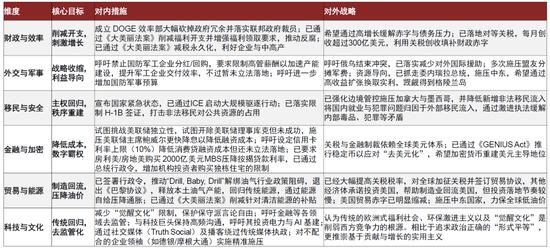
Core Viewpoint - Trump's unconventional policies are a response to escalating domestic social contradictions in the U.S., rooted in long-term distribution imbalances caused by neoliberalism since the 1980s [2][3][4]. Group 1: Domestic Policies - Trump has initiated measures to cut government spending and stimulate growth, including the establishment of the DOGE Efficiency Department to reduce government redundancy and accelerate federal layoffs [6]. - He has challenged the independence of the Federal Reserve and proposed a cap on credit card interest rates at 10% to lower consumer loan financing costs [6][4]. - The administration has implemented policies to limit executive compensation and has pressured allies to share military expenses [6][4]. Group 2: International Strategies - Trump's foreign policy includes imposing tariffs on a wide range of imports and advocating for the end of the Russia-Ukraine conflict while reducing international aid [6][4]. - The administration aims to strengthen control over overseas resources and energy to lower domestic living costs [3][4]. Group 3: Economic Implications - The ongoing internal contradictions in the U.S. are contributing to a relative decline in its international standing, with Trump's policies likely to expand in scope as he seeks to win midterm elections and achieve the goal of "Making America Great Again" [4]. - The proposed monetary policy changes, such as the nomination of Warsh as Fed Chair, aim to shift from a large fiscal framework to a model involving interest rate cuts and balance sheet reductions, which could lead to significant market volatility [4][6]. Group 4: Structural Issues - The article highlights the widening gap in income distribution in the U.S., with labor's share of income remaining stable while corporate profits have increased [9][10]. - The disparity between actual household income and the "qualified" income needed for affordable housing has widened significantly, indicating a growing financial burden on American families [9][11]. Group 5: Theoretical Framework - The return of neoclassical economics is identified as a key factor in the exacerbation of social contradictions in the U.S., with Keynesian policies being normalized in response to crises without addressing structural reforms [39][66]. - The article suggests that the challenges faced by the U.S. in implementing structural reforms are compounded by political and economic factors, including the weakening of labor unions and regional inequalities [58][66].
中金:不是选择,是必然——政治经济学眼中的美国政策
中金点睛· 2026-02-08 23:37
Core Viewpoint - Trump's unconventional policies are a response to escalating domestic social contradictions in the U.S., rooted in long-term distribution imbalances caused by neoliberalism since the 1980s [2][4]. Group 1: Domestic Policies - Trump's administration has implemented measures to cut government spending, such as the "Great Beautiful Act," which reduces welfare spending and increases eligibility requirements [6]. - The establishment of the DOGE Efficiency Department aims to eliminate government redundancies and promote federal layoffs [5]. - The administration has challenged the independence of the Federal Reserve and proposed a cap on credit card interest rates at 10% to lower consumer loan financing costs [5][6]. - Measures to limit institutional investors from purchasing single-family homes have been introduced to address housing affordability [5][6]. Group 2: Foreign Policies - Trump's foreign strategy includes imposing tariffs on a wide range of imports to protect domestic industries and reduce living costs [5][6]. - The administration has called for an end to the Russia-Ukraine conflict and reduced international aid commitments [5][6]. - There is a focus on increasing military spending and pressuring allies to share defense costs [5][6]. Group 3: Economic Implications - The policies aim to alleviate internal contradictions but are unlikely to resolve them fundamentally, reflecting a tendency for short-term gains at low costs [4][5]. - The proposed changes in monetary policy, such as the nomination of Warsh to the Federal Reserve, could lead to significant market volatility [4][5]. - The ongoing financialization of the U.S. economy has led to a widening gap between corporate profits and worker wages, with the share of labor income remaining stable while corporate income has increased [9][11]. Group 4: Structural Challenges - The U.S. faces significant structural challenges, including income inequality, healthcare affordability, and educational disparities, which have been exacerbated by the pandemic [7][39]. - The political landscape shows increasing polarization regarding economic issues, making it difficult to implement necessary reforms [56][57]. - The return of neoclassical economics has contributed to the exacerbation of social contradictions, with a reliance on Keynesian policies without substantial structural reforms [60][61].