咖啡场景战争

Search documents
瑞幸“入侵”岗亭、地铁闸机旁!成打工人“9.9元收费站”?
东京烘焙职业人· 2025-12-27 08:33
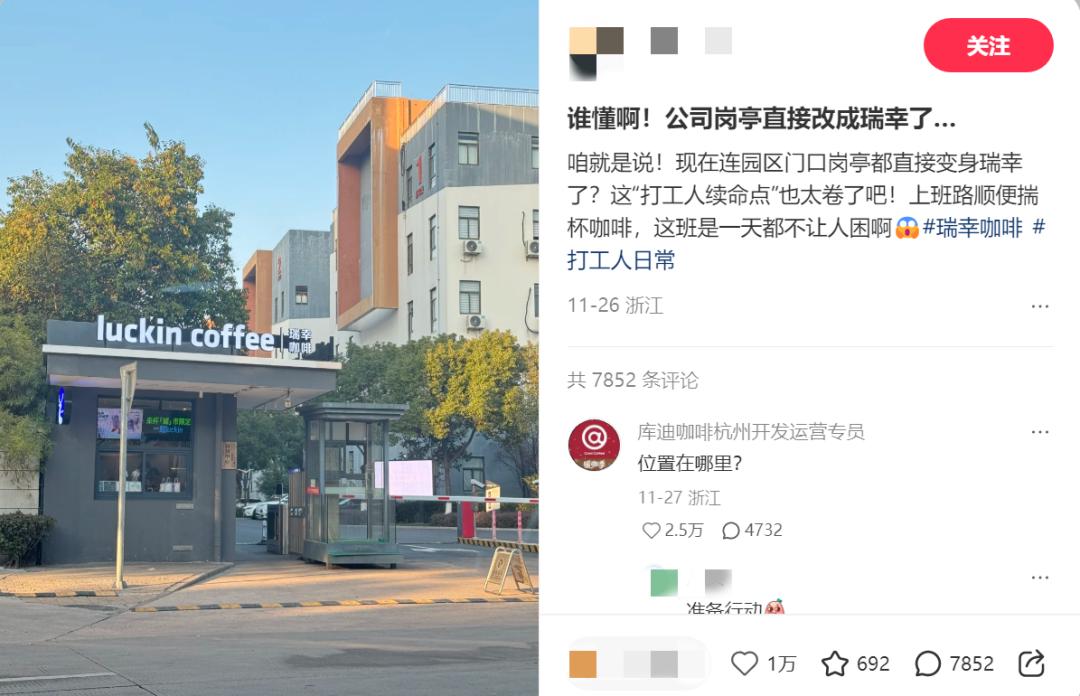
Core Viewpoint - The article discusses the innovative strategies employed by coffee brands, particularly Luckin Coffee, to expand their market presence by opening stores in unconventional locations, thereby transforming consumer access to coffee and enhancing convenience [2][12][39]. Group 1: Innovative Store Locations - Luckin Coffee has transformed a security booth in a Zhejiang industrial park into a mini coffee shop, attracting attention on social media for its unique positioning [5][8]. - The coffee brand is strategically placing stores in high-traffic areas such as subway stations and train stations, allowing customers to order coffee conveniently during their daily commutes [18][19]. - The trend of coffee brands occupying unexpected spaces, such as newspaper kiosks and public transport stations, signifies a shift in retail strategy from waiting for customers to come to actively reaching out to them [17][41]. Group 2: Creative Store Transformations - Coffee shops are being creatively integrated into existing structures, such as transforming newspaper kiosks into coffee outlets, which blend nostalgia with modern convenience [24][25]. - The article highlights various examples of coffee shops located in unusual settings, including temples and public parks, which create a unique consumer experience [28][30]. - The innovative use of space not only expands the physical boundaries of coffee shops but also enhances their visibility and accessibility to consumers [20][23]. Group 3: Collaborative Business Models - The article notes that some coffee brands are adopting a "store within a store" model, partnering with convenience stores and internet cafes to increase operational efficiency and expand their footprint [33][34]. - Nova Coffee, for instance, has successfully integrated its offerings into major convenience store chains, achieving significant growth with over 10,000 locations [35][36]. - This collaborative approach allows coffee brands to penetrate deeper into retail networks, making coffee more accessible to consumers [38][40].



瑞幸「入侵」岗亭、地铁闸机旁,成打工人「9.9元收费站」?
36氪· 2025-12-22 13:36
Core Viewpoint - The coffee industry is undergoing a "location revolution," with brands like Luckin Coffee strategically placing stores in unconventional spots to intercept consumers during their daily routines [13][18][45]. Group 1: Innovative Store Locations - Luckin Coffee has transformed a security booth in a Zhejiang industrial park into a mini coffee shop, attracting attention and business from employees [8][12]. - The brand is expanding its presence in unexpected locations such as subway stations, bus stops, and even traditional settings like temples and markets, effectively changing the traditional retail logic from "waiting for customers" to "finding customers" [19][20][42]. - The company has launched stores in high-traffic areas, such as near subway exit gates, allowing customers to order via mobile and pick up their coffee quickly [20][45]. Group 2: Creative Store Transformations - Luckin Coffee has repurposed various structures, including newsstands and shipping containers, into coffee shops, maintaining their original aesthetics while providing modern coffee services [25][26]. - The transformation of traditional spaces into coffee shops is gaining popularity, with many locations retaining their original functions while integrating coffee services, thus enhancing urban convenience [27][29]. Group 3: Expansion Strategies - The trend of "borrowing space" for coffee shops is on the rise, with brands like Nova Coffee partnering with convenience stores and internet cafes to expand their reach efficiently [34][36]. - Nova Coffee recently surpassed 10,000 stores, indicating significant growth and interest in this operational model [37][38]. Group 4: Market Potential - The coffee market in China is still seen as having substantial growth potential, with four local brands already exceeding 10,000 stores, suggesting that consumer demand is far from saturated [43][44]. - The shift in coffee shop presence from traditional settings to everyday locations reflects a broader trend of making coffee more accessible and integrated into daily life [42][46].

瑞幸“入侵”岗亭、地铁闸机旁,成打工人“9.9元收费站”?
3 6 Ke· 2025-12-22 01:15
Core Viewpoint - The article discusses the innovative trend of coffee brands, particularly Luckin Coffee, transforming unconventional locations such as security booths and public transport stations into mini coffee shops, thereby enhancing customer accessibility and convenience [1][2][4]. Group 1: Transformation of Locations - A security booth in a Zhejiang industrial park has been converted into a Luckin Coffee outlet, leading to humorous social media reactions about the new "charging station" for commuters [2][4]. - The mini coffee shop has become a popular stop for employees, especially during morning and lunch hours, indicating a successful business model in a previously underutilized space [4][6]. Group 2: Strategic Location Choices - Coffee brands are shifting their location strategy from "waiting for customers" to "actively seeking customers," embedding themselves in high-traffic areas such as subway stations and train platforms [6][9]. - Luckin has opened a store next to the exit of the Guomao station on Beijing's subway line 1, allowing customers to order coffee conveniently while on the go [7]. Group 3: Creative Store Formats - The article highlights the trend of repurposing traditional structures like newsstands and shipping containers into coffee shops, which blend nostalgia with modern convenience [10][12]. - Examples include a Luckin store in Guangzhou that retains the original newsstand design while offering a modern coffee experience, appealing to urban consumers [10]. Group 4: Expanding into Unconventional Spaces - Coffee brands are entering unexpected venues such as temples, parks, and markets, creating unique customer experiences that attract younger demographics [12][14]. - The article mentions various locations where coffee shops have emerged, including a coffee shop in a traditional ancestral hall and others in local markets, making coffee a regular part of daily errands [12][14]. Group 5: Leveraging Existing Retail Spaces - The trend of "borrowing" retail space is gaining traction, with brands like Nova Coffee partnering with convenience stores and internet cafes to expand their reach efficiently [14][15]. - Nova Coffee has reportedly surpassed 10,000 locations through this strategy, indicating a significant growth trend in the coffee industry [15]. Group 6: Changing Consumer Interaction - The coffee industry is evolving from a model where consumers go to cafes to one where cafes come to consumers, making coffee more accessible and integrated into daily life [17][18]. - The article emphasizes that the coffee market in China still has substantial growth potential, with brands needing to focus on efficient penetration strategies to meet consumer demand [17].