商业化效率

Search documents
为什么罗永浩也没有把视频播客带火?
3 6 Ke· 2025-12-10 11:14
Core Viewpoint - The entry of prominent figures like Luo Yonghao into the video podcasting space in China was expected to ignite interest in a previously lukewarm market, but the anticipated surge in popularity has not materialized, highlighting the challenges faced by this format in the Chinese digital landscape [1][3]. Group 1: Content Consumption Trends - Domestic internet users have shifted towards short content, favoring efficiency and instant gratification, which makes the long-form nature of video podcasts less appealing [5][6]. - The algorithms of Chinese content platforms prioritize completion rates and initial engagement, disadvantaging longer formats that struggle to capture attention within the critical first few seconds [6][12]. - The phenomenon of short video clips from longer podcasts gaining traction on platforms like Douyin and Xiaohongshu exacerbates the preference for fragmented content over full-length videos [7][12]. Group 2: Cultural and Infrastructure Differences - In contrast to the U.S., where there is a robust market for long-form content and a culture of serious reading, Chinese users are more accustomed to consuming content in short bursts, often on mobile devices [8][13]. - The lack of a platform equivalent to YouTube in China limits the potential for video podcasts, as existing platforms focus on short, easily consumable content rather than accommodating long-form discussions [10][12]. - The fragmented nature of mobile internet usage in China creates an environment where lengthy video podcasts struggle to find a suitable audience [13]. Group 3: Production and Commercial Viability - Producing high-quality video podcasts requires significant investment in equipment, editing, and guest coordination, making it a high-risk venture in the Chinese market [14][15]. - The monetization mechanisms for long-form content in China are not as developed as those in the U.S., where platforms like YouTube provide substantial revenue opportunities through ad placements [15][16]. - The reliance on traditional advertising methods for monetization in China limits the scalability and efficiency of video podcasts, making it difficult for creators to sustain their projects [15][16]. Group 4: Future Outlook - Video podcasts in China are unlikely to achieve the same level of mainstream popularity as in the U.S., but they may find a niche audience among those seeking deeper engagement and connection [18]. - The format is expected to remain a luxury for a select group of creators who prioritize building a strong personal brand and cultivating a loyal audience over immediate financial returns [18].


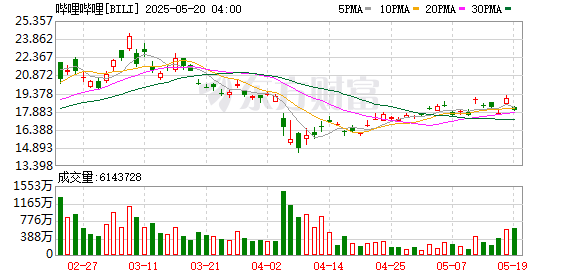
现金翻倍!哔哩哔哩Q1营收同比增长24% 净利润3.62亿
Hua Er Jie Jian Wen· 2025-05-20 11:12
Core Insights - Bilibili's Q1 revenue increased by 24% year-on-year to 7.003 billion RMB, surpassing market expectations of 6.91 billion RMB [3] - The company achieved an adjusted net profit of 362 million RMB, recovering from a loss of 456 million RMB in the same period last year [5][9] - Monthly active users reached a record high of 368 million, reflecting a 7.8% year-on-year growth [6] Revenue Breakdown - Value-added services generated 2.807 billion RMB, up 11% year-on-year, accounting for 40% of total revenue [9] - Advertising revenue was 1.998 billion RMB, a 20% increase year-on-year, making up 28.5% of total revenue [10] - Mobile games revenue soared by 76% to 1.731 billion RMB, representing 24.7% of total revenue [11] - Revenue from IP derivatives and others declined by 4% to 467 million RMB, constituting 6.8% of total revenue [12] User Engagement and Financial Performance - Daily active users (DAU) averaged 106.7 million, a 4.2% increase year-on-year, while monthly active users (MAU) reached a historic high [13] - The average monthly paying users hit 32 million, indicating a strong willingness to pay [13] - The company reported a gross profit margin increase to 36.3%, up from 28.3% in the previous year, driven by high-margin advertising and gaming businesses [12][14] Operational Efficiency - Operating cash flow doubled to 1.302 billion RMB compared to 638 million RMB in the same quarter last year [14] - Total operating costs grew by only 10%, significantly lower than the revenue growth rate [14] - Research and development expenses decreased by 13%, showcasing improved operational efficiency [14]