商业模式缺陷

Search documents
董事长涉案、财报难产,“水果第一股”明日退市
第一财经· 2025-12-29 09:17
Core Viewpoint - Hongjiu Fruit (06689.HK) will have its listing status terminated on December 30, 2025, due to failure to meet the resumption conditions set by the Hong Kong Stock Exchange, following a series of financial and legal issues [3]. Group 1: Company Background - Hongjiu Fruit was founded in 2002 in Chongqing by Deng Hongjiu and his wife Jiang Zongying, and it is recognized as one of the "three giants" in the fruit supply chain and trade industry alongside Baiguoyuan and Xianfeng Fruit [3]. - The company went public on the Hong Kong Stock Exchange in September 2022, becoming the "first fruit stock" [3]. Group 2: Financial Issues - The company has been suspended since March 2024 due to its inability to publish financial reports on time, with KPMG raising concerns about a sudden increase of 3.4 billion yuan in prepayments for Q4 2023, questioning the identity of the payment recipients and the completeness of the accounting materials provided [3]. - Hongjiu Fruit's accounts receivable grew significantly, increasing by 106.7% in 2022 compared to 2021, indicating cash flow difficulties [4]. Group 3: Management and Legal Challenges - In April 2025, founder Deng Hongjiu and several executives were subjected to criminal coercive measures for alleged loan fraud and issuing false VAT invoices [3]. - The company's business model, which relies on direct sourcing from producers and immediate payment for fruits, has led to cash flow strain, exacerbated by the economic crimes of its executives and governance failures [4].


董事长涉案、财报难产,“水果第一股”明日退市
Di Yi Cai Jing· 2025-12-29 08:13
Core Viewpoint - Hongjiu Fruit's delisting is attributed to flaws in its business model and failures in corporate governance, following legal issues involving its chairman and delays in financial reporting [1][2]. Group 1: Company Overview - Hongjiu Fruit, founded in 2002 in Chongqing by Deng Hongjiu and his wife Jiang Zongying, is a traditional fruit supply chain and trading company, recognized as one of the "three giants" in the fruit industry alongside Baiguoyuan and Xianfeng Fruit [1]. - The company went public on the Hong Kong Stock Exchange in September 2022, becoming the "first fruit stock" [1]. Group 2: Financial Issues - Hongjiu Fruit has faced significant financial challenges, including a suspension of trading since March 2024 due to its inability to publish financial reports on time [1]. - The auditing firm KPMG raised concerns about a sudden increase of 3.4 billion yuan in prepayments for the fourth quarter of 2023, questioning the identity of the payment recipients and the completeness of the accounting materials provided by the company [1]. Group 3: Business Model Challenges - The company employs a traditional "end-to-end" model, sourcing fruits directly from producers, which allows for quality control but requires substantial capital due to immediate payment needs for purchases, while sales do not progress as quickly [2]. - The shift in domestic consumption trends post-pandemic has put pressure on the fruit industry, making it harder to recover accounts receivable, with Hongjiu Fruit's accounts receivable increasing by 106.7% in 2022 compared to 2021 [2]. Group 4: Governance and Legal Issues - The company's management has been embroiled in legal troubles, with founder Deng Hongjiu and several executives facing criminal charges for loan fraud and issuing false VAT invoices [1][2]. - The combination of a "high prepayment + long receivables" model has led to cash flow issues, exacerbated by compliance crises stemming from the alleged economic crimes of executives, ultimately resulting in the inability to disclose financial reports and subsequent delisting [2].
洪九果品迎来退市终局
Xin Lang Cai Jing· 2025-12-29 03:44
Core Viewpoint - Hongjiu Fruit, known as the "first fruit stock," is facing delisting from the Hong Kong Stock Exchange after a series of financial and governance issues, including failure to disclose financial reports, stock suspension, and investigations into its executives [3][5]. Group 1: Company Background and Financial Performance - Hongjiu Fruit was founded in 2002 by Deng Hongjiu and Jiang Zongying, and it quickly rose to prominence in the high-end fruit market, becoming the largest fruit distributor in China by sales revenue in 2022 [3][4]. - The company went public on September 5, 2022, with an initial share price of HKD 40, achieving a market capitalization of nearly HKD 19 billion on its first trading day. In 2022, it reported a revenue increase of 46.7% to CNY 15.081 billion and a net profit surge of 397.95% to CNY 1.452 billion [3][4]. Group 2: Financial Troubles and Governance Issues - The turning point for Hongjiu Fruit occurred on March 20, 2024, when it was suspended from trading due to its inability to disclose the 2023 financial report, which was questioned by its auditing firm, KPMG. The firm raised concerns about a prepayment balance of approximately CNY 4.47 billion, with CNY 3.42 billion paid to new suppliers in Q4 2023, many of whom had low registered capital and no social insurance contributors [4][5]. - Following the suspension, the company failed to release its 2023 annual report and subsequent periodic reports. As of the suspension date, its stock price had dropped over 95% to HKD 1.74, with a market capitalization of approximately HKD 2.795 billion [4][5]. Group 3: Legal and Operational Challenges - In April 2025, Hongjiu Fruit announced that several executives, including Chairman Deng Hongjiu, were under investigation for alleged loan fraud and issuing false VAT invoices, leading to various criminal measures against them [5][6]. - The company has faced ongoing financial pressure, leading it to apply for restructuring and consider bringing in strategic investors to support its recovery plan. The resignation of three independent non-executive directors in May 2025 left the company without independent oversight [6][7]. Group 4: Expert Analysis and Future Outlook - Experts suggest that the core issues leading to Hongjiu Fruit's delisting stem from a flawed business model and ineffective corporate governance. The company's cash flow issues, family-style management, and compliance crises contributed to its inability to disclose financial reports, ultimately resulting in its delisting [7]. - To recover post-delisting, Hongjiu Fruit must address challenges such as a broken cash flow, lack of core management, and loss of market trust. Strategies may include optimizing the supply chain, reducing costs, embracing e-commerce, and restructuring corporate governance to rebuild market confidence [7].
财报难产、高管被查 洪九果品终遭退市
Bei Jing Shang Bao· 2025-12-28 13:38
Core Viewpoint - Hongjiu Fruit, known as the "first fruit stock," is facing delisting from the Hong Kong Stock Exchange due to a series of financial and governance issues, culminating in its inability to disclose financial reports and ongoing investigations into its executives [2][3][4]. Company Overview - Hongjiu Fruit was established in 2002 by Deng Hongjiu and his spouse Jiang Zongying, and it quickly rose to prominence in the high-end fruit market through a self-built cold chain logistics system and direct procurement model [3]. - The company became the largest fruit distributor in China by sales revenue in 2022, with a revenue of 15.081 billion yuan, marking a 46.7% year-on-year increase, and a net profit of 1.452 billion yuan, up 397.95% [3]. Listing and Suspension - Hongjiu Fruit was listed on the Hong Kong Stock Exchange on September 5, 2022, at an issue price of 40 HKD per share, achieving a market capitalization of nearly 19 billion HKD on its first day [3]. - The stock was suspended from trading on March 20, 2024, due to the company's failure to disclose its 2023 financial report, which raised concerns from its auditing firm, KPMG [4]. Financial Issues - As of the last disclosed financial report, Hongjiu Fruit reported a revenue of 8.538 billion yuan for the first half of 2023, a 19.37% increase, but a net profit decline of 6.51% to 800 million yuan [4]. - The company faced significant financial scrutiny, with a prepayment balance of approximately 4.47 billion yuan as of the end of 2023, including 3.42 billion yuan paid to new suppliers, raising red flags about the legitimacy of these transactions [4]. Governance and Legal Challenges - Multiple executives, including Chairman Deng Hongjiu, are under investigation for alleged loan fraud and issuing false VAT invoices, leading to a crisis in corporate governance [4][5]. - Following the resignation of three independent non-executive directors, the company currently lacks independent oversight, exacerbating its governance issues [6]. Future Outlook - Hongjiu Fruit is attempting to restore operations amid financial strain and has filed for restructuring in May 2024, while also considering bringing in new investors [5]. - Experts suggest that the company needs to address its cash flow issues, improve its supply chain, and enhance corporate governance to regain market trust and adapt to new consumer trends in the fruit industry [6].
财报难产、高管被查,洪九果品终遭退市
Bei Jing Shang Bao· 2025-12-28 12:19
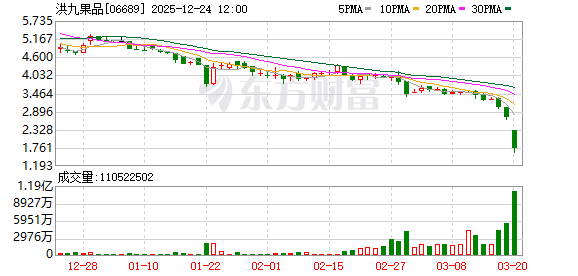
Core Viewpoint - Hongjiu Fruit, known as the "first fruit stock," is facing delisting after a series of financial and governance issues, including failure to disclose financial reports, stock suspension, and investigations into executives [1][3][5]. Group 1: Company Background and Performance - Hongjiu Fruit was founded in 2002 by Deng Hongjiu and Jiang Zongying, establishing itself as a multi-brand fresh fruit group with a differentiated competitive advantage through its cold chain logistics and direct procurement model [3][4]. - The company became the largest fruit distributor in China by sales revenue in 2022, with a revenue of 15.081 billion yuan, a year-on-year increase of 46.7%, and a net profit of 1.452 billion yuan, up 397.95% [3][4]. - Hongjiu Fruit went public on the Hong Kong Stock Exchange on September 5, 2022, with an initial share price of 40 HKD, achieving a market capitalization of nearly 19 billion HKD on its first trading day [3][4]. Group 2: Financial Issues and Suspension - The turning point occurred on March 20, 2024, when Hongjiu Fruit was suspended from trading due to its inability to disclose the 2023 financial report, with KPMG raising concerns about the company's prepayment balance of approximately 4.47 billion yuan [4][5]. - As of the suspension date, the company's stock price had dropped over 95% to 1.74 HKD per share, resulting in a market capitalization of about 2.795 billion HKD [4][5]. Group 3: Governance and Legal Challenges - Multiple executives, including Chairman Deng Hongjiu, are under investigation for alleged loan fraud and issuing false VAT invoices, leading to various criminal measures against them [5][6]. - The company has faced ongoing financial pressure, leading to a court application for restructuring and pre-restructuring, while also considering bringing in strategic investors to support its recovery plan [6][7]. Group 4: Future Challenges and Recommendations - Experts suggest that the core issues leading to delisting are a flawed business model and ineffective corporate governance, with recommendations for Hongjiu Fruit to optimize its supply chain, embrace e-commerce, and restructure its governance to rebuild market trust [7].
北京文化收入增长与利润背离之谜
Xin Lang Cai Jing· 2025-08-07 23:20
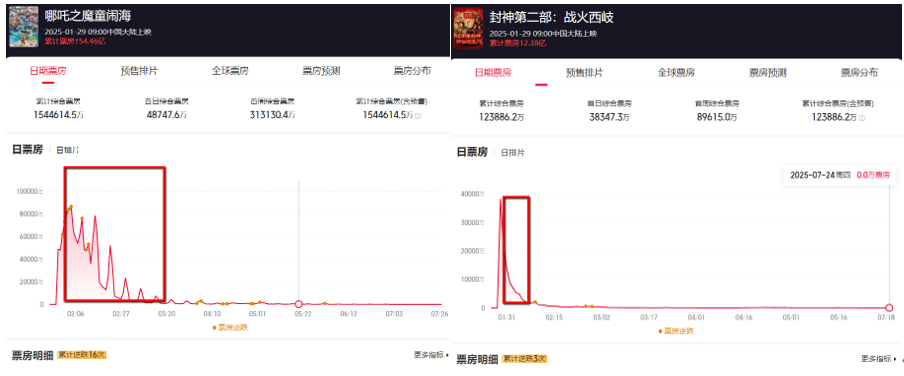
Core Viewpoint - Beijing Culture (000802.SZ) reported a significant divergence between revenue and profit in the first half of 2025, with revenue soaring to 158 million yuan, a year-on-year increase of 1944.24%, while net profit plummeted to -233 million yuan, a year-on-year decline of 610.29% [1][2]. Revenue Analysis - The dramatic revenue increase was primarily driven by the film business, particularly from the movie "Fengshen Part II," which was released on January 29, 2025, contributing significantly to the revenue growth [2][4]. - Despite achieving a box office of 1.238 billion yuan, "Fengshen Part II" underperformed against market expectations due to strong competition from other films [2][4]. Cost Structure and Profitability - The company's operating costs surged by 25084.52% to 357 million yuan, far exceeding the revenue growth, leading to a gross margin of -126.14%, a decline of 207.78 percentage points [4][6]. - The high production costs associated with "Fengshen Part II," including special effects and marketing expenses, were key factors in the substantial losses [4][6]. Financial Health and Risks - Beijing Culture has been trapped in a cycle of continuous losses, accumulating nearly 3.7 billion yuan in losses since 2019, with net assets reduced to 831 million yuan [8][10]. - The company's reliance on a single film's success exposes it to significant financial risks, as seen with the underperformance of "Fengshen Part II" [10][12]. Market Expectations and Future Outlook - Despite weak financial performance, the company's stock price has seen a significant increase, driven by market speculation regarding its project pipeline and potential future earnings [11][12]. - The market is focused on three key areas: the long-term value of film series, short-term catalysts from upcoming projects, and the potential revaluation of IP assets due to strengthened copyright protections [11][12]. Strategic Challenges - The company faces a critical transformation window in the second half of 2025, with upcoming projects like "Dongji Island" and "Fengshen Part III" expected to influence its financial trajectory [12]. - Long-term sustainability hinges on diversifying revenue streams and reducing dependence on single film performances, necessitating a fundamental restructuring of its business model [12].