《哪吒之魔童闹海》

Search documents
中国动画电影为什么会成功?
腾讯研究院· 2026-03-09 08:33
Core Viewpoint - The article emphasizes the significant role of animated films in driving the growth of China's film industry, highlighting their contribution to box office revenue and cultural impact, while suggesting that the industry should learn from the success of animated films to better meet public cultural demands [2][4][8]. Group 1: Box Office Performance - In 2025, China's film box office reached 51.832 billion yuan, with a year-on-year growth of 21.95%, showcasing strong industry resilience [2]. - Animated films contributed 25.49 billion yuan to the box office, accounting for 49.2% of the total, with four animated films in the top ten box office rankings [4][5]. - "Nezha: Birth of the Demon Child" became the highest-grossing film in Chinese history with a box office of 15.446 billion yuan, significantly boosting the Spring Festival box office [5]. Group 2: Cultural Impact and Audience Engagement - Animated films have sparked widespread empathy and taken on a more significant cultural mission, focusing on contemporary human experiences and universal themes [5][6]. - The audience demographic for animated films has shifted, with adults becoming the primary consumers; over 42% of "Nezha" viewers were aged 30-39, and 26% of "Wang Wang Mountain's Little Monster" viewers were aged 25-29 [5][6]. Group 3: Market Dynamics and Competition - The domestic animated film box office reached 28.75 billion yuan in 2024, achieving a "46-54" split with imported films, and in 2025, the top four domestic animated films surpassed 18.5 billion yuan, making up 72.6% of the animated film box office [6]. - The critical acclaim for domestic animated films is evident, with "Nezha," "Wang Wang Mountain's Little Monster," and "The King's Avatar: For the Glory" receiving Douban scores of 8.4, 8.5, and 8.7, respectively [6]. Group 4: Changing Cultural Demands - The rise of animated films reflects a shift in public cultural demands, with younger audiences increasingly seeking personal narratives and emotional resonance [8][9]. - The decline in the appeal of traditional films to younger audiences is notable, with the percentage of moviegoers under 24 dropping from 38% in 2019 to 15% in 2025 [9]. Group 5: Recommendations for Industry Improvement - The article suggests enhancing the connection between films and digital cultural IPs, improving the film industry chain, and fostering cross-media IP development to boost competitiveness [14]. - It advocates for innovations in talent development, content themes, and narrative styles to better engage younger audiences and adapt to changing consumption patterns [14][15]. - Emphasis is placed on increasing investment in cutting-edge technologies to reduce costs and enhance creative processes within the film industry [16].

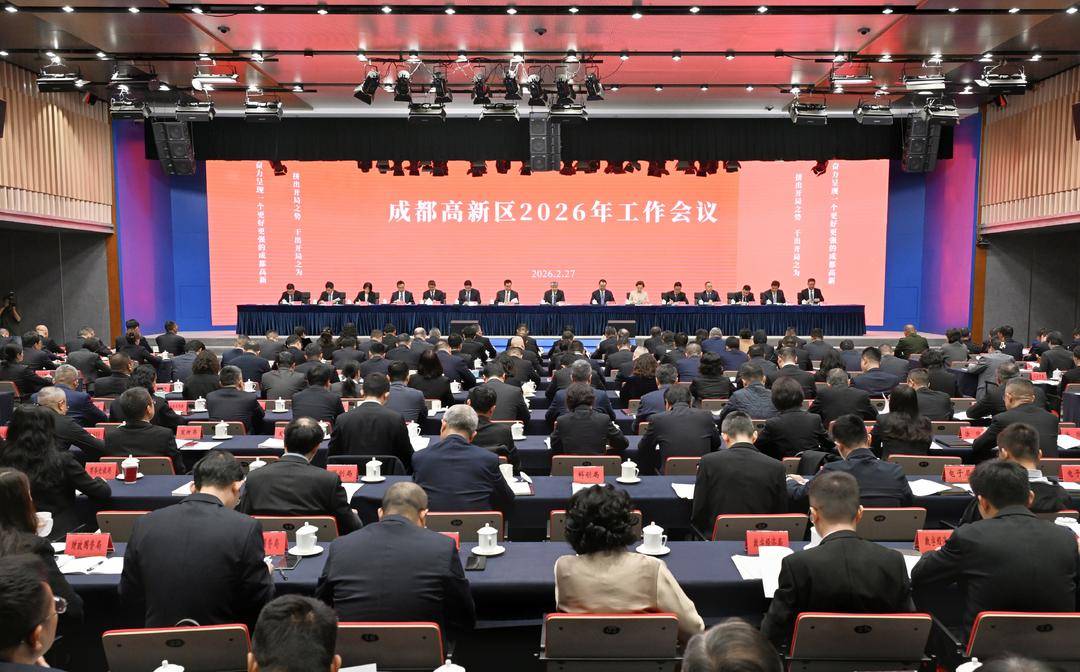
成都高新区:拼出开局之势 干出开局之为
Zhong Guo Jing Ji Wang· 2026-02-28 03:45
Group 1 - The core viewpoint of the news is the strategic planning and achievements of Chengdu High-tech Zone, highlighting its economic growth and future development goals for the "14th Five-Year Plan" and beyond [1][3] - In 2025, Chengdu High-tech Zone achieved a GDP of 366.15 billion yuan, with a growth rate of 6.1%, and fixed asset investment of 80.55 billion yuan, growing by 12.5% [1] - The industrial investment reached 45.06 billion yuan, showing a significant increase of 59.1%, while the total foreign trade import and export volume was 550.8 billion yuan, accounting for 53.4% of Sichuan Province and 64.8% of Chengdu City [1] Group 2 - Chengdu High-tech Zone is focusing on integrating industrial chains and building a multi-point support structure, with the electronic information industry growing by 10.0% and becoming a key pillar of the industrial economy [2] - The digital economy sector achieved a core industry added value of 186.02 billion yuan, with a growth of 10.8%, and significant projects such as iQIYI's new film and television center were introduced [2] - The zone has established 70 national-level innovation platforms and has seen the emergence of 172 original advanced technology achievements and 48 landmark products from new R&D institutions [2] Group 3 - The "15th Five-Year Plan" period is seen as a critical time for Chengdu High-tech Zone to transition its development model, aiming to establish a modern governance system that aligns with new productive forces [4] - The zone will focus on the integration of science and industry, utilizing a "pilot+" ecosystem to enhance its technical service capabilities [4] - Key actions include deepening institutional reforms, promoting technological innovation, and improving industrial concentration and resource efficiency [4]
地区生产总值超3600亿 成都高新区加快建设世界领先科技园区
Mei Ri Jing Ji Xin Wen· 2026-02-27 08:44
Core Insights - Chengdu High-tech Zone achieved a GDP of 366.15 billion yuan in 2025, with a growth rate of 6.1% [1] - The zone aims to establish itself as a world-leading technology park by 2035, focusing on innovation and industrial development [4] Economic Performance - In 2025, the total retail sales of consumer goods reached 114.83 billion yuan, growing by 4.0% [1] - Fixed asset investment totaled 80.55 billion yuan, with industrial investment at 45.06 billion yuan, marking a significant growth of 59.1% [1] - The total import and export volume reached 550.8 billion yuan, accounting for 53.4% of the province and 64.8% of the city [1] Industry Development - The electronic information industry saw a 10.0% increase in industrial added value, with the launch of the first high-generation AMOLED production line [2] - The pharmaceutical and health industry introduced major projects, including the establishment of a global new drug discovery center [2] - The digital economy sector achieved a core industry added value of 186.02 billion yuan, growing by 10.8% [2] Innovation and Talent - The zone has established 70 national-level innovation platforms and incubated 59 companies with significant technological advancements [3] - By 2025, the number of new enterprises increased by 48,600, a growth of 7.9%, with a total of 274,100 existing enterprises [3] Strategic Goals - The Chengdu High-tech Zone aims to solidify its foundation during the 14th Five-Year Plan and transition from "catching up" to "leading" by 2035 [4] - The strategy includes five unifications in planning, goal setting, role performance, methods, and mindset to ensure cohesive development [4] Functional Enhancements - The zone will strengthen five key functions: innovation transformation, high-end industry leadership, inland openness, and urban development [5] - Plans include creating high-energy innovation platforms and fostering key technology breakthroughs [5] Development Focus for 2026 - The focus for 2026 includes high-quality and connotative development, with breakthroughs planned in seven key areas such as supporting national strategies and enhancing economic stability [6]
从“一流”到“领先”,成都高新区2026要拼什么?
Sou Hu Cai Jing· 2026-02-27 06:56
Core Insights - Chengdu High-tech Zone achieved a GDP of 366.15 billion yuan in 2025, with a growth rate of 6.1% [1] - The region's fixed asset investment reached 80.55 billion yuan, growing by 12.5%, with industrial investment at 45.06 billion yuan, marking a significant increase of 59.1% [1] - The total import and export volume was 550.8 billion yuan, accounting for 53.4% of the province and 64.8% of the city [1] Economic Development - The electronic information industry saw an industrial added value growth of 10.0%, with the launch of the first high-generation AMOLED production line [3] - The digital economy sector achieved a core industry added value of 186.02 billion yuan, growing by 10.8%, with significant investments from major companies [3][4] - Strategic emerging industries reached a total scale of 247.83 billion yuan, representing 28% of the province's total [4] Innovation and Talent - Chengdu High-tech Zone aims to build a world-leading technology park, with a roadmap to transition from "first-class" to "leading" by 2035 [6] - The region has attracted over 48,600 new enterprises, a growth of 7.9%, with a total of 274,100 existing enterprises, marking an 11.0% increase [4] - The area has gathered over 850,000 talents, including more than 2,300 high-level talents at national and provincial levels [4] Strategic Goals - The zone will focus on seven key breakthroughs this year, including enhancing support for national strategies and expanding domestic demand [7] - The modern industrial system will be continuously improved, with a focus on electronic information, healthcare, and digital economy sectors [8] - The region aims to accelerate the transformation of strategic emerging industries and support the development of AI and quantum technology [8]
节前抢筹,节后跌停,60亿票房为何没能救得了影视股?
Jing Ji Guan Cha Wang· 2026-02-25 13:00
Market Overview - The A-share market experienced a significant rebound after the Lunar New Year, with major indices showing strong performance, while the film sector faced a sharp decline [1][2][3] - On February 24, the Shanghai Composite Index rose by 0.87%, the Shenzhen Component Index increased by 1.36%, and the ChiNext Index gained 0.99%, with total trading volume reaching 2.22 trillion yuan [2] - The following day, the indices continued to rise, with the Shanghai Composite Index up 0.72%, the Shenzhen Component Index up 1.29%, and the ChiNext Index up 1.41%, and total trading volume increasing to 2.46 trillion yuan [2] Film Sector Performance - The film sector, represented by the CSI Film Theme Index, saw a significant decline, dropping by 6.73% on February 24, with multiple stocks hitting the daily limit down [3][4] - Major film companies such as Light Media, China Film, and Shanghai Film experienced substantial losses, with the ETFs linked to the film sector also falling over 7% [3][4] Box Office Analysis - The 2026 Spring Festival box office was disappointing, with total revenue of 5.752 billion yuan, a 39.5% decrease year-on-year, marking the lowest total since 2021 [5] - The total number of moviegoers was 120 million, down 35.8% year-on-year, and the average ticket price was 47.8 yuan, also the lowest since 2021 [5] Comparison with Previous Year - In contrast, the 2025 Spring Festival box office exceeded 51.8 billion yuan, showing a nearly 22% increase year-on-year, driven by the success of the film "Nezha" [6] - The strong performance in 2025 led to significant stock price increases for companies like Light Media, which saw a 260% surge in stock price due to the film's success [6] Market Sentiment and Future Outlook - The optimistic expectations for the 2026 Spring Festival were not met, leading to a rapid sell-off in the film sector as investors adjusted their valuations based on the disappointing box office results [8][9] - Analysts noted that the lack of blockbuster films contributed to the underperformance, with the absence of a major hit like "Nezha" leading to lower market enthusiasm [9] - Despite the short-term challenges, some analysts believe there are long-term opportunities for industry restructuring and growth, particularly with the potential for quality films in upcoming seasons [10]


没有赢家的春节档,在幕后偷偷赚钱
3 6 Ke· 2026-02-25 12:07
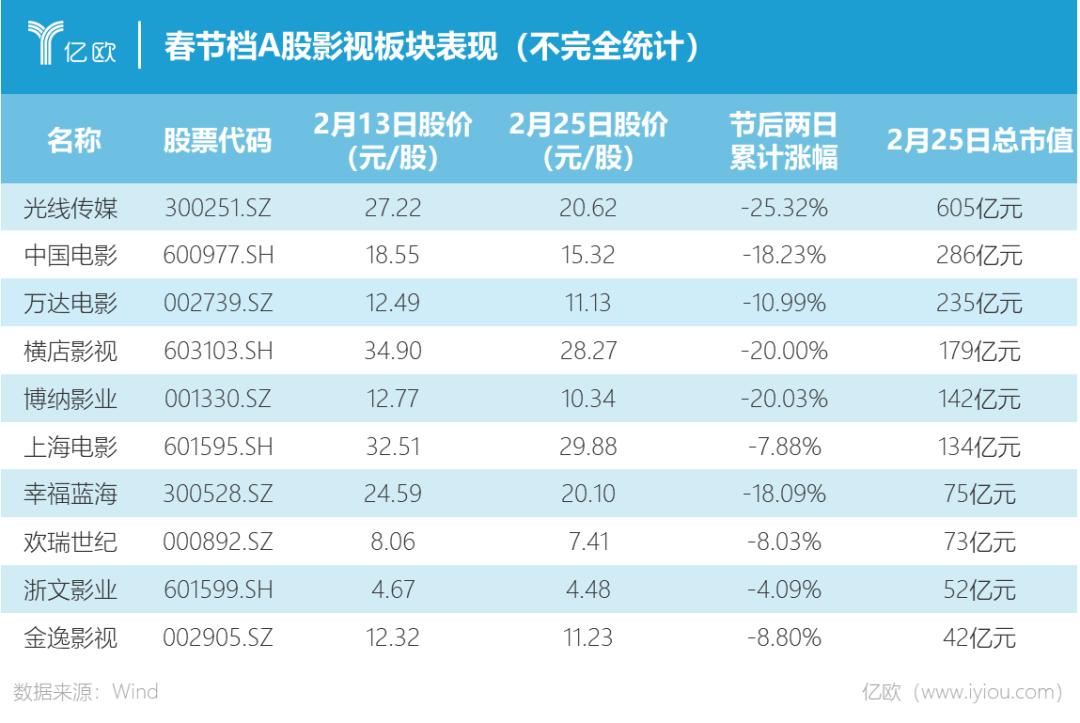
Core Insights - The A-share market for the film industry experienced a significant downturn following the Spring Festival, contrasting sharply with the previous year's performance [2][10] - The 2026 Spring Festival box office reached 57.52 billion yuan, but lacked a standout hit film, leading to a more competitive landscape without a single dominant player [4][10] - Despite the disappointing box office results, the film industry is supported by favorable policies and initiatives aimed at boosting consumer spending [5][11] Box Office Performance - The top film, "Flying Life 3," grossed 29.3 billion yuan, accounting for nearly half of the total box office, while other films like "Silent Invasion" and "The Wandering Earth" followed with 8.7 billion and 8.1 billion yuan respectively [4][10] - The absence of a blockbuster film similar to "Nezha" from the previous year has led to a more fragmented box office performance [10][12] Market Reaction - Following the Spring Festival, the A-share film sector saw a collective decline, with major companies like Light Media and China Film experiencing significant drops in stock prices [8][9] - Light Media's stock fell by 25.32%, while China Film and Wanda Film also saw declines of 18.23% and 10.99% respectively, reflecting a broader market sentiment shift [9][10] Industry Outlook - The film industry is benefiting from ongoing policy support, including the launch of 16 pilot cities for film consumption and a projected 1.2 billion yuan in subsidies for viewers [5][11] - Companies like Light Media and Wanda Film are expected to report substantial profit increases, with Light Media projecting a net profit of 1.5 to 1.9 billion yuan for 2025, a significant rise from the previous year's 292 million yuan [11][12] Challenges and Opportunities - The film industry faces challenges such as a lack of original blockbuster content and competition from micro-short dramas that capture audience attention [12][13] - However, there is potential for growth as the industry adapts to changing consumer preferences and seeks to diversify its offerings [12][13]

春节档票房缩水近四成,A股影视板块马年首日垫底
Di Yi Cai Jing· 2026-02-24 12:17
Core Viewpoint - The traditional cinema industry is facing significant challenges, with a notable decline in box office performance during the 2026 Spring Festival period, while the emerging short drama market is thriving and becoming a dominant force in digital cultural consumption. Group 1: Cinema Industry Performance - The A-share film and television sector experienced a sharp decline, with the CSI Film and Television Theme Index dropping by 6.73% on the first trading day of the Year of the Horse [1] - The total box office for the 2026 Spring Festival was 5.752 billion yuan, a year-on-year decrease of 39.5%, marking the lowest total since 2021 [3] - The total number of moviegoers was 120 million, down 35.8% year-on-year, with an average ticket price of 47.8 yuan, also the lowest since 2021 [3] Group 2: Reasons for Poor Performance - The lack of blockbuster films this year contributed to the disappointing performance, as the previous year's hit "Nezha: Birth of the Demon Child" generated over 50% of the total box office, creating a high baseline for comparison [4] - The film "Silent Awakening," despite having a star-studded cast and directed by Zhang Yimou, struggled due to its serious theme, limiting its audience base [4] - The phenomenon of late scheduling for films compressed the window for audience recognition and decision-making, particularly affecting non-IP films [5] Group 3: Rise of Short Dramas - The short drama market has emerged as a new powerhouse, with the Hongguo short drama platform reporting over 19.3 billion views during the previous Spring Festival, and plans to release 1,000 short dramas this year [6] - Several sequels of popular short dramas achieved significant viewership milestones, with one series reaching over 1 billion views shortly after its release [6] - The micro-short drama market is projected to grow significantly, with estimates suggesting it will reach 67.79 billion yuan by 2025, reflecting a year-on-year increase of 34.4% [7]
2026年电影春节档放映场次创新高但票房缩水
Zhong Guo Jing Ying Bao· 2026-02-24 11:48
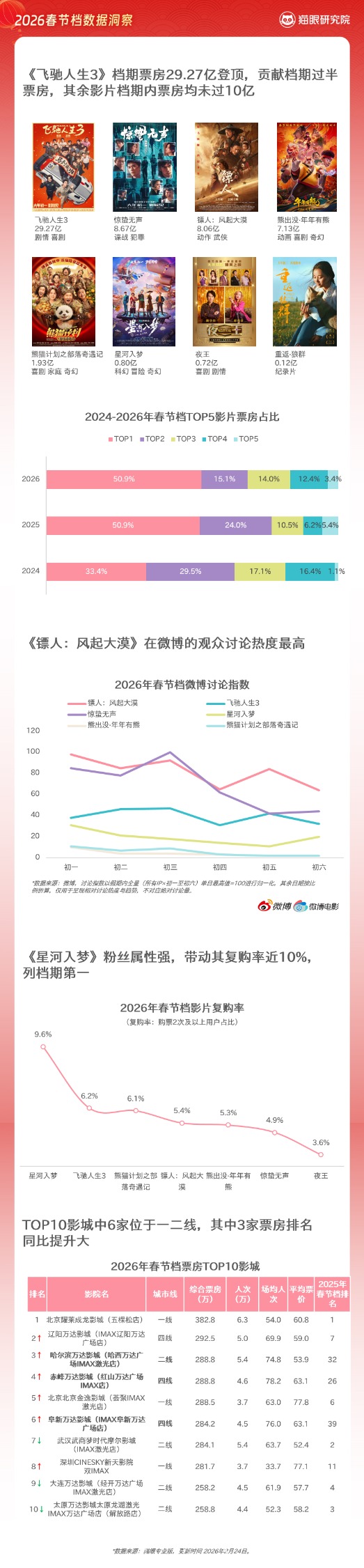
Core Insights - The 2026 Spring Festival box office reached 5.752 billion yuan with 120 million admissions, marking a year-on-year decline of 39.5% and 35.8% respectively compared to the previous year [1] - The number of screenings reached a record high of 4.351 million, but the average attendance per screening dropped to 27.58, the lowest in recent years [1] - The decline in box office performance is attributed to the films themselves not aligning with the characteristics of the Spring Festival period, despite the long holiday [1][5] Box Office Performance - The top film, "Flying Life 3," captured 50.9% of the box office share, mirroring the performance of "Nezha: Birth of the Demon Child" from the previous year [1][3] - The second and third places were taken by "Silent Awakening" and "Biao Ren: Wind Rises in the Desert," with box office earnings of 868 million yuan and 806 million yuan respectively, both significantly lower than their counterparts from 2025 [5][6] - The overall box office performance was described as "ice and fire," with only one day exceeding 1 billion yuan in ticket sales, indicating a lack of blockbuster films to drive the market [5] Audience Engagement - The average attendance on the first day of the festival was below 40%, with a significant number of empty seats observed in theaters [8][10] - The average number of viewers per screening has decreased significantly, with 2026 showing a drop to 43.2 compared to previous years [12][14] - "Biao Ren" was noted for its unique performance, achieving a reverse growth in ticket sales during the holiday, indicating strong audience engagement despite the overall market decline [6][7] Market Trends - The industry is facing challenges with a lack of strong, high-traffic blockbuster films, leading to a general decline in audience numbers and engagement [5][19] - The trend of late film scheduling has compressed the audience's decision-making window, negatively impacting box office performance, especially for non-IP films [19] - The reliance on "traffic+" models is diminishing, as over-dependence on popular actors can lead to public skepticism regarding film quality [19]
知名IP“哪吒”“泡泡玛特”等遭侵权,最高检:加大文创产品版权保护力度
Xin Lang Cai Jing· 2026-02-24 06:00
Group 1 - The core viewpoint of the articles highlights the increasing focus on intellectual property (IP) protection in the cultural and creative industries, particularly in response to the rise of copyright infringement cases [1][2] - In 2025, from January to November, a total of 1,434 copyright cases were handled by national prosecutorial authorities, with 915 cases leading to the prosecution of 1,795 individuals for copyright infringement [1] - The prosecutorial authorities are particularly targeting well-known intellectual properties, historical artifacts, and intangible cultural heritage, with 64 cases related to cultural products being prosecuted, including 20 cases involving "Nezha" and 13 cases involving "Pop Mart" [1] Group 2 - The rapid development of information network technology, especially artificial intelligence and big data models, is creating new challenges for existing intellectual property laws [2] - The prosecutorial authorities are conducting research on emerging issues related to IP protection, such as the copyrightability and patentability of AI-generated works and the rights allocation of data elements [2] - In a recent case involving AI technology, the authorities successfully prosecuted three individuals for copyright infringement by establishing that the infringing works were substantially similar to the original works, leading to criminal penalties [2]

“春运化”排片换不来真繁荣 电影市场需回归日常烟火
Mei Ri Jing Ji Xin Wen· 2026-02-20 01:04
Core Insights - The Chinese film market during the Spring Festival is experiencing a paradox where increased screening numbers do not correlate with higher box office revenues or audience attendance [1][3][5]. Group 1: Screening and Box Office Performance - On the first day of the Spring Festival, total screenings reached a record 595,800, an increase of nearly 90,000 compared to the previous year, representing a 17.65% growth. However, box office revenue was 1.277 billion yuan, a year-on-year decrease of approximately 29%, with audience numbers down about 27% [1]. - The highest attendance rate for the most screened film, "Fast and Furious 3," was only 46.6% on the first day, and no film exceeded 30% on the second day [2]. Group 2: Market Dynamics and Investment Implications - The significant fluctuations in screening numbers during the Spring Festival resemble the "Spring Festival travel rush," indicating a potential overcapacity in the market that could affect long-term investment in the film industry [3][5]. - The increase in total screenings likely reflects a rise in the number of cinemas and screens, particularly in lower-tier cities, which may not be a sustainable investment strategy as these areas could face market saturation post-holiday [5]. - Historical data shows that while the Spring Festival box office can be strong, the overall annual box office performance may not align with peak periods, highlighting the need for a more balanced and sustainable approach to cinema investment [6]. Group 3: Future Market Considerations - The film industry should aim for a robust Spring Festival while also reducing reliance on single peak periods, promoting a more consistent audience experience throughout the year [6]. - A rational market should avoid overcrowding during holidays and allow for flexible ticket pricing to attract more viewers regularly [6].