商业航天规模化发射

Search documents
商业火箭高频发射下的最刚性需求:推进剂与特种气体
Hua Er Jie Jian Wen· 2026-01-22 08:37
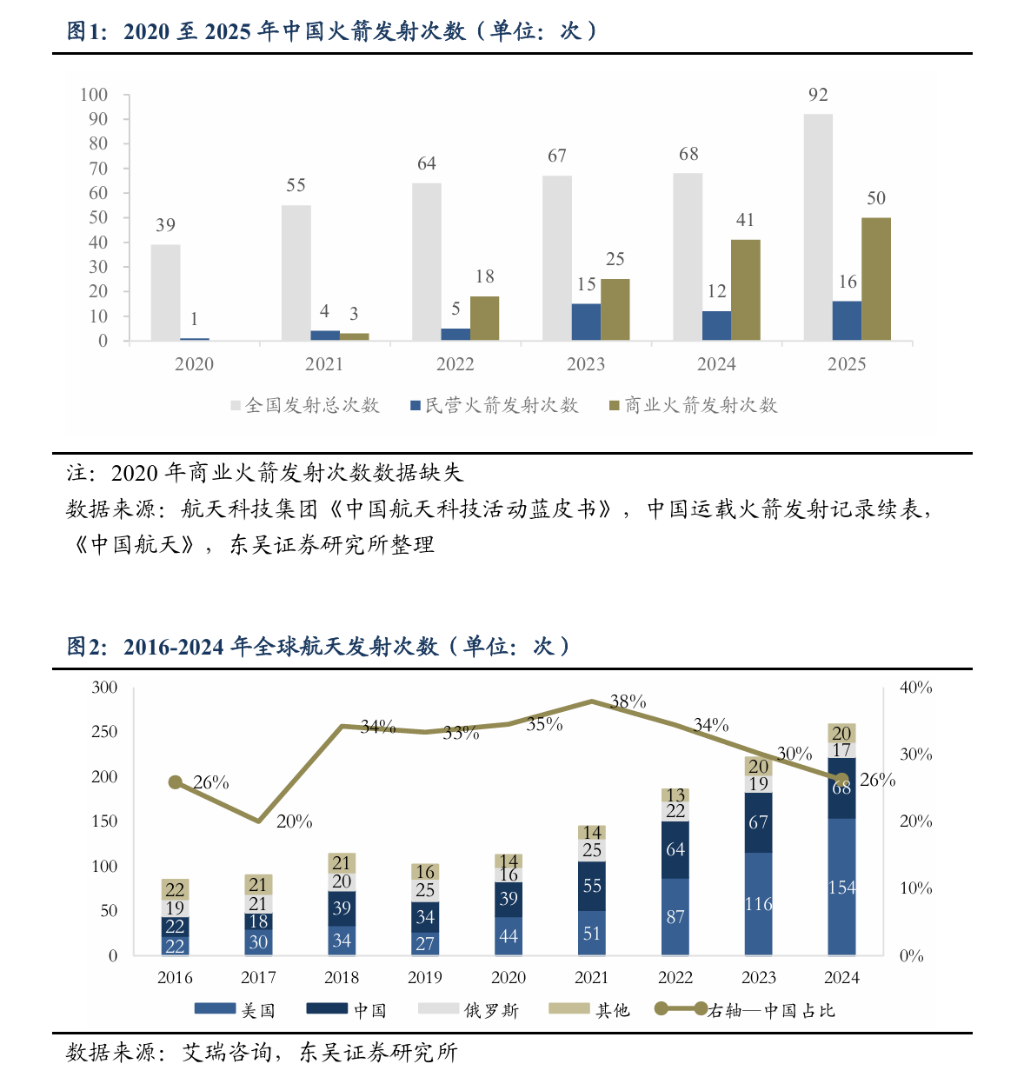
Core Insights - The commercial space industry in China is entering a phase of scaled launches, with a clear path to cost reduction through high payload capacity and reusable technology [1][3] - The demand for propellants and specialty gases is closely tied to launch frequency, making it a stable and predictable value segment in the commercial space sector [2][11] Group 1: Launch Frequency and Infrastructure - China's rocket launch frequency is projected to grow rapidly, reaching 92 launches by 2025, with 50 of those being commercial launches, a significant increase from 39 total launches in 2020 [1][3] - The launch infrastructure is being enhanced, with a total of 21 existing launch sites and 5 more under construction or planned, creating a comprehensive system for inland, coastal, and maritime launches [1][3] Group 2: Cost Structure and Reusability - Reusable technology is significantly altering the cost distribution in rocket launches, with the cost of a Falcon 9 launch's propellant and specialty gas demand estimated at approximately $800,000 [1][11] - The cost of the rocket itself has decreased from $50 million to $15 million due to reusability, while the proportion of launch costs attributed to propellant and specialty gases has increased from 1.6% to 5.3% [1][11] Group 3: Propellant and Specialty Gas Demand - The demand for propellants and specialty gases is expected to grow steadily with increased launch frequency, as they are essential consumables with high safety and reliability requirements [11][12] - The market for propellants and specialty gases is characterized by strong customer loyalty and a converging technology path, providing higher long-term visibility and value stability compared to rocket manufacturing [2][11] Group 4: Fuel Technology Comparison - Liquid oxygen-methane is emerging as a preferred fuel in reusable rocket scenarios due to its low carbon residue and stable combustion properties, which enhance engine performance over multiple flights [13][15] - The comparison of fuel types shows that while liquid oxygen-methane offers advantages in maintenance and operational efficiency, liquid oxygen-kerosene remains prevalent due to its established technology and existing infrastructure [13][15]

首飞在即:天兵完成“一箭36星”全流程试验验证
Guan Cha Zhe Wang· 2025-11-18 09:16
Core Viewpoint - Tianbing Technology's Tianlong-3 large liquid launch vehicle has successfully completed key tests, including "one rocket 36 satellites" transportation and vibration tests, validating the structural stability and dynamic characteristics of the "36 satellite combination" under ground transportation and flight vibration environments [1][3][6] Group 1: Technical Achievements - The successful completion of the "one rocket 36 satellites" ground verification tests significantly enhances China's commercial space launch capabilities, providing solid support for satellite internet infrastructure construction [3][6] - The "36 satellite combination" successfully passed transportation tests that simulated the entire process of moving the rocket from the technical site to the launch site, confirming the structural strength and rigidity of the combination [6][7] - The vibration test conducted on November 14 demonstrated that the combination can withstand intense vibrations during the rocket's flight, ensuring the satellites function properly before reaching orbit [6][8] Group 2: Strategic Developments - The completion of the transportation and vibration tests, along with the earlier successful 36 satellite separation test, forms a complete technical loop for Tianlong-3's multi-satellite launch capability [7][8] - Tianlong-3 is the first large liquid launch vehicle in China to complete the full process verification of multi-satellite launches, which will significantly increase the number of satellites deployed per launch and reduce launch costs [8][11] Group 3: Financial and Market Position - Tianbing Technology has accelerated its activities, including a successful test of the Tianlong-3's sub-stage nine-engine parallel propulsion system, setting a new domestic record for commercial liquid rocket engine thrust [8][9] - The company completed nearly 2.5 billion yuan in financing in October, which will primarily be used for rocket mass production and the development of new-generation engines [9][11] - Tianlong-3 is positioned to meet the demand for over 30,000 low-orbit satellites, supporting the country's satellite network needs [11]