
四季运营

Search documents
开工即加速
Liao Ning Ri Bao· 2026-01-14 01:12
Core Viewpoint - The construction of the Dalian Jinpu New Area Ice and Snow Sports Public Fitness Center, specifically the cross-country skiing venue, has commenced and is progressing rapidly, with site leveling and mountain track construction underway [1] Group 1: Project Overview - The project covers a total area of 340,000 square meters and includes the construction of an ice sports center, a cross-country skiing venue, and a public skiing area [1] - It will host events for curling and cross-country skiing, comprising 15 sub-events in total [1] Group 2: Venue Specifications - The cross-country skiing track is designed to be 5 kilometers long, featuring 5 tracks and additional practice and wax testing tracks, meeting the certification requirements of the International Ski Federation [1] - The design follows a "four-season operation" principle, allowing for activities such as roller skiing, mountain biking, and trail running during non-snow seasons [1] Group 3: Community Engagement - The project also includes the construction of a public skiing area equipped with advanced ice and snow equipment and a variety of engaging sports activities, aimed at boosting ice and snow consumption [1]
四季皆宜 将“冰爽”进行到底
Xin Lang Cai Jing· 2026-01-09 21:49
Group 1 - The construction of the Jinpu New District Ice and Snow Sports Public Fitness Center, a key project for the 15th National Winter Games, has reached the main structure completion ahead of schedule, showcasing effective project management despite challenging weather conditions and complex geological conditions [1][2] - The project covers an area of 340,000 square meters and will host 15 events across two disciplines: curling and cross-country skiing, enhancing the region's capacity for high-standard ice sports facilities [2] - The Ice Sports Center employs a "one ice, four uses" model, allowing for versatile functionality to accommodate various ice sports and community activities, thus promoting year-round operations and integration of cultural, sports, and tourism development [2][3] Group 2 - The next phases of construction will focus on the steel structure roofing, facade, and interior decoration, with a commitment to adhere to the overall project timeline and ensure timely delivery [3] - The city of Dalian aims to leverage the hosting of the winter sports events to develop a unique cultural and tourism landscape, transforming the ice sports venues into a significant attraction for ice and snow consumption [3]
万亿冰雪,南方“尔滨”怎么掘金?
3 6 Ke· 2025-10-20 00:29
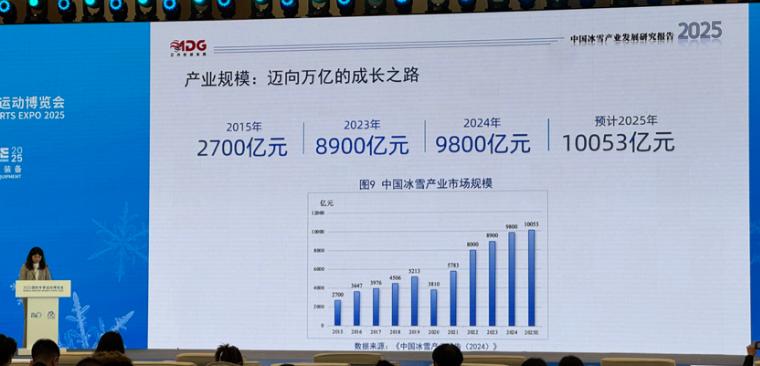
Core Insights - The report "China Ice and Snow Industry Development Research Report (2025)" indicates that the scale of China's ice and snow industry will exceed 1 trillion yuan by 2025, reaching 1,005.3 billion yuan [1] - The compound annual growth rate of the ice and snow industry over the past decade has exceeded 15%, with the industry scale rising from 270 billion yuan in 2015 to 980 billion yuan in 2024 [1] - The participation of Chinese residents in ice and snow sports and related consumption is expected to exceed 187.5 billion yuan in the 2024-2025 season, with a year-on-year growth of over 25% [1] Industry Growth - The Chinese ice and snow industry is entering a phase of sustained high growth, driven by major events like the 15th National Winter Games [2] - Northern regions dominate the ice and snow market due to natural resources, with the Northeast, Inner Mongolia, and Xinjiang accounting for nearly 40% of national ski resort traffic [2] - Southern cities are increasingly eager to tap into the ice and snow economy, with the Yangtze River Delta region leading in the number of indoor ski resorts [2] Infrastructure Challenges - Southern cities face high costs and planning challenges in developing ice and snow facilities due to a lack of natural resources [3] - The energy cost of artificial snowmaking can account for nearly 50% of operational costs, with some indoor ski resorts spending tens of millions on electricity annually [3] - Effective planning is crucial, with successful examples from the Yangtze River Delta demonstrating the importance of location and accessibility for attracting visitors [3] Technological Innovations - Technological advancements are key to controlling operational costs, with energy-saving technologies significantly reducing expenses [5] - The exploration of year-round operational models allows facilities to diversify revenue streams beyond the winter season [5] - Policy support, such as tax incentives and government services, can help reduce operational burdens for southern ice and snow venues [5] Equipment Manufacturing Opportunities - The domestic production rate of ice and snow equipment has room for improvement, presenting opportunities for southern cities to lead in this sector [6] - Innovations in equipment, such as smart snow machines and advanced clothing, are being developed to enhance efficiency and reduce costs [6] - The potential for southern cities to become global manufacturing hubs for ice and snow equipment is significant, leveraging existing industrial strengths [7] Consumer Engagement Strategies - Ice and snow sports in southern cities should be positioned as novel experiences rather than necessities, requiring innovative project designs to attract broader audiences [8] - The integration of local culture and leisure needs into ice and snow offerings can create unique competitive advantages [8] - Engaging families and youth through educational and recreational programs can cultivate future consumer bases for ice and snow activities [10] Tourism and Economic Integration - The combination of ice and snow activities with local tourism resources can enhance visitor experiences and extend their stay [10] - Multi-faceted tourism packages that incorporate local attractions can significantly increase overall tourism revenue [10] - The development of a cohesive strategy that combines ice and snow experiences with regional characteristics is essential for sustainable growth [11]

泰旅集团探索四季运营——业态创新生态优先
Jing Ji Ri Bao· 2025-09-29 22:29
Core Viewpoint - The article highlights the development and transformation of the Jiangjun Mountain International Ski Resort in Altay, Xinjiang, emphasizing its role as a key driver of the local ice and snow economy while balancing facility upgrades, innovative business models, and ecological protection [1][2][3]. Group 1: Development and Operations - Jiangjun Mountain Ski Resort is positioned as the only urban high-altitude ski resort in China, serving as a catalyst for local ice and snow economic growth [1]. - The resort has invested in facility upgrades, including multiple ski trails and the creation of the "BK Ski Park," which has become a popular destination for young skiers [1]. - In the 2024-2025 snow season, the resort is expected to welcome 890,000 visitors, marking a 14% increase year-on-year [1]. Group 2: Seasonal Operations and Ecological Initiatives - The resort has successfully diversified its offerings beyond winter sports, introducing summer activities such as cable car sightseeing, go-kart racing, stargazing camping, and ecological hiking [2]. - Since 2009, the resort has adhered to an "ecological priority" development philosophy, implementing ecological restoration projects and selecting local tree species for planting [2]. - The presence of a snow leopard has been recorded twice, indicating a healthy ecosystem, and the resort has taken measures to protect wildlife and educate visitors about conservation [3]. Group 3: Economic Impact and Community Engagement - The development of the ski resort has positively impacted local farmers and herders, enabling them to earn income through homestays and rural tourism, with high demand for accommodations near the ski slopes [3]. - The company aims to leverage the ice and snow economy not only for corporate growth but also as a means to enhance the livelihoods of local communities [3].