回归年

Search documents
今年除夕,为啥不是“年三十”?
Xin Lang Cai Jing· 2026-02-16 01:31
Group 1 - The article discusses the significance of the lunar calendar and its impact on traditional Chinese festivals, particularly the absence of "New Year's Eve" for five consecutive years due to astronomical phenomena [5][2] - It explains the relationship between solar and lunar calendars, highlighting that the lunar calendar is based on the moon's cycles, which leads to discrepancies with the solar year [4][3] - The article emphasizes the cultural importance of these traditional timekeeping methods and their integration into Chinese life, despite modern advancements in timekeeping [5][6] Group 2 - The article mentions that the average lunar month is approximately 29.5 days, resulting in a need for adjustments to align with the solar year, which is about 365.25 days [4][5] - It notes that the phenomenon of having no "New Year's Eve" for five years is rare but not unprecedented, reflecting the complexities of lunar calendar calculations [5][2] - The discussion includes insights from experts on the historical and scientific aspects of timekeeping in China, linking it to agricultural practices and cultural heritage [2][3][6]
公历日期不固定,农历春节有讲究(信息服务台)
Ren Min Ri Bao· 2026-02-07 00:44
Group 1 - The Spring Festival in 2026 will be on February 17, which is the latest date in recent years, being 19 days later than in 2025 [1] - The Spring Festival dates fluctuate due to the differences between lunar and solar calendars, with the lunar calendar being based on the moon's phases and the solar calendar based on the sun's position [2][3] - The lunar calendar has an average of 354 days in a common year and 384 days in a leap year, leading to variations in the Spring Festival date by approximately 11 days earlier or 19 days later each year [3] Group 2 - Other lunar festivals, such as the Dragon Boat Festival and Mid-Autumn Festival, also experience similar fluctuations in their corresponding solar calendar dates [4] - The lunar calendar is closely tied to agricultural production in China, utilizing the 24 solar terms, which are based on the solar year, to guide farming activities [5]
【新华社】星空有约丨立春日期为啥“变来变去”?
Xin Hua She· 2026-02-04 03:32
Group 1 - The article discusses the upcoming solar term "Lichun" (Beginning of Spring), which will occur on February 4 at 4:02 AM [5] - The date of "Lichun" varies each year due to the astronomical definition of solar terms, which are based on the sun's position along the ecliptic [6] - The average length of a tropical year is approximately 365 days, 5 hours, 49 minutes, leading to variations in the corresponding Gregorian calendar dates for solar terms [6][7] Group 2 - The article explains that if two consecutive years have the same solar term separated by a common year, the solar term in the following year is delayed by about 5 hours and 49 minutes [7] - The current Gregorian calendar uses a leap year system to adjust for discrepancies with the tropical year, which can cause fluctuations in the dates of solar terms [7] - The article highlights that "Lichun" typically falls between February 3 and 5, while other solar terms also have similar date ranges [7]


星空有约丨立春日期为啥“变来变去”?
Xin Hua She· 2026-02-03 09:42
Group 1 - The core point of the article discusses the timing of the solar term "Lichun" (Beginning of Spring), which will occur on February 4, 2025, and its astronomical basis [1][3][4] - The astronomical definition of solar terms indicates that they are specific moments in time, with each term corresponding to the sun's movement along the ecliptic, where every 15 degrees of movement marks a new solar term [3][4] - The concept of different types of years (tropical year, sidereal year, etc.) explains the discrepancies in the calendar dates of solar terms, with a tropical year averaging about 365 days, 5 hours, and 49 minutes, leading to shifts in the dates of solar terms over the years [5][6] Group 2 - The article highlights that the Gregorian calendar and the 24 solar terms reflect the relative motion of the Earth and the Sun, with solar terms generally falling within a few days of their expected dates in the Gregorian calendar [7] - The complexity of lunar calendar dates is noted, as the first day of the lunar year (Spring Festival) varies between January 21 and February 21, which can lead to "Lichun" not always aligning with the beginning of the lunar year [8][9] - Examples of lunar years are provided, such as the upcoming Year of the Horse, where "Lichun" will occur at the end of the lunar year, and the Year of the Snake, which had two occurrences of "Lichun" [9]
今年为啥又没有大年三十?下次要等到……
Xin Lang Cai Jing· 2026-01-24 11:21
Core Viewpoint - The article discusses the phenomenon of "New Year's Eve" (大年三十) disappearing for five consecutive years, with the next occurrence not expected until 2030, due to the traditional lunar calendar's structure and the nature of lunar months [1]. Group 1: Lunar Calendar Explanation - The lunar calendar is often mistakenly referred to as the lunar calendar, but it is actually a lunisolar calendar that incorporates both lunar and solar cycles [2][4]. - Lunar months are based on the moon's phases, with an average month lasting approximately 29.53 days, leading to a lunar year of about 354 days [2][7]. - To align with the solar year, which is about 365 days, the lunar calendar adds an extra month approximately every 2-3 years, known as a leap month [5][7]. Group 2: Disappearance of New Year's Eve - The absence of "New Year's Eve" for five consecutive years is attributed to the lunar calendar's structure, where the last month of the lunar year (腊月) is consistently a short month (29 days) during this period [13][14]. - The phenomenon of having two New Year's Days can occur when a leap month is added after the first month, resulting in two occurrences of the lunar New Year [14]. Group 3: Cultural Significance - The lunar calendar has been integrated into daily life and reflects a time-honored wisdom that has been passed down through generations, emphasizing its cultural importance [20].

今年为啥又没有大年三十?
Xin Lang Cai Jing· 2026-01-24 11:21
Core Viewpoint - The phenomenon of "New Year's Eve" disappearing will occur again until 2030 due to the traditional lunar calendar's structure and the occurrence of "small months" in the lunar calendar [1][14]. Group 1: Lunar Calendar Explanation - The lunar calendar is not merely a lunar calendar but a lunisolar calendar, which incorporates both lunar and solar cycles [2][4]. - The lunar calendar is based on the phases of the moon, with an average month lasting approximately 29.53 days, leading to a lunar year of about 354 days [2][7]. - To reconcile the time difference with the solar year, a leap month is added approximately every 2-3 years, creating a leap year [5][9]. Group 2: Disappearance of New Year's Eve - The absence of "New Year's Eve" is attributed to the fact that from 2025 to 2029, the lunar month of December will consistently be a "small month," which has only 29 days [13][14]. - The lunar calendar's structure allows for flexibility in month lengths, resulting in the phenomenon of "New Year's Eve" not appearing in certain years [13][14]. Group 3: Cultural Significance - The lunar calendar reflects ancient wisdom, integrating both lunar and solar cycles to guide agricultural practices and seasonal activities [9][21]. - The concept of having two New Year's Days can occur when a leap month is added after the first month, leading to two occurrences of the lunar New Year [14].
为什么会有闰月?带你了解农历背后的时间智慧→
Yang Shi Xin Wen· 2026-01-22 03:16
Core Viewpoint - The article discusses the disappearance of "New Year's Eve" (大年三十) for five consecutive years, highlighting the complexities of the lunar calendar and its impact on traditional celebrations [1][13]. Group 1: Lunar Calendar Explanation - The lunar calendar, often confused with the lunar calendar, is based solely on the moon's phases, with a complete cycle called a "synodic month" averaging about 29.53 days [2][4]. - A lunar year typically consists of about 354 days, which is shorter than the solar year of approximately 365 days [4][6]. - The lunar calendar, known as a "lunisolar calendar," incorporates both lunar and solar cycles to guide agricultural activities, resulting in a system that adjusts for seasonal changes [6][8]. Group 2: Leap Month and Its Implications - To reconcile the difference between the lunar year and the solar year, a leap month is added approximately every 2 to 3 years, referred to as a "leap month" [8][9]. - The placement of the leap month is determined by the 24 solar terms, starting from the beginning of spring [8][9]. - In some years, a leap month may occur after the first month, leading to two occurrences of the lunar New Year, although only the first is recognized as the official Spring Festival [16]. Group 3: Recent Observations - The absence of "New Year's Eve" for five years is attributed to the lunar calendar's flexible month lengths, where the last month (lunar December) has been consistently shorter [13]. - The phenomenon of having two New Year celebrations can occur in rare cases when a leap month follows the first month, resulting in two lunar New Year's [16].

公历2026年比农历丙午马年多11天,为啥?
Xin Lang Cai Jing· 2026-01-01 08:29
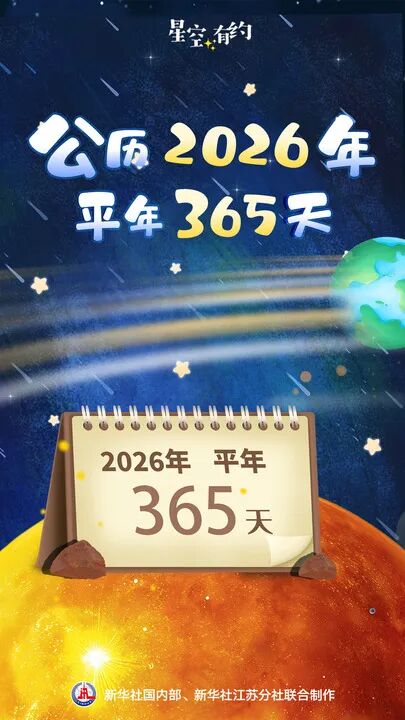
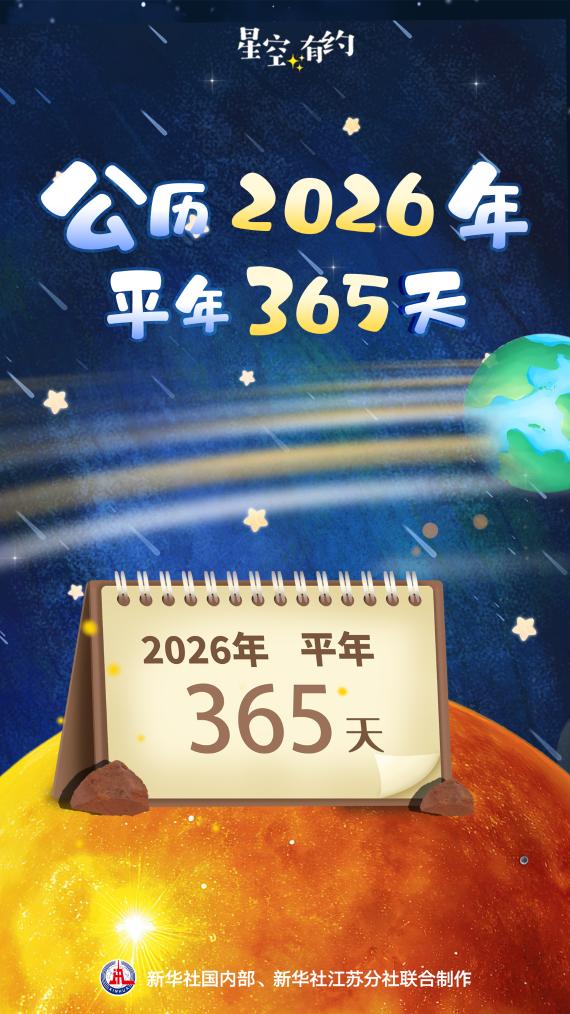
Group 1 - The core reason for the difference in the lengths of the Gregorian and lunar years is due to their reliance on different celestial cycles [3] - The Gregorian calendar is a solar calendar based on the Earth's orbit around the Sun, with an average year length of approximately 365.2422 days [3] - The lunar calendar, or Chinese calendar, is a lunisolar calendar that considers both the lunar phases and the solar year, resulting in an average year length of about 354 days [5] Group 2 - The Gregorian year 2026 is a common year with 365 days, while the lunar year of the Year of the Horse (丙午) is also a common year with 354 days, making the Gregorian year 11 days longer [7] - To reconcile the differences between the lunar and solar years, the lunar calendar includes leap months, with approximately 7 leap years occurring every 19 years, extending those years to about 384 days [5]
星空有约|公历2026年比农历丙午马年多11天
Xin Hua She· 2025-12-30 03:50
Core Viewpoint - The difference in the length of the Gregorian calendar year and the lunar calendar year is due to their reliance on different celestial cycles for their respective calendar systems [3][5][7]. Group 1: Gregorian Calendar - The Gregorian calendar is based on the solar cycle, with a year length of approximately 365.2422 days, leading to the establishment of regular years (365 days) and leap years (366 days) [3][6]. - The rules for leap years in the Gregorian calendar are "one leap year every four years, no leap year in a century, and a leap year every four centuries" [3]. Group 2: Lunar Calendar - The lunar calendar, or traditional Chinese calendar, is a lunisolar calendar that considers both the lunar phases and the solar year, with an average year length of about 354 days [5][6]. - To reconcile the difference between the lunar year and the solar year, the lunar calendar includes intercalary months, with approximately seven leap years occurring every 19 years, resulting in a leap year length of about 384 days [5].
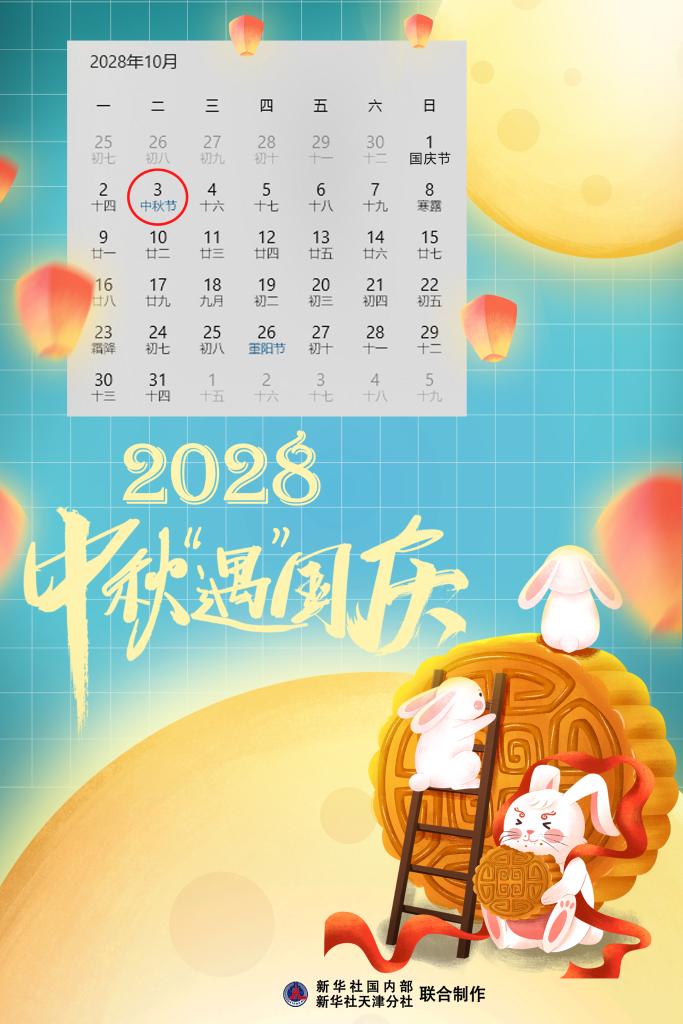
“双节”同辉!3年后中秋国庆将再次“喜相逢”
Xin Hua She· 2025-10-06 05:19
Group 1 - The occurrence of the Mid-Autumn Festival coinciding with National Day is a normal calendrical phenomenon, with the last occurrence in 2020 and the next one expected in 2028 [5] - The Mid-Autumn Festival can fall on any date between September 7 and October 8 in the Gregorian calendar, depending on the lunar calendar's leap months [2] - The lunar calendar's average year length is aligned with the solar year by adding leap months, which occurs seven times in a 19-year cycle [1] Group 2 - The current lunar year is a leap year, which has resulted in the Mid-Autumn Festival being pushed back to October 6 this year, compared to September 17 last year [1] - The next occurrence of the Mid-Autumn Festival on October 6 will not happen again until 2063 [5]