国企私有化

Search documents
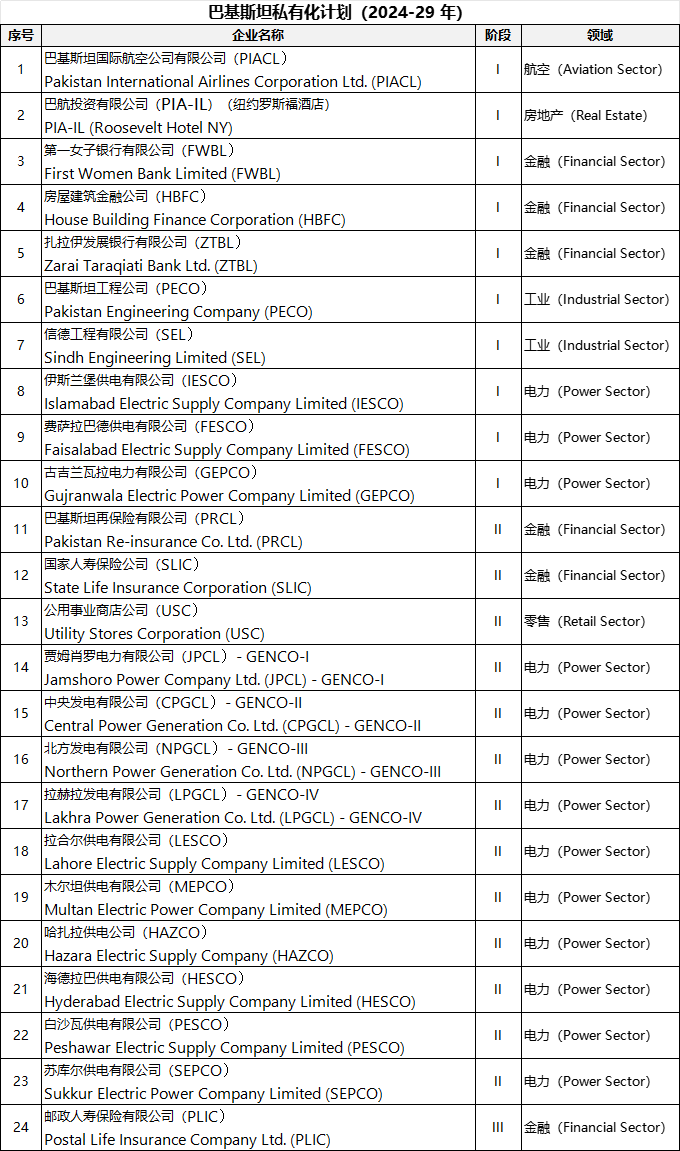
巴基斯坦加速推进国企私有化进程
Zhong Guo Jing Ji Wang· 2025-11-28 06:03
Core Viewpoint - The Pakistani government is accelerating the privatization of state-owned enterprises (SOEs) to address long-standing financial losses and improve operational efficiency, driven by deteriorating financial conditions and increasing subsidy pressures [1]. Group 1: Financial Performance of SOEs - In the first half of the fiscal year 2024-25, Pakistani SOEs reported a cumulative net loss of 343 billion Pakistani Rupees (approximately 1.2 billion USD) [1]. - The National Highway Authority (NHA) recorded the highest loss of 153.3 billion Rupees, with total losses reaching 1.95 trillion Rupees [1]. - The Quetta Electric Supply Company (QESCO) reported a loss of 58.1 billion Rupees, accumulating to 770.6 billion Rupees [1]. - Despite restructuring, Pakistan International Airlines (PIACL) still faced a net loss of 4.6 billion Rupees [1]. - The government provided 616 billion Rupees in financial support to maintain operations of these loss-making SOEs in the first half of the fiscal year [1]. Group 2: Privatization Plan - The privatization plan, initiated in August 2024, aims to privatize 24 SOEs over five years in three phases [1][2]. - The first phase includes 10 key enterprises such as PIACL, First Women Bank (FWBL), and Islamabad Electric Supply Company (IESCO) [2]. - The second phase will involve 13 SOEs, including Pakistan Re-insurance Company (PRCL) and Lahore Electric Supply Company (LESCO) [2]. - The third phase focuses on the Postal Life Insurance Company (PLIC) [2]. Group 3: Progress and Challenges - The privatization committee has been granted full autonomy to expedite the process and eliminate bureaucratic barriers [5]. - PIACL is in a critical stage of privatization, with the government agreeing to take on 80% of its debt and offering tax incentives [5]. - The financial sector has seen significant progress, with the UAE International Holdings Company acquiring FWBL for 5 billion Rupees, marking a 60% premium [6]. - However, the privatization of the power sector has faced setbacks due to previous failures and corruption issues, preventing any electricity company from completing privatization transactions [6]. Group 4: Economic Impact - The privatization efforts have contributed to a decrease in the credit default swap (CDS) spread by 2200 basis points over 15 months, enhancing Pakistan's sustainable financing framework [6]. - The privatization of SOEs is seen as a crucial part of fiscal consolidation, alleviating some financial pressure and improving the country's international credibility [6].

东风在港上市公司再发公告:岚图将介绍上市,东风集团股份私有化退市
Sou Hu Cai Jing· 2025-08-29 10:55
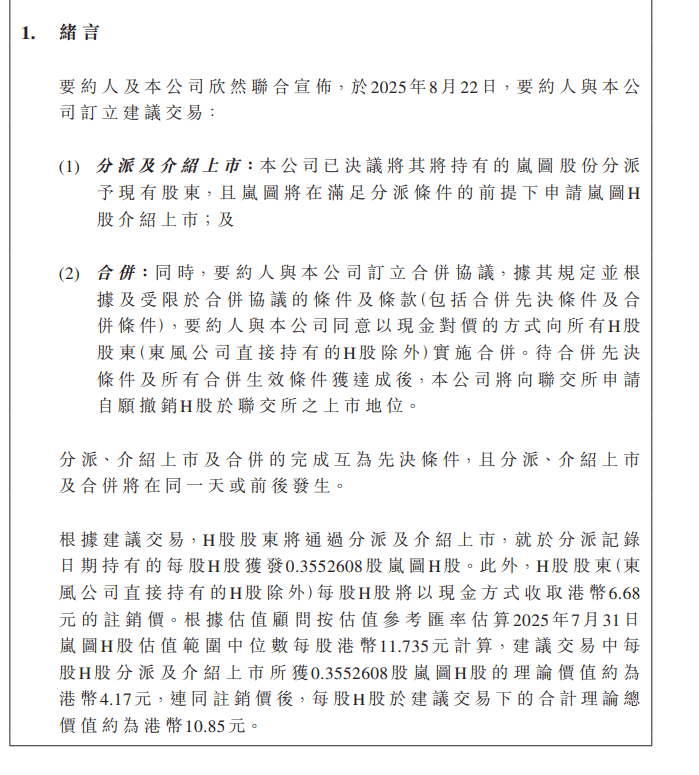
Core Viewpoint - Dongfeng Motor Group Co., Ltd. announced that its subsidiary, Lantu Automotive, will be listed on the Hong Kong Stock Exchange through an introduction listing, while Dongfeng Group will simultaneously complete its privatization and delisting [1][4]. Group 1: Transaction Structure - The transaction involves a combination of "equity distribution + absorption merger," with two core components being interdependent and progressing simultaneously [2][3]. - Dongfeng Group will distribute 79.67% of its shares in Lantu Automotive to all shareholders, followed by Lantu's introduction listing on the Hong Kong Stock Exchange [2][3]. Group 2: Financial Details - H-share shareholders will receive 0.3552608 shares of Lantu for each H-share held, along with a cash cancellation price of HKD 6.68 per share [2][7]. - The total acquisition price is set at HKD 10.85 per share, comprising a cash component of HKD 6.68 and an equity component valued at HKD 4.17 [7]. Group 3: Market Context and Performance - Dongfeng Group's stock has been undervalued, with a market capitalization of HKD 39.12 billion and a price-to-book (PB) ratio of only 0.25 as of July 31, 2025 [6]. - In contrast, Lantu Automotive has shown strong growth, delivering 85,697 vehicles in 2024, a year-on-year increase of approximately 70%, and has maintained a monthly sales volume exceeding 10,000 units since the beginning of 2025 [6][4]. Group 4: Strategic Implications - The innovative transaction structure is expected to strengthen Dongfeng's strategic positioning and set a benchmark for reform and innovation within the state-owned enterprise sector [4]. - Following the listing, Lantu Automotive aims to enhance its financing channels, improve brand image, and expand international operations, leveraging its advanced technology and product quality [6].

东风集团股份,深夜新动作!
第一财经· 2025-08-25 14:25
Core Viewpoint - Dongfeng Group's privatization and delisting process has progressed with a merger plan involving its subsidiaries, indicating a deeper level of privatization compared to previous state-owned enterprise transactions [3][4]. Group 1: Merger Details - Dongfeng Group's indirect controlling shareholder, Dongfeng Motor Group Co., Ltd., plans to merge with Dongfeng Group Co., Ltd. through its wholly-owned subsidiary, Dongfeng Motor Group (Wuhan) Investment Co., Ltd. [3] - After the merger, Dongfeng Investment will directly hold 55% of Dongfeng Shares, while Dongfeng Group will no longer hold any shares in Dongfeng Shares [3][4]. - The merger involves a two-step process: first, the distribution of 79.67% equity in Lantu Automotive to all shareholders, followed by Lantu's introduction to the Hong Kong Stock Exchange [4]. Group 2: Financial Impact - Following the announcement, Dongfeng Group's shares surged nearly 70% at the opening, closing at HKD 9.2, a 54.1% increase, raising its total market capitalization to HKD 759.24 billion [4]. - The market capitalization prior to the announcement on July 31 was HKD 391.2 billion, indicating a significant increase in investor confidence post-announcement [4].