
国防支出增长

Search documents
可回收火箭突破、商飞出海提速、船企订单爆发……多重催化剂注入,军工ETF华宝(512810)放量上行!
Xin Lang Ji Jin· 2026-02-12 11:43
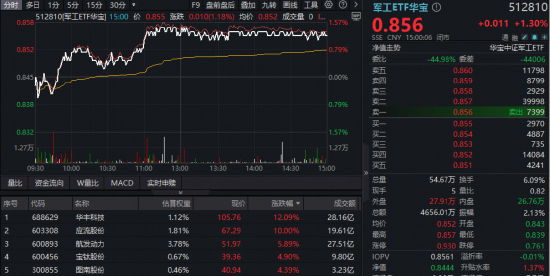
Core Viewpoint - The military industry sector shows strong performance with significant gains in key stocks and ETFs, indicating a bullish trend in the market [1][3]. Group 1: Military Industry Performance - The military sector opened lower but rebounded, with the popular military ETF, Huabao (512810), increasing by 1.3%, outperforming the market [1]. - Among the constituent stocks, 58 increased while 22 declined, with Huafeng Technology leading the gains at 12.09%, and Yingliu Co. hitting the daily limit with a new high [1]. - Major stocks such as Aero Engine Corporation of China and China Shipbuilding Industry Corporation rose by 5.89% and 3.06%, respectively [1]. Group 2: Commercial Aerospace Developments - On February 11, the Long March 10 rocket successfully completed its return flight segment, marking a breakthrough in China's reusable rocket technology, which is expected to enhance space transportation capacity [3]. - China Commercial Aircraft Corporation showcased the C909 and C919 at the Singapore Airshow, securing an order for six C909 firefighting aircraft, accelerating the global expansion of domestic large aircraft [3]. Group 3: Shipbuilding Sector Outlook - By 2025, China's shipbuilding industry is projected to see growth in three core indicators: completion volume, new orders, and backlog orders, maintaining its position as the global leader for 16 consecutive years [3]. - The strong momentum is expected to continue into 2026, with several shipbuilding companies already securing significant contracts at the start of the year [3]. Group 4: Defense Budget Insights - Recent years have seen China's defense budget growth maintained at around 7%, with defense spending accounting for less than 1.5% of GDP, indicating substantial room for growth compared to other major military powers [3]. - The structure of defense spending is anticipated to shift towards new domains and qualities, with military trade exports expected to open up larger market opportunities [3]. - The year 2026 marks the beginning of the 14th Five-Year Plan, suggesting that the military industry may enter a phase of rapid development driven by both domestic demand and foreign trade [3]. Group 5: Investment Opportunities - The military ETF Huabao (512810) covers various hot themes such as commercial aerospace, low-altitude economy, large aircraft, satellite navigation, military informationization, and controllable nuclear fusion, serving as an efficient tool for investing in core military assets [3].

联合作战能力加速提升,军工含量最高的航空航天ETF天弘(159241)跟踪指数深“V”反弹,强势翻红涨近1%!
Xin Lang Cai Jing· 2025-12-10 02:38
Core Viewpoint - The aerospace ETF Tianhong (159241) has shown significant growth, with a 3.47 billion yuan increase in scale over the past six months, reflecting strong performance in the aerospace and defense sector [1]. Product Highlights - The aerospace ETF Tianhong (159241) is designed to efficiently capture core military aerospace opportunities, tracking the National Aerospace Index, with a military attribute ratio of 97.86%, making it the highest in the market [1]. - The ETF has a high weight of 66.8% in aerospace equipment, surpassing other indices like the CSI Military and CSI Defense [1]. Hot Events - On December 9, the Chinese and Russian militaries conducted their 10th joint aerial strategic patrol in the East China Sea and the western Pacific, as part of their annual cooperation plan [1]. Institutional Viewpoints - Pacific Securities notes that China's defense budget has maintained a growth rate of around 7% in recent years, with defense spending accounting for less than 1.5% of GDP, which is below the average of major military powers [1]. - There is significant potential for growth in China's defense spending, expected to exceed GDP growth by about 2 percentage points in the long term, with a shift towards new domains and qualities in defense spending structure [1]. - The industry is anticipated to enter a rapid development phase driven by both domestic demand and foreign trade, as modern warfare evolves towards information and intelligence [1].
美银证券:国防支出攀升引爆金属“军工红利“ 铝铜需求迎结构性强增
智通财经网· 2025-07-17 08:09
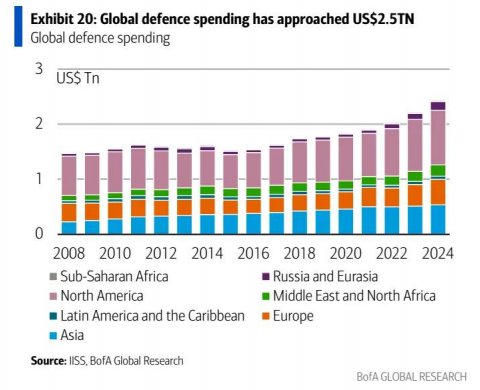
Group 1 - The core viewpoint is that increasing defense spending and its impact on metal demand are gaining more attention as the world becomes more multipolar, with NATO committing to allocate 5% of GDP for defense [1] - Defense metal demand is expected to grow structurally, driven by NATO's upgraded spending targets, with NATO countries (excluding the US) projected to spend $507 billion on core defense in 2024, potentially increasing by an additional $371 billion if they reach the 3.5% GDP target [2] - Germany's defense budget is set to rise from €62.4 billion in 2024 to €154 billion in 2029, with 40% allocated for equipment procurement, which will significantly boost metal demand [2] Group 2 - The reconstruction of Ukraine is identified as a "second battlefield" for metal demand, with direct damages estimated at $170 billion and total reconstruction costs ranging from $543 billion to $1.23 trillion [4] - Using two methods to estimate metal demand, it is projected that if reconstruction takes 10 years, annual copper demand could increase by 200,000 tons (0.65% of global share), aluminum by 750,000 tons (1.1%), and steel by 1.76 million tons (1%) [6] - If reconstruction extends to 14 years with a $1 trillion cap, copper demand could reach 1.8 million tons (6.8% annual market), aluminum 720,000 tons (1%), and steel 1.6 million tons (1.8%), which could tighten an already constrained market given the global copper production growth rate of only 2% [6] Group 3 - The combination of defense modernization and post-war reconstruction is expected to drive up metal demand, with steepening demand curves for copper, aluminum, and steel, while strategic metals like rare earths, gallium, and germanium may become bottlenecks [7] - Factors such as spending efficiency, technological advancements (lightweight, intelligent, unmanned systems), and geopolitical dynamics will ultimately determine the intensity of metal consumption [7]
欧盟委员会主席冯德莱恩:国防支出实现五倍增长反映出安全已成为公民和政府的首要关切。
news flash· 2025-07-16 14:51
Core Viewpoint - The statement by the President of the European Commission, Ursula von der Leyen, highlights that the fivefold increase in defense spending reflects that security has become the top priority for both citizens and governments [1] Group 1 - The increase in defense spending is a significant indicator of changing priorities in Europe, emphasizing the importance of security in current times [1]